





What is Wood Mackenzie’s base case for the global energy transition?
Our base case represents our assessment of the most likely evolution of energy markets under current policy, technology and market trends.
Global energy demand continues to rise. Renewables grow rapidly and electrification expands, but infrastructure constraints, affordability pressures and insufficient policy support prevent clean energy from displacing fossil fuels quickly enough to deliver a more ambitious climate outcome.
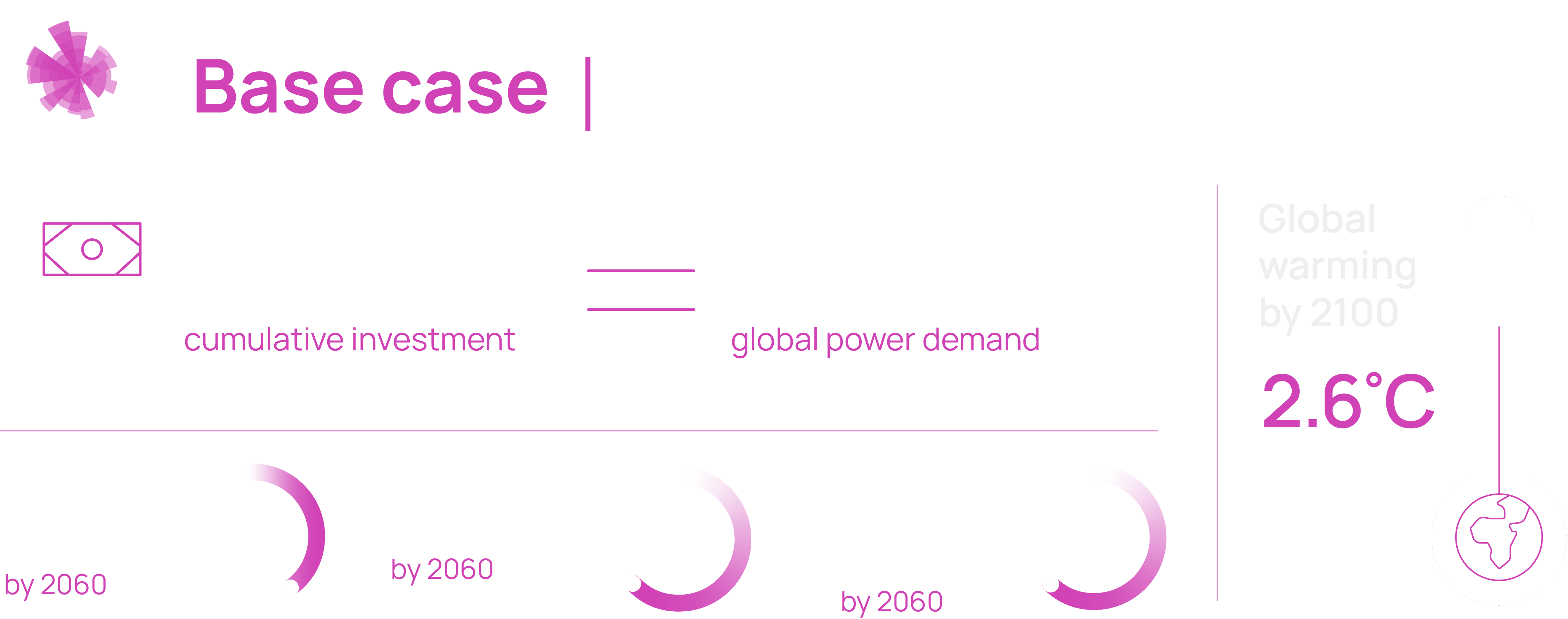
The result is a pathway corresponding to approximately 2.6 °C of global warming.

What are the key features of our base case scenario?
Energy demand keeps growing
Economic development, rising incomes, industrialisation and population growth continue to drive consumption, even as energy efficiency improves.

Electricity takes a bigger role
Efficiency and electrification increasingly separate economic growth from growth in overall energy demand. In our Base Case, global power demand doubles by 2060.
Renewables grow rapidly
Solar, wind and battery capacity expand strongly, helping meet rising electricity demand and increasing the role of clean power in the global energy mix.
Fossil fuels decline slowly
Renewables increasingly compete with incumbent fuels, but oil, gas and coal remain important across major parts of the energy system.
Grids and infrastructure constrain the transition
Growing electricity demand is colliding with congested connection queues, equipment shortages and the need for greater grid investment.
AI creates a new source of demand
Data centres contribute to rising electricity consumption, adding further pressure to power systems while increasing demand for generation and infrastructure.
Frequently asked questions
Power sits at the heart of the base case.
AI adoption, industrial development and greater electrification contribute to a doubling of global electricity demand by 2060.
Solar and wind become increasingly important sources of supply, while storage, grids and dispatchable generation are needed to support a larger and more complex electricity system.
The challenge is therefore not simply adding renewable capacity. It is building the wider system needed to connect and integrate it reliably.
Oil, gas and coal follow different trajectories.
Liquids demand rises in the near term and peaks at around 108 million barrels per day in 2031, remaining close to that peak into the following decade. Road transport increasingly electrifies, but aviation, shipping, petrochemicals and industrial uses are harder to replace.
Natural gas remains resilient, while coal declines.
The overall picture is one of transition rather than immediate substitution: clean energy expands, but incumbent fuels remain part of the energy system for decades.