



Discuss your challenges with our solutions experts
Global energy storage market surpasses 100 GW annual installation milestone in 2025
Installations reached the total capacity of nearly 270 GW/630 GWh by the end of 2025
1 minute read

Anna Darmani
Principal Analyst, Energy Storage EMEA

Anna Darmani
Principal Analyst, Energy Storage EMEA
Anna is a principal analyst focused on the European, Middle East and African storage markets.
Latest articles by Anna
-
Opinion
Global energy storage market surpasses 100 GW annual installation milestone in 2025
-
Opinion
European Power & Renewables: what to look for in 2026
-
Opinion
Europe’s residential storage market: Plateau market growth and high competition push European brands towards HEMS
-
Opinion
Europe’s power market transition and the role of energy storage
-
Opinion
European power in 2025: the pace, opportunities and challenges of the transition
-
The Edge
Battery energy storage comes of age

Allison Weis
Global Head of Storage

Allison Weis
Global Head of Storage
Allison leads our global research into energy storage.
Latest articles by Allison
-
Featured
Energy storage 2026 outlook
-
Opinion
Global energy storage market surpasses 100 GW annual installation milestone in 2025
-
Featured
Energy storage 2025 outlook
-
Opinion
The state of the US energy storage market
-
Opinion
Learnings from RE+: A sunny outlook for US solar and storage
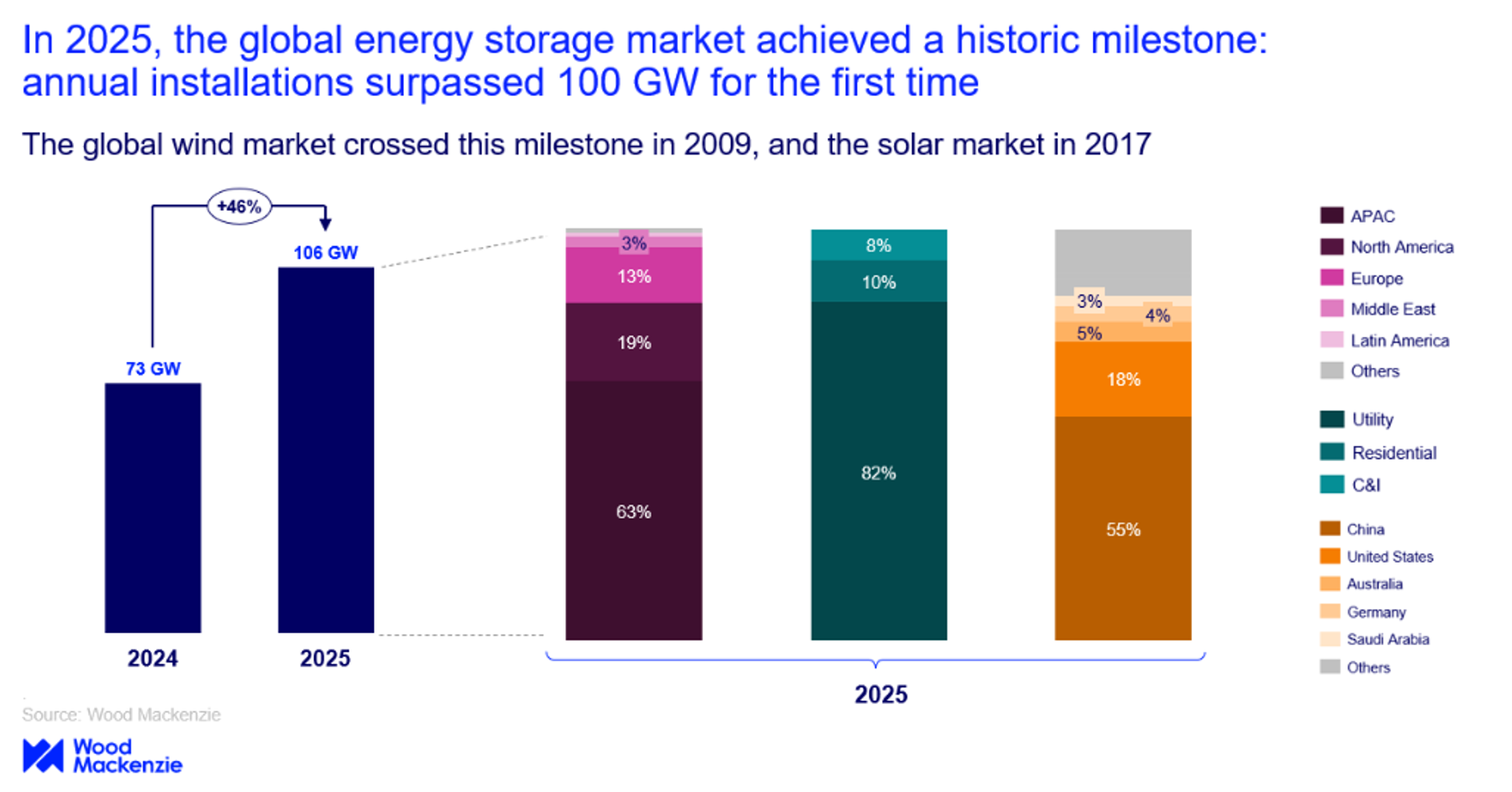
The global energy storage market achieved substantial 43% year-on-year growth in 2025, with 106 GW of new capacity added worldwide. This represents a significant increase from the 73 GW installed in 2024, demonstrating the sector's rapid expansion and growing investment appeal. Total global capacity now stands at approximately 270 GW, with projections indicating the market will reach 1,545 GW by 2034 - nearly a sixfold increase. Energy storage has established itself as a critical component of the global energy transition.

Large-scale utility projects capture majority of new capacity installations
Utility-scale projects account for 82% of 2025 installations. This segment continues to significantly outpace both residential and C&I installations, driven by large grid applications, renewable energy integration requirements, and government procurement programs.
By 2025, average utility-scale energy storage durations reached approximately 2.5 hours globally, with some markets like Chile and Saudi Arabia developing projects with durations exceeding 3-4 hours to address specific grid requirements.
The utility-scale segment's leadership position is expected to continue through 2034, with projections showing sustained strong growth across all major markets. The business case for utility-scale storage has strengthened considerably, supported by declining battery costs, improved project economics, and increasingly diverse revenue opportunities. Additionally, government-led tenders are driving deployment of utility storage systems. Even limited policy support can accelerate project development and provide investors with the confidence needed when fully merchant business cases appear too risky.
China remains the global leader of the energy storage market throughout the outlook
China emerged as the clear leader in global energy storage deployment in 2025, accounting for 54% of worldwide installations. This significant market concentration reflects China's ambitious renewable energy targets, mandatory renewable-storage coupling policies, and substantial domestic manufacturing capacity.
However, the Chinese market faces considerable challenges entering 2026-2027. The removal of mandatory renewable-storage coupling requirements and the absence of established revenue frameworks create substantial uncertainty. Despite these challenges, China's market is projected to contribute approximately 50% of new storage capacity between 2025 and 2034, maintaining its global leadership position.
US installations surge 53% in 2025 despite policy headwinds
The US demonstrated notable resilience in 2025, with installations growing 53% year-over-year despite federal policy changes. The passage of reconciliation legislation introduced supply chain restrictions for projects seeking federal tax credits, creating initial market uncertainty.
However, US large-scale forecast actually increased following the bill's passage, driven by announcements of domestic cell manufacturing facilities and committed large electricity loads. Developers accelerated construction on over 13 GW of "safe harboured" projects to qualify under previous policy frameworks.
Key growth drivers in US include capacity-constrained markets where storage provides critical reliability services, state-level incentives and mandates, and the country's first wave of battery augmentation projects. Approximately 12% of existing systems required capacity additions in 2025, creating a new market segment that is expected to expand significantly in the coming years.
Australia, Germany, Saudi Arabia emerge as key growth markets
Australia continued to exceed expectations with 55% growth, driven by the expanded Capacity Investment Scheme and successful state-level procurement auctions. Over 6.5 GW of capacity is currently under construction, with the National Electricity Market projected to host more than 30 GW of large-scale storage by 2034.
Germany maintained its position as Europe's distributed storage leader in 2025, supported by strong policy frameworks, high retail tariffs and the potential elimination of feed-in tariff schemes, which strengthens the business case for storage paired with existing distributed solar installations. Germany has also emerged as one of Europe's most active large-scale storage markets, as high power price volatility, increasing renewable energy penetration, and market liquidity drive demand for large-scale storage.
Saudi Arabia established itself as a significant new market with major gigawatt-scale projects, though some experienced delays. The Kingdom successfully commissioned four standalone projects in 2025 and has ambitious plans for continued expansion.
Market growth to moderate in 2026 before resuming long-term trajectory
While 2025's 43% growth rate was exceptional, the market is expected to moderate in 2026 due to policy transitions in the US and China. However, sustained long-term growth remains strong, supported by government tenders driving large-scale deployment and support schemes accelerating distributed segment adoption.