



Get Ed Crooks' Energy Pulse in your inbox every week
Iran conflict a test of US energy supply response
Production of both oil and LNG can grow, but only by a fraction of lost output from the Gulf
1 minute read

Ed Crooks
Vice Chair Americas and host of Energy Gang podcast

Ed Crooks
Vice Chair Americas and host of Energy Gang podcast
Ed examines the forces shaping the energy industry globally.
Latest articles by Ed
-
Opinion
A power producer’s view of keeping the lights on. What does rising electricity demand from data centers mean for the US grid?
-
Opinion
Oil prices rise despite IEA reserves release
-
Opinion
The war with Iran: what does the disruption in the Strait of Hormuz mean for global energy?
-
Opinion
Iran conflict a test of US energy supply response
-
Opinion
Are VPPs really a viable solution for easing strain on the grid?
-
Opinion
Data centers are adding an extra 220 gigawatts of electricity demand in the US. How can the grid cope?
The shale gas and tight oil revolution is often described as having delivered “energy independence” for the US. While that claim is justified in some senses – the nation has been transformed from the world’s largest energy importer to a significant exporter – it does not mean that it is immune to commodity price shocks. The limits of that independence are now being put to the test.
Iranian attacks on tankers and other shipping in the Gulf mean that traffic through the Strait of Hormuz, a vital artery for global energy supplies, is at a virtual standstill. Energy infrastructure has been damaged in the region, forcing suspension of production at facilities including the Rumaila oilfield in Iraq and the Ras Laffan LNG complex in Qatar.
The shockwaves have already reverberated through world markets, and their effects will grow the longer the disruption continues.
The crisis has brought into focus the position of the US as a larger producer of oil and gas than Russia and Saudi Arabia combined. Over time, it can play a role in easing the current tightness of global oil and LNG markets. But its ability to use that production strength to shape conditions in its favour is strictly limited.
The effects of the conflict with Iran are already being felt by American consumers. The average retail price of regular gasoline in the US was US$3.251 a gallon on Thursday, up 36 cents, or 12%, from its level a month ago, according to the Automobile Association of America. It is the highest price since the summer of 2024, and the rise in crude oil prices at the end of the week suggests it will continue to increase.
That is a problem for President Donald Trump both economically and politically. Bringing down the cost of living for American consumers was a central plank in his victorious election campaign in 2024. Until now, gasoline prices have been one of the successes he could point to.
Higher fuel costs will increase inflationary pressure, limiting the Federal Reserve’s scope for interest rate reductions, another key economic objective for the Trump administration.
Susie Wiles, President Trump’s chief of staff, has reportedly been urging his advisers to provide ideas for bringing fuel prices down.
Chris Wright, the US energy secretary, addressed the issue in an appearance on Fox News on Thursday. While there was “a transient bump-up” in gasoline prices, he said, they were still well below their peak levels during the Biden administration, and would drop back below US$3 a gallon before too long.
He added that the US had offered to backstop insurance for tankers moving through the Gulf, and would soon use the US Navy to escort ships through the Strait of Hormuz.
There is a precedent for that. The last time there were active threats to shipping in the Gulf was during the Iran-Iraq War in the 1980s. President Ronald Reagan sent US warships to protect tankers and other ships, and to clear mines laid by Iran to block the Strait.
Another potentially significant intervention could come from China, which has been an ally and supporter of Iran and the buyer of most of its oil exports. China was reported to be in talks with Iran over allowing safe passage for oil tankers and Qatari LNG vessels through the Strait.
There are also other sources of supply that can help offset some of the lost production from the Gulf. The Trump administration issued a 30-day sanctions waiver to allow Indian companies to buy Russian oil that is currently on the water.
Oil exports from Venezuela have also been on the rise.
However, the biggest questions are over the contribution that can be made by the US itself. What can it do to increase oil and gas supply to the world, to offset at least part of the shortfall in exports from the Gulf?
The Wood Mackenzie view
For LNG, the answer is straightforward: there is very little scope to increase US exports in the short term. The plants are already running at close to full capacity. Any increase that can be squeezed out from existing facilities is unlikely to be material, says Kristy Kramer, Wood Mackenzie’s head of LNG strategy and market development.
New capacity is set to come on stream this year. Golden Pass LNG in Texas, a joint venture between QatarEnergy and ExxonMobil, is expected to start production this month. Cheniere Energy’s Corpus Christi Stage 3 is ramping up through the year.
But the additional production from US LNG plants in 2026 will be only about 20% of what has been lost from the shutdown of QatarEnergy’s Ras Laffan.
For oil, the supply response will depend on how far prices rise, and for how long. E&Ps have so far been suggesting that they are not yet committing to increased activity, in case the higher prices prove to be temporary.
Jeff Leitzell, chief operating office of EOG Resources, said at a conference on Tuesday that although the company was getting “a little bit of a bump” to revenues from the rise in prices, “we think it's going to be probably short-lived”.
Investors’ continued focus on capital discipline and cash distributions through dividends and buybacks means that those are likely to remain the priority for most of the E&P industry, ahead of any acceleration in drilling. That will only change if it becomes clear that higher prices are likely to last.
Currently, about 520 horizontal rigs are running in the US. If oil prices rise to US$100 a barrel and stay there, the industry has the capacity to add about another 200. That would take the total number of active horizontal rigs back to the previous peak of about 700, seen in the fourth quarter of 2022.
However, even that surge of activity would be unlikely to deliver the scale of production growth that the US industry delivered in the 2010s. Crude and condensate production in the Lower 48 states rose by about 1.5 million barrels per day in the single year of 2018.
Today, output is much higher, and the volume of new oil required to offset decline from producing wells has increased proportionally. That means the same level of activity now yields a smaller net contribution to total production growth, says Nathan Nemeth, Wood Mackenzie’s principal analyst for global unconventionals.
Even though US tight oil is a short-cycle industry, which can generally react to changing market conditions much faster than offshore production, for example, the response is not instantaneous. There can be a quick gain from bringing more drilled but uncompleted wells (“DUCs”) into production, but that is likely to add at most another 150,000 b/d.
Larger increases will have to come from the industry adding more rigs. Rig activity typically lags prices by two to three months, with a further wait of three to nine months before the oil flows. Adding that up, it can be a year before the full supply response to a price change works through.
In 2022, activity in the Lower 48 surged along with oil prices. The significant production growth did not materialise until the end of that year and through 2023.
Given US$100 a barrel oil through the next six months, the US could potentially add another 600,000 b/d of production by the fourth quarter of 2026. The Lower 48 could reach 12.6 million b/d for 2027, up from about 11.2 million b/d in 2025.
However, Nemeth adds, in any realistic scenario, with uncertainty over how long high prices will last, rig additions will be slower. Production is unlikely to hit those theoretical limits.
In short, he concludes: “The Lower 48 can do very little in the near term to offset a sustained multi-million b/d supply impact.”
In brief
President Trump joined the leaders of tech companies, including Amazon, Google and Microsoft, to announce a plan intended to address consumers’ concerns about data centres driving up electricity bills. Under the new Ratepayer Protection Pledge, tech companies have agreed to a series of commitments, including paying the full cost of any new power generation or grid infrastructure needed to support their data centres. They have also promised to coordinate with system operators and, whenever possible, to make their backup generation available to ease strain on the grid.
The White House said President Trump was “ensuring the data center boom is leveraged to address affordability and benefit all American households and businesses”.
The US Department of Energy announced the largest US government loan package outside a financial crisis, lending US$26.5 billion to Georgia-based Southern Company to support infrastructure investment and cut bills for consumers. The loans will support investment in 5.3 gigawatts (GW) of new gas generation, 6.3 GW of nuclear licence renewals and capacity upgrades, 1 GW of hydropower modernisation and 1,300 miles of grid enhancement projects.
The package is projected to cut Southern Company’s interest costs by more than US$300 million per year, helping support lower electricity costs for its customers in Georgia and Alabama. Georgia regulators last year approved a plan for Southern’s Georgia Power subsidiary to freeze its base rates for electricity until at least 2028.
The first US construction permit for one of the new generation of advanced reactors has been awarded by the Nuclear Regulatory Commission to TerraPower, the nuclear startup backed by Bill Gates. The permit allows Terrapower to start construction in Wyoming in the coming weeks, to build its first Natrium reactor with an innovative sodium-cooled design.
The reactor has a 345-megawatt capacity, with a molten salt-based energy storage system that can boost the system's output to 500 MW when needed. It is scheduled to be completed in 2030, making it the first utility-scale advanced nuclear power plant in the US.
Other views
Can natural hydrogen deliver its potential? – Simon Flowers and Kate Adie
An oil company quietly dug a surprisingly deep geothermal well – Sam Brasch
Are AI datacenters increasing electric bills for American households? – Aishwarya Mahesh and others
Quote of the week
“People talk about how much energy it takes to train an AI model, but it also takes a lot of energy to train a human… It takes about 20 years of life – and all the food you consume during that time – before you become smart.”
Sam Altman, CEO of OpenAI, argued that concerns about AI models’ energy use should be kept in context.
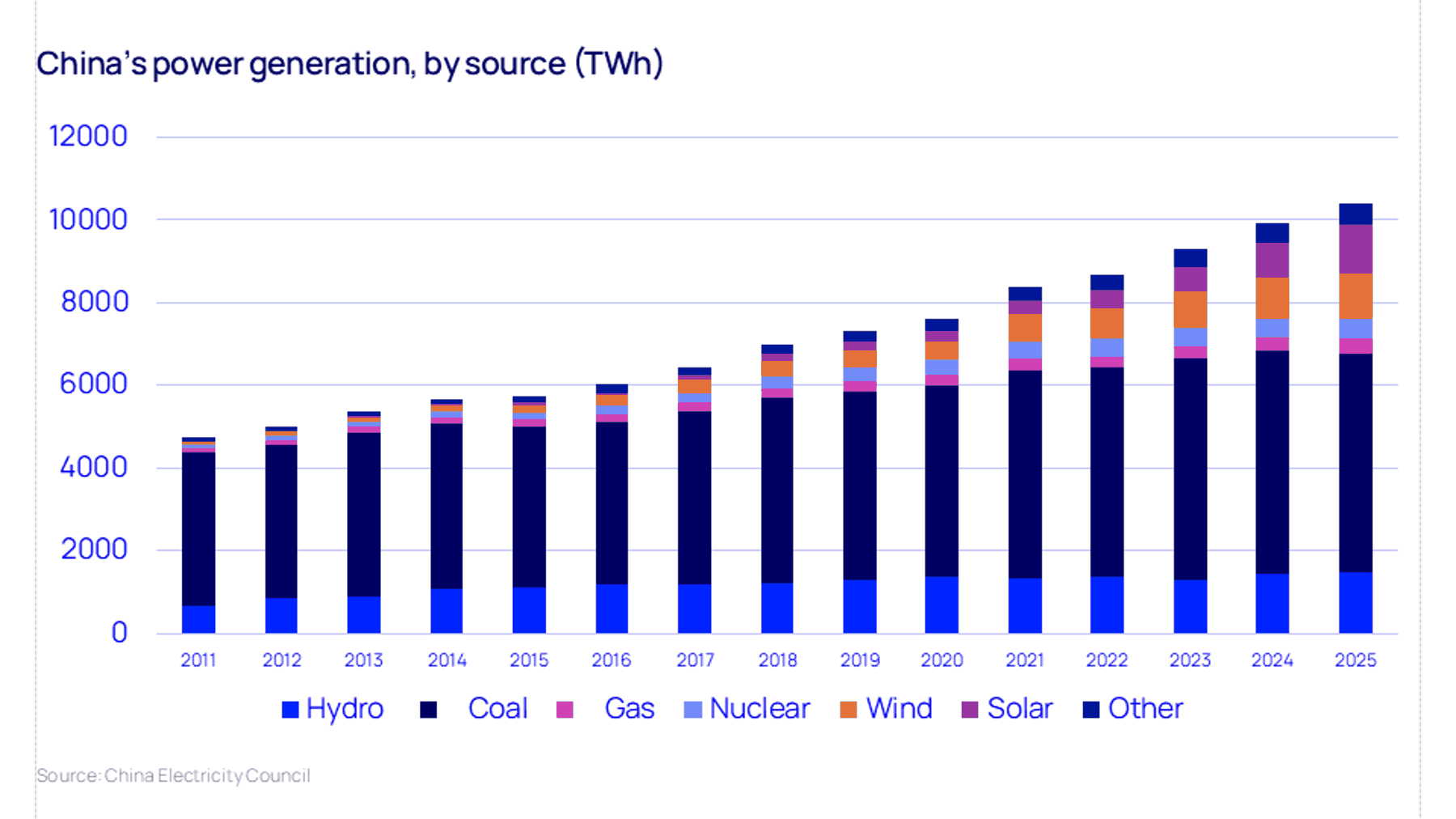
Chart of the week
This chart comes from work done by Sharon Feng, who leads Wood Mackenzie's research coverage of the power and renewables industry in China. She points out that China’s coal-fired power generation fell by nearly 2% in 2025, as the growth of non-fossil supply, including renewables and nuclear, outpaced the increase in electricity demand. It was the country’s first decline in coal power generation since 2015.
Feng says that if the decline were to be sustained, it would be “a watershed moment for global clean energy and climate efforts”. But it is not clear that we are at that point yet. The rapid growth of AI and data centres in China could force continued reliance on existing coal-fired power plants to meet immediate needs. For more detail, read her full note.

Get The Inside Track
Ed Crooks’ Energy Pulse is featured in our weekly newsletter, the Inside Track, alongside more news and views from our global energy and natural resources experts. Sign up today via the form at the top of the page to ensure you don’t miss a thing.