



Discuss your challenges with our solutions experts
How Venezuela complicates the oil market’s delicate rebalancing
Geopolitical risk premium supporting price could persist
1 minute read

Simon Flowers
Chairman, Chief Analyst

Simon Flowers
Chairman, Chief Analyst
Simon is our Chief Analyst; he provides thought leadership on the trends and innovations shaping the energy industry.
Latest articles by Simon
-
The Edge
How war in the Middle East is hitting Asia hard
-
The Edge
The energy crisis is coming to the boil
-
The Edge
Boiling a frog – could oil prices test US$200/bbl?
-
The Edge
War is once again reshaping gas and LNG
-
Opinion
Middle East conflict set to drive oil and LNG prices significantly higher
-
The Edge
Can natural hydrogen deliver its potential?

Gavin Thompson
Vice Chairman, Energy – Europe, Middle East & Africa

Gavin Thompson
Vice Chairman, Energy – Europe, Middle East & Africa
Gavin oversees our Europe, Middle East and Africa research.
Latest articles by Gavin
-
The Edge
How war in the Middle East is hitting Asia hard
-
The Edge
The energy crisis is coming to the boil
-
The Edge
War is once again reshaping gas and LNG
-
Opinion
Middle East conflict set to drive oil and LNG prices significantly higher
-
The Edge
The big themes on Big Oil’s mind
-
Opinion
European gas: 6 Q&As on prices, supply, and regulatory impact

Douglas Thyne
Research Director, Oil Supply

Douglas Thyne
Research Director, Oil Supply
Douglas manages our global oil supply research and forecasts.
Latest articles by Douglas
-
The Edge
Boiling a frog – could oil prices test US$200/bbl?
-
The Edge
How Venezuela complicates the oil market’s delicate rebalancing
-
Opinion
Venezuela regime change: what it means for oil production, crude and product markets
-
The Edge
Oil’s resilience in the energy system
-
Opinion
Trump’s tariff plan: implications for the future of global liquids trade
-
The Edge
Can China’s recovery turn the oil market around?

Alan Gelder
SVP Refining, Chemicals & Oil Markets

Alan Gelder
SVP Refining, Chemicals & Oil Markets
Alan is responsible for formulating our research outlook and cross-sector perspectives on the global downstream sector.
Latest articles by Alan
-
The Edge
The energy crisis is coming to the boil
-
The Edge
Boiling a frog – could oil prices test US$200/bbl?
-
Opinion
Middle East conflict set to drive oil and LNG prices significantly higher
-
The Edge
How Venezuela complicates the oil market’s delicate rebalancing
-
Opinion
Venezuela regime change: what it means for oil production, crude and product markets
-
The Edge
Oil’s resilience in the energy system
Oil is firmly entrenched in a downcycle underway for two years. Global inventories are climbing as rising supply continues to outpace weak demand growth. Even with heightening geopolitical tension, we still expect Brent in 2026 to average well below last year.
I caught up with Alan Gelder and Douglas Thyne from our Macro Oils team on how the events in Venezuela and Iran have influenced their thinking.
How do you see the fundamentals in 2026?
The market was awash with supply even before recent events in Venezuela. We expect global liquids growth of 2.4 million b/d in 2026, split roughly equally between OPEC (1.4 million b/d) and non-OPEC (1.0 million b/d). This will swamp global demand growth, which we forecast at 0.7 million b/d – half that of two years ago, the slowdown in large part reflecting the impact on the global economy from trade tariffs.
What does this mean for Brent?
We’re forecasting an average of just under US$60/bbl in 2026, down from US$69/bbl in 2025, threatening a second successive year of substantial price drops. The low point could be around the mid-US$50s/bbl late in Q1. Though fundamentals are very weak, outages, rising geopolitical tension and US dollar weakness have supported prices over the last few weeks. Uncertainty around Venezuela and Iran suggests, if anything, that the difficult geopolitical environment will continue to support oil prices.
Will Venezuela change the fundamentals?
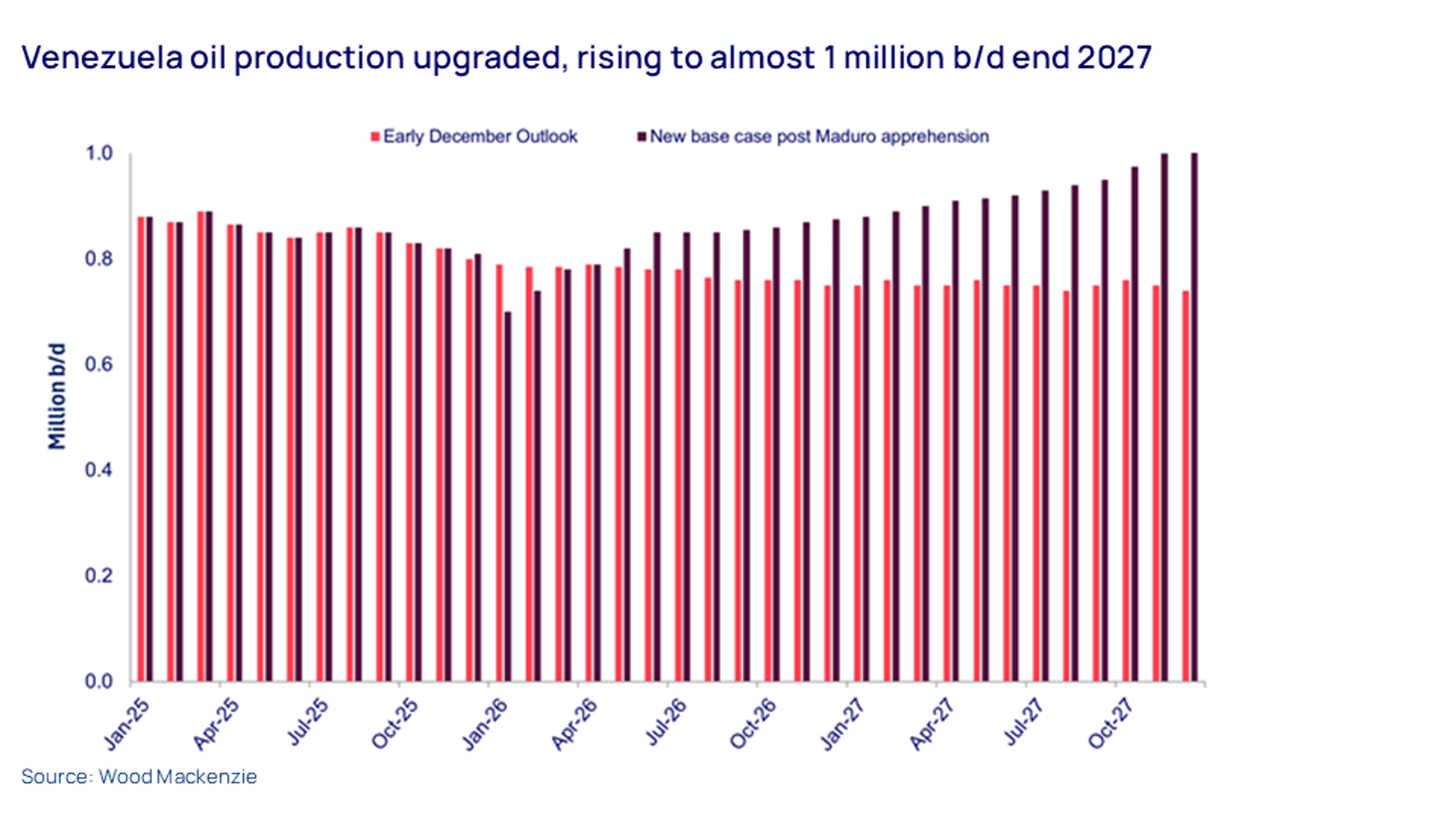
It won’t add much volume in 2026, so we haven’t adjusted our price forecast. Our data suggests that since the exit of President Nicolás Madura in early January, Venezuela’s production slipped as storage capacity filled up following the maritime blockade in December 2025.
Assuming export permits are granted soon, we expect output to recover to pre-blockade levels by mid-year and edge up to 0.9 million b/d by year-end. Well workovers, financed by sustained exports, will also be completed by then, further supporting output. Assuming there’s relative political stability within Venezuela, volumes could surpass 1 million b/d by the end of 2027, up by around 0.2 million b/d from the pre-blockade levels of November 2025.
What about Iran?
The concern is less about oil production and exports, which are currently 1.5 million b/d of crude and condensate. Much of this will find its way to China. Iran’s oil fields and export infrastructure are located far from the unrest so are not, in our view, at risk.
The primary concern in the oil market is that any external move toward regime change spills out across the region. Last week, Brent prices rose by US$4/bbl to US$5/bbl on the threat of oil supply disruption from the Gulf to the global market. For the time being, US interest in direct action against the Iranian regime appears to have waned but we expect the price upside to hold through Q1. The Trump administration has publicly resurrected its goal of US$50/bbl oil to deliver lower gasoline prices in the run-up to November’s mid-term elections. Market jitters over US threats to strike Iran may be contributing to the change in US tactics.
And the market dynamics beyond 2026?
Our analysis suggests another year of oversupply through 2027, likely exacerbated by incremental barrels from Venezuela, and Brent averaging US$60/bbl.
However, 2027 could prove to be an inflection point. The OPEC+ strategy to dampen non-OPEC liquids supply growth by driving prices down has proved effective. Our analysis shows that non-OPEC production growth falls by two-thirds from 1.8 million in 2025 to average just 0.5 million b/d in 2027, grinding almost to a halt by the end of that year. By then, US Lower 48 liquids production is in decline.
At this point, OPEC+ faces two choices. Firstly, does it keep unwinding its production restraint into the market, maintaining price at or near the current modest levels? Or does it say, ‘job done’, allow prices to recover and risk encouraging a bounce back of non-OPEC production? Venezuela, perhaps even Iran, complicate both options.
Our view is that the sheer scale of volumes that OPEC+ has to get into the market suggests it will lean towards the former. Price recovery will take time. We currently forecast that Brent only returns to US$70/bbl (real) – the price needed to incentivise investment in new supply to meet demand in the mid-2030s – by the end of the decade.

Make sure you get The Edge
Every week in The Edge, Simon Flowers curates unique insight into the hottest topics in the energy and natural resources world.
Sign up today using the form at the top of the page.