



Discuss your challenges with our solutions experts
Southeast Asia faces its deepwater gas 2.0 moment
We explore how operators can navigate fragile economics to unlock 28 tcf of critical new deepwater gas supply across the region
2 minute read

Angus Rodger
Vice President, SME Upstream APAC & Middle East

Angus Rodger
Vice President, SME Upstream APAC & Middle East
Angus leads our benchmark analysis of global Pre-FID delays, and deep water developments.
Latest articles by Angus
-
Opinion
Southeast Asia faces its deepwater gas 2.0 moment
-
Featured
Upstream-oil-gas-2026-outlook
-
Opinion
Can Andaman Sea resources avert Thailand’s gas crisis/crunch?
-
The Edge
Why upstream companies might break their capital discipline rules
-
Featured
Upstream oil & gas regions 2025 outlook
-
Opinion
How to make upstream licensing work

Munish Kumar
Senior Research Analyst, APAC Upstream

Munish Kumar
Senior Research Analyst, APAC Upstream
Dr Munish Kumar provides insight and analysis of the industry across the region.
Latest articles by Munish
-
Opinion
Southeast Asia faces its deepwater gas 2.0 moment
-
Opinion
The potential of Indonesia’s ‘energy super basins’
Southeast Asia is entering a second wave of deepwater gas development as shallow-water and onshore fields mature. Deepwater resources, once considered high risk, have shifted from the margin to a core component of regional energy security.
The first wave of Asian deepwater projects (‘Deepwater 1.0’) took place between 2008 and 2017, during which approximately 23 tcf of gas (4 bnboe) was developed. This period saw the first-ever deepwater gas projects in Malaysia, India and China. Since then, activity has been sporadic, constrained by commercial, strategic, technical and regulatory challenges.
Today, projects such as Kelidang in Brunei; North Ganal, Rapak, Ganal and South Andaman in Indonesia; and Rosmari–Majoram in Malaysia are aiming to monetise around 28 tcf of gas. We term these developments ‘Deepwater 2.0’. Collectively, they will deliver critical new supply to domestic markets and LNG export plants.
Read on as we assess why, despite their scale, these projects face a narrow path to commercial success.
A geopolitical safe harbour
Despite geopolitical tensions and related global supply chain disruptions, Southeast Asia continues to offer a relatively stable investment environment. We see renewed exploration and upstream interest from both national oil companies (NOCs) and international oil companies (IOCs). Ongoing farm-downs by Eni in the Kutei Basin and Harbour Energy in North Sumatra present timely entry opportunities for companies seeking to build or expand deepwater portfolios.
Navigating fragile economics
Despite the material resource volumes, the economics of Deepwater 2.0 projects are exceptionally fragile. Wood Mackenzie data shows that achieving a targeted 15% internal rate of return (IRR) leaves little margin for cost overruns, schedule delays or fiscal slippage.
Breaking the mould to unlock value
Success will depend on three critical factors: accelerating development timelines, leveraging brownfield infrastructure and maintaining disciplined project execution. Those that secure infrastructure early, lock in service capacity and move decisively will capture value. Those that cannot risk seeing project value erode rapidly.


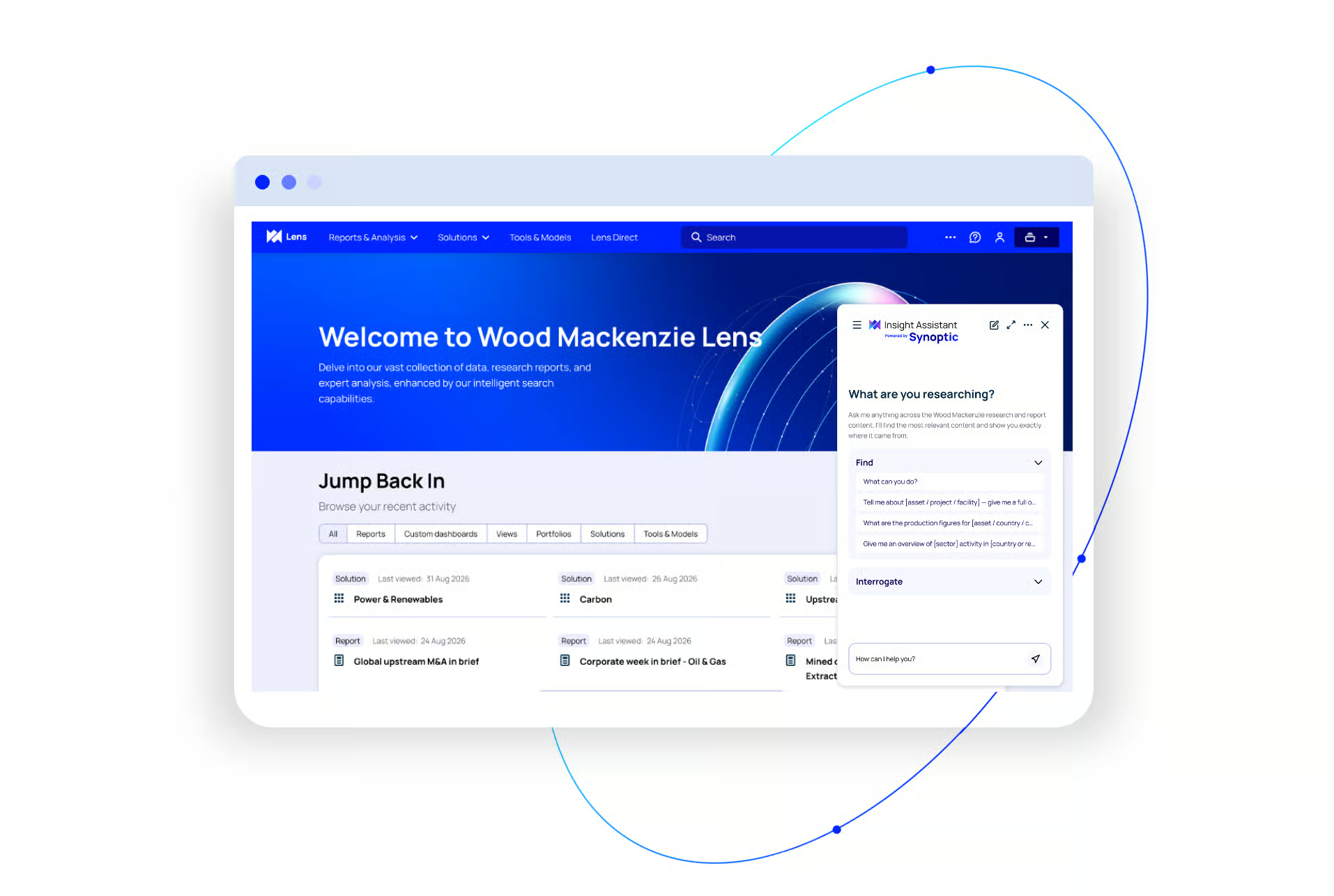
Our full insight, available to Lens Upstream customers, includes in-depth economic sensitivities, an evaluation of fiscal regimes, rig market analysis, and global benchmarking of Southeast Asia’s deepwater rock productivity. Fill out the form above to learn more.