


Get in touch
-
Mark Thomtonmark.thomton@woodmac.com
+1 630 881 6885 -
Hla Myat Monhla.myatmon@woodmac.com
+65 8533 8860 -
Chris Bobachris.boba@woodmac.com
+44 7408 841129 -
Angélica Juárezangelica.juarez@woodmac.com
+5256 4171 1980
Middle East's ambitious climate goals at odds with current trajectory
Region poised to become global solar manufacturing leader, yet maintains central role as one of world's largest oil and gas exporters for decades to come
1 minute read
The Middle East's energy transition is progressing unevenly, with ambitious 2050 and 2060 climate targets increasingly at odds with current trends, according to Wood Mackenzie's latest Energy Transition Outlook for the region.
While the region is on track to become a global solar manufacturing hub—with 44 GW of production capacity expected by 2028—achieving net zero by 2060 would require cumulative investment of US$5.3 trillion. Under Wood Mackenzie's base case scenario, the region is projected to reach only 2.6°C of warming, falling short of the 1.5°C net zero pathway most countries have pledged.
"The Middle East's energy transition reflects a fundamental tension between climate ambitions and economic reality," said Jom Madan, principal analyst at Wood Mackenzie. "Oil and gas remain central to national economies, and the region supplied 40% of global energy exports in 2025. While power generation has advanced rapidly with utility-scale solar deployment, deeper economy-wide decarbonisation will depend on policy follow-through and credible demand signals from trade partners."
Key Findings:
Resource Endowment Drives Diverging National Strategies
The outlook reveals stark contrasts in how countries are approaching the transition, largely driven by their remaining hydrocarbon reserves and economic vulnerability to energy transition risks:
- Oman (approximately 20 years of oil and gas resources at current production levels) is pursuing the region's most aggressive decarbonisation strategy. The country is on track to exceed its 30% renewables target by 2030 and reach 89% by 2050. Facing challenging geology and higher production costs than its neighbors, Oman is positioning clean energy and industrial diversification as economic necessities, not just climate commitments.
- Qatar, with gas reserves exceeding 2,000 trillion cubic feet and over 100 years of supply at current production, faces minimal transition pressure in the near term. The country is doubling down on its LNG leadership, aiming to expand export capacity from 77 to 142 million tonnes per annum by 2032. Qatar's strategy reflects confidence in resilient long-term gas demand across all climate scenarios.
- Saudi Arabia, with roughly 50 years of oil resources at current production, is balancing both strategies—scaling renewables to divert domestic crude consumption toward more valuable exports while continuing upstream expansion. The kingdom aims for 50% clean power by 2030 but is tracking toward 20% in Wood Mackenzie's base case.
- United Arab Emirates is rapidly expanding both fossil fuel production and clean energy infrastructure simultaneously. The country will exceed its 30% clean power target by 2030 but may fall short of its 47% emissions reduction goal by 2035.
"The ambition countries show in reducing emissions depends on two factors: their reliance on hydrocarbon revenue and how their resources compare with other producers," noted Madan. "Producers with large, low-cost reserves face little pressure to transition quickly, while those with declining reserves see the shift as a strategic necessity."
Power Sector Advances Rapidly, Solar Manufacturing Emerges as Major Opportunity
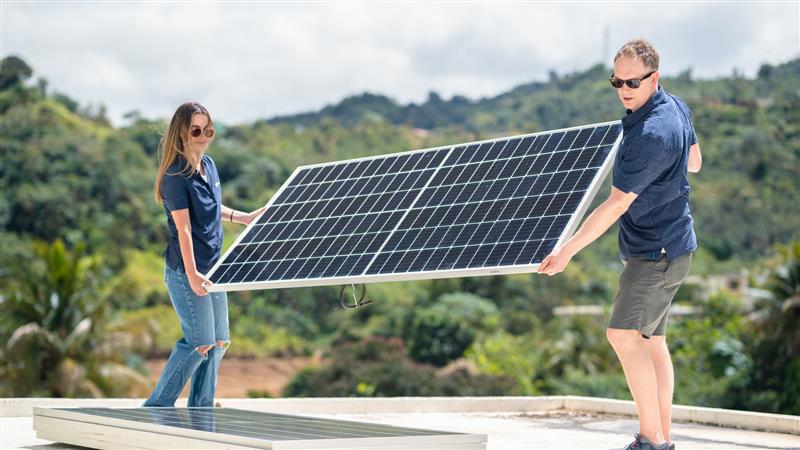
Progress is most visible in electricity generation, where utility-scale solar is being deployed at a rapid pace. Regional installed solar capacity is projected to surge from 30 GW in 2025 to 97 GW by 2030, reaching 580 GW by 2050.
This domestic demand surge is attracting significant manufacturing investment, with solar production capacity expected to reach around 44 GW by 2028, positioning the Middle East as a global solar supply chain hub rivaling Southeast Asian centers. Key drivers include tariff advantages when exporting to major markets, domestic content requirements, and abundant low-cost energy.
Battery storage is increasingly paired with renewables to manage peak demand, particularly as cooling and desalination needs rise with population and income growth. Solar and wind generation are expected to meet most incremental demand, with their combined share of regional power supply rising from 14% in 2025 to approximately 67% by 2050.
Oil and Gas Investment Resurging Despite Climate Targets
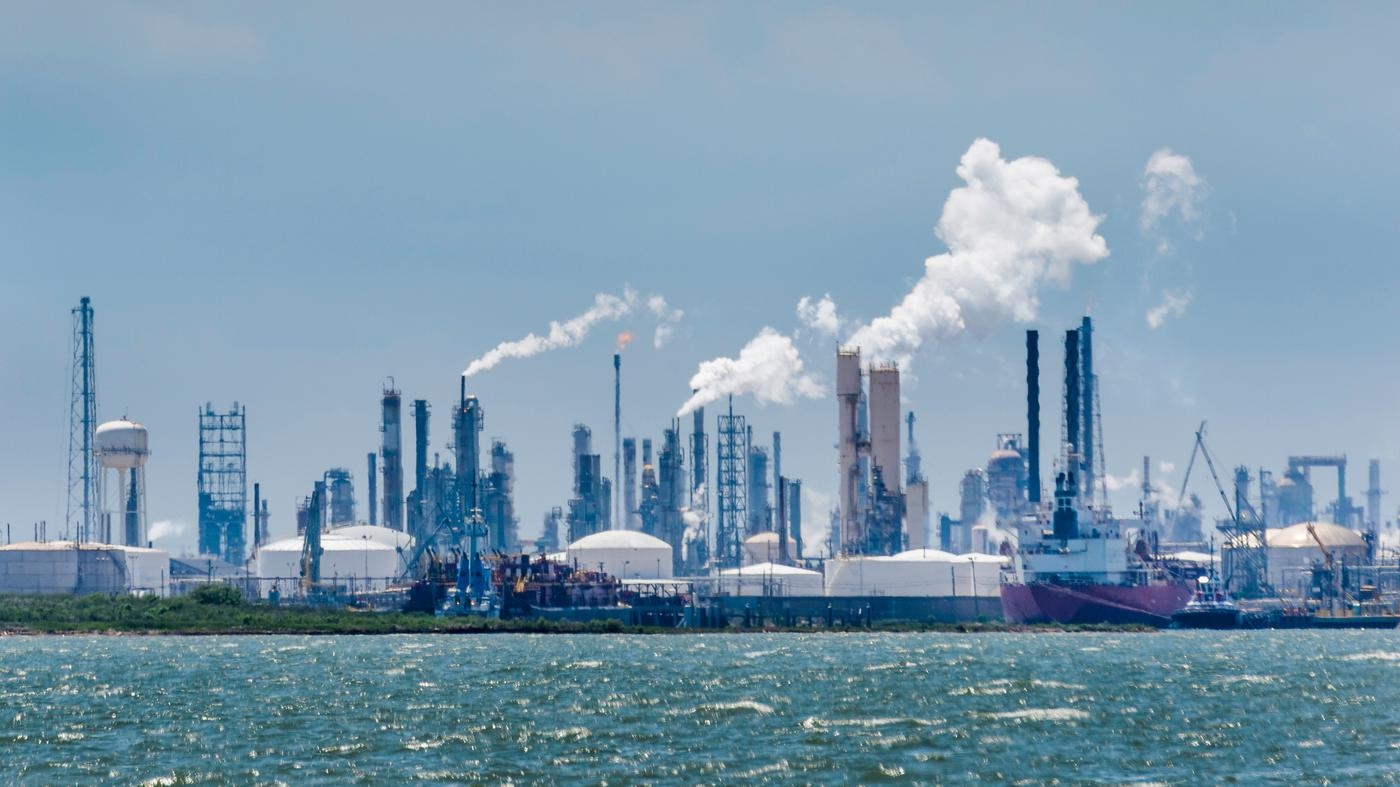
Despite ambitious climate commitments, oil and gas investment across the region is rising as supply security increasingly shapes national policy worldwide. National oil companies are expanding capacity and attracting international capital, positioning Middle Eastern exporters to maintain or increase global market share through 2050.
State-run oil companies continue to expand upstream capacity and LNG infrastructure, betting on resilient long-term demand and positioning natural gas as both a transition fuel and petrochemical feedstock. This reflects confidence that oil and gas will remain economically viable for decades, even as clean energy expands.
Clean Energy Targets Remain Ambitious but Face Implementation Gaps
Most regional governments have announced 2050 or 2060 net zero targets alongside interim goals for renewable energy deployment, emissions reductions, and clean technology adoption. However, current policies and investment trajectories fall short of these commitments. Challenges include the economic prioritization of hydrocarbon revenues, infrastructure lock-in from existing fossil fuel assets, and limited market demand for premium-priced low-carbon products.
"Climate targets are ambitious but at odds with current trends, as outcomes are shaped by economics and export competitiveness," added Madan. "The Middle East is on a path to becoming a major solar manufacturing hub and is making real progress in the power sector. However, deeper economy-wide decarbonisation will depend on sustained policy support, technological breakthroughs in hard-to-abate sectors, and stronger demand signals from global trade partners."
Regional Power Demand to Double by 2060
Power demand across the Middle East is projected to grow from approximately 1,450 TWh in 2025 to 1,650 TWh by 2030 (up 12%) and nearly 2,400 TWh by 2060. Growth is driven by rising incomes and population, increased cooling requirements due to extreme heat, growing desalination needs to address water stress, industrial expansion in energy-intensive sectors, and emerging demand from data centers seeking low-cost, reliable power.
Gas-fired generation remains significant throughout the period, providing flexible capacity to balance variable renewable output.
About the Research
Wood Mackenzie's Energy Transition Outlook explores four possible emissions trajectories: Delayed Transition (3.1°C), Base Case (2.6°C), Country Pledges (2°C), and Net Zero (1.5°C). The analysis covers Saudi Arabia, Oman, United Arab Emirates, Qatar, Kuwait, and Israel, with integrated modeling across power, renewables, oil, gas, hydrogen, carbon capture, and industrial sectors through 2060.