



Get Ed Crooks' Energy Pulse in your inbox every week
The Trump administration moves to curb rising US electricity bills
The federal government and state governors have launched a plan to address surging demand from data centres in northern and eastern states
1 minute read

Ed Crooks
Vice Chair Americas and host of Energy Gang podcast

Ed Crooks
Vice Chair Americas and host of Energy Gang podcast
Ed examines the forces shaping the energy industry globally.
Latest articles by Ed
-
Opinion
Are VPPs really a viable solution for easing strain on the grid?
-
Opinion
Data centers are adding an extra 220 gigawatts of electricity demand in the US. How can the grid cope?
-
Opinion
How are energy supply chains changing as electricity demand surges?
-
Opinion
Supply chain constraints limit the growth of gas-fired generation in the US
-
Opinion
A solution to the problem of paying for data centre power?
-
Opinion
The US oil industry is consolidating as growth slows
US President Donald Trump last week put a spotlight on the issue of rising power prices. “I never want Americans to pay higher Electricity bills because of Data Centers,” he posted on his Truth Social platform.
A few days later, his administration and the governors of 12 northern and eastern states responded to that call.
On Friday, the National Energy Dominance Council at the White House and a bipartisan group of governors announced a “Statement of Principles” for the PJM power market, which is the largest in the US, stretching from Illinois to North Carolina.
The same day, the board of PJM, which operates the grid for the region, published its own separate plan for connecting large loads such as data centres. David Mills, the chair of PJM’s board and its interim CEO, said: “This is not a yes/no to data centers. This is: ‘How can we do this while keeping the lights on and recognizing the impact on consumers at the same time?’”
The reasons for the mounting anger about consumers’ electricity bills were made very clear by the latest Consumer Price Index data for December, published a week ago. Headline annual inflation for all items was reasonably subdued, at 2.7%. But the rise in utility costs was much stronger, with electricity up 6.7%, and piped gas up 10.8%.
PJM has been a particular focus of concern. Soaring prices for capacity to support grid reliability led to the grid operator introducing a price cap in April 2025. At two capacity auctions last year the price hit that cap. The result was that not enough power was procured to meet PJM’s target for a reserve margin for generation to keep the grid stable.
The principles for reform agreed by the Trump administration and the state governors include three key elements:
- Accelerating the development of new dispatchable power generation by providing 15-year revenue certainty for new plants
- Limiting the amount that existing plants can be paid in the PJM capacity market
- Requiring data centres to pay for the new generation built on their behalf.
The plan set out by the PJM grid operator includes:
- Improved load forecasting
- Avenues for new large loads to bring their own power
- An accelerated interconnection track for state-sponsored generation projects
- A new backstop generation procurement process to address short-term reliability needs
- A review of PJM markets to assess how they can best support investment.
As discussed in Energy Pulse before, the surge in US power prices over the past few years has been driven mainly by other factors, not new data centres. But with new data centre investment surging, their impact on power markets is clearly growing.
The tech companies have been responding to consumers’ discontent. Microsoft last week published its “Community-first AI infrastructure plan”: five principles for its data centre buildout, addressing key issues including employment, training, tax payments and water use. Number one is: “We’ll pay our way to ensure our datacenters don’t increase your electricity prices.”
Some of its peers have made similar moves. A few days before Christmas, Alphabet, the owner of Google, announced a US$4.75 billion deal to buy Intersect Power, a developer of gas-fired and renewable generation. Alphabet said it was committed to developing “abundant, reliable, affordable energy supply that enables the buildout of data center infrastructure without passing on costs to grid customers”.
With excitement over AI capabilities continuing to grow, and no sign yet of a market correction, politicians and regulators are under pressure to make sure that the tech companies and other participants in the power industry live up to those commitments.
The Wood Mackenzie view
Wood Mackenzie’s Chris Seiple and Ben Hertz-Shargel predicted back in June that something like the Trump administration’s initiative was a likely outcome for US power markets.
“Something will have to give,” they wrote. “[States may] establish a mandate to purchase power from new resources on an expedited basis through long-term power purchase agreements… Waiting for a power-outage crisis to spark policy and regulatory change would be a worst-case scenario.”
That seems to be the conclusion that the federal government, state leaders and PJM itself have all come to.
Hertz-Shargel, Wood Mackenzie’s global head of grid edge research, says that although the Trump administration and PJM announced two separate initiatives on the same day, their ideas are complementary, rather than in competition.
In particular, they agree that a reliability backstop auction is needed immediately to secure additional dispatchable generation capacity, with the costs allocated to large load customers.
They also agree that large loads must make a long-term commitment to generation, either through a “Bring Your Own New Generation” mechanism or the backstop auction. If they don’t, they will face supply interruptions.
“The price of firm service for data centres is about to rise, and only developers with strong balance sheets are positioned to succeed,” Hertz-Shargel says.
In brief
A sixth oil tanker was seized by US forces in the Caribbean last Thursday, as the Trump administration continues to put pressure on Venezuela following the capture of President Nicolás Maduro. President Trump and his advisers are planning “to dominate the Venezuelan oil industry for years to come,” with the goal of driving crude prices down towards US$50 a barrel, the Wall Street Journal reported.
The US has carried out its first sale of Venezuelan oil, raising about US$500 million.
Oil prices surged last week, with Brent crude briefly approaching US$67 a barrel, as speculation grew that the US would strike Iran following a crackdown on large-scale protests. Crude prices then subsided following reports that President Trump had decided against immediate military action. On Tuesday morning, Brent was trading at about US$64 a barrel.
The UK’s latest offshore wind allocation round, AR7, awarded a record 8.4 GW of capacity. The final strike price for the UK projects was about 12% above last year’s AR6 clearing price. The UK government said the auction had delivered the biggest single procurement of offshore wind energy in European history, “confounding the global challenges facing the industry”.
Akif Chaudhry, a director on Wood Mackenzie’s corporate research team, said RWE was the standout winner in the round, and was now set to take over from Ørsted as the leading offshore wind developer worldwide. For more on what the allocation round means for offshore wind and power in the UK and Europe, take a look at our on-demand webinar.
Germany’s Chancellor Friedrich Merz has said it was “a serious strategic mistake” for the country to have shut down its nuclear power plants. Speaking at a business conference in Saxony-Anhalt, Chancellor Merz said: “We're now making the most expensive energy transition in the entire world. I don't know of a second country that makes it as difficult and as expensive for itself as Germany does.”
Meta announced deals with three companies – Vistra, Oklo and TerraPower – to support up to 6.6 GW of new and existing nuclear generation. The deals follow a request for proposals for new nuclear capacity, announced in 2024. The deals with Oklo and TerraPower will support the development of advanced nuclear technologies, potentially bringing the first new reactors online by 2030.
The deal with Vistra involves buying power from two existing nuclear plants in Ohio under 20-year agreements, and supporting uprates to add additional capacity at those two plants and one other.
The first graphite mine in the US for decades has started production in New York state.
The US Department of Energy and NASA are working to develop a new nuclear reactor for use on the Moon and Mars. The goal is to have a fission surface power system in operation on the Moon by 2030.
Other views
Is Greenland Venezuela 2.0? – Simon Flowers and Gavin Thompson
Nuclear: 5 things to look for in 2026 – Zoé Sulmont and Prakash Sharma
Global upstream M&A: 4 things to look for in 2026 – Greig Aitken and Scott Walker
Permitting certainty is a bigger problem than wind farms – Elizabeth McCarthy and Marc Levitt
Trump’s surprising win for the climate – Ted Nordhaus
They’re coming for our data centers – Peter Huntsman
Quote of the week
“If you talk to most of these oil companies, they’ll give you a range between 60 and 70 dollars a barrel is where they need to actually be profitable. However, if we can bring stability in the regulatory environment, bring down the regulatory cost of entry into drilling and delivering the product to the market, that price can easily slip from $60, let’s say on the low end, down to $45. But we need to do it not just through executive orders; it needs to be done through permit reform. Which is why myself and several senators on both sides of the aisle, and representatives, are working on doing that.”
Senator Markwayne Mullin, a Republican from Oklahoma, gave an interview to CNBC and made the case for permitting reform legislation to help the US oil industry survive at lower oil prices. President Trump said this week he would be “pleased” to see oil at US$53 a barrel.
Chart of the week
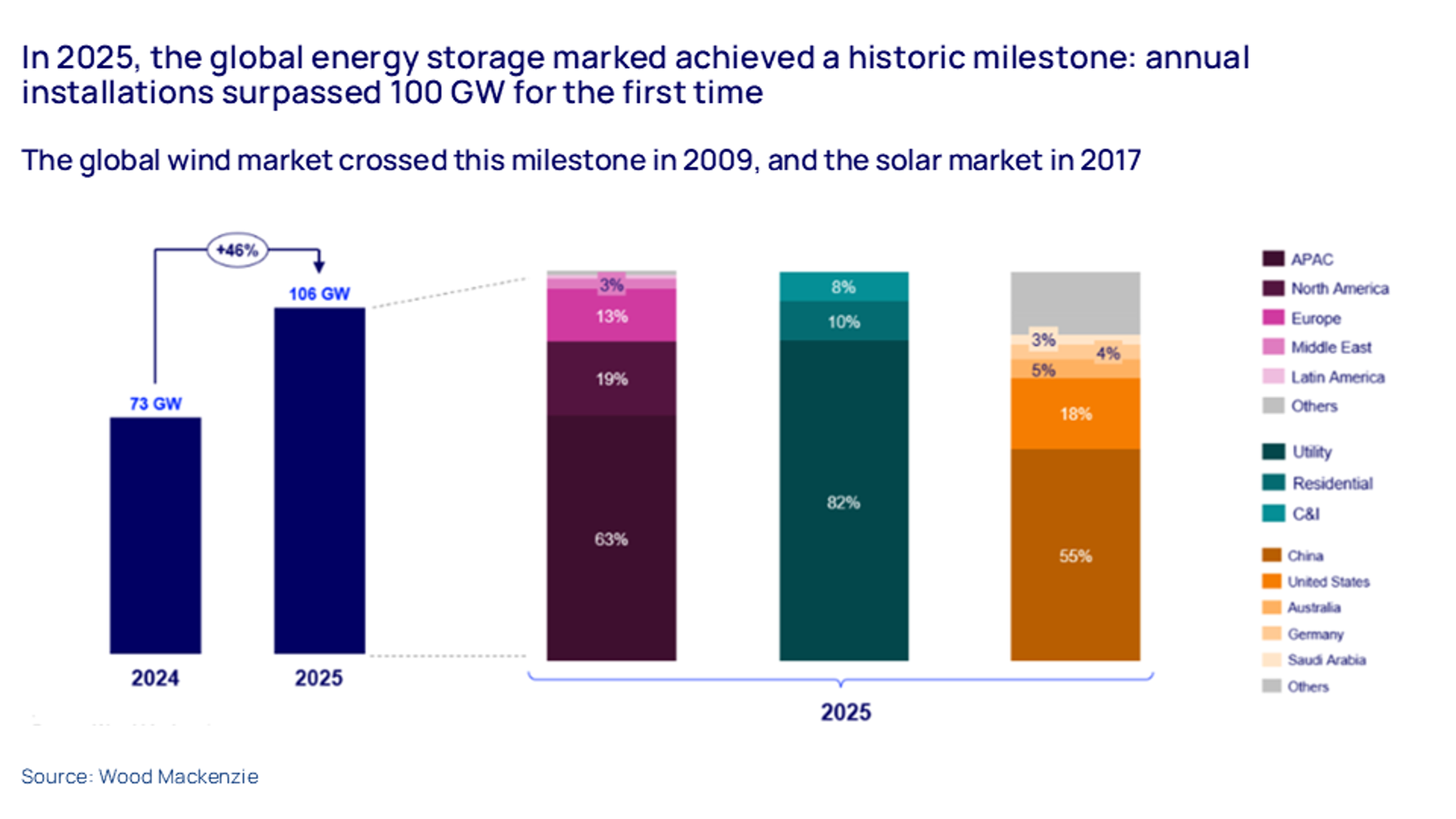
This is a graphic from Wood Mackenzie’s storage analysts Anna Darmani and Allison Weis, showing global installations of new energy storage capacity last year. The numbers are remarkable. Total installations were 46% higher last year than in 2024, with 55% of that capacity added in China, almost three times as much as in the US.

Get The Inside Track
Ed Crooks’ Energy Pulse is featured in our weekly newsletter, the Inside Track, alongside more news and views from our global energy and natural resources experts. Sign up today via the form at the top of the page to ensure you don’t miss a thing.