


Get Ed Crooks' Energy Pulse in your inbox every week
What Big Oil needs to invest in Venezuela
President Trump hopes to attract more than US$100 billion of investment to rebuild its shattered industry
1 minute read

Ed Crooks
Vice Chair Americas and host of Energy Gang podcast
Ed Crooks
Vice Chair Americas and host of Energy Gang podcast
Ed examines the forces shaping the energy industry globally.
Latest articles by Ed
-
Opinion
Oil prices rise despite IEA reserves release
-
Opinion
The war with Iran: what does the disruption in the Strait of Hormuz mean for global energy?
-
Opinion
Iran conflict a test of US energy supply response
-
Opinion
Are VPPs really a viable solution for easing strain on the grid?
-
Opinion
Data centers are adding an extra 220 gigawatts of electricity demand in the US. How can the grid cope?
-
Opinion
How are energy supply chains changing as electricity demand surges?
After the dramatic US capture of Venezuela’s former president Nicolás Maduro last weekend, this week has been dominated by manoeuvring aimed at shaping the country’s future.
US senators on Thursday voted 52-47 in favour of legislation that would force President Donald Trump to seek approval from Congress before taking any further military action in Venezuela. It looks unlikely to become law, but it is a sign of caution in Congress about the US taking on further military commitments.
Meanwhile, the Trump administration has been working to secure the future of Venezuela’s oil industry, which is at the heart of its plans for the country. At publication time on Friday, President Trump was scheduled to meet executives from about 20 large oil companies, mostly but not exclusively American, to discuss plans for rebuilding the sector.
His goal is to secure billions of dollars in investment from US and international companies to restore Venezuela’s failing oil infrastructure, which has been debilitated by many years of mismanagement and sanctions.
On Wednesday, the Department of Energy set out the first stages in implementing that strategy. The US has begun marketing Venezuelan crude, planning to sell an initial 30 to 50 million barrels. Those sales will continue indefinitely, with the proceeds held in US-controlled accounts at international banks. They will then be disbursed by the US government “for the benefit of the American people and the Venezuelan people,” the energy department said.
The administration promised exports of light oil to Venezuela as needed for use as diluent, to be blended with the country’s heavy oil for transport and sale. And it is easing sanctions to allow Venezuela to bring in oilfield equipment and parts, as well as expertise and investment from US and other international companies.
The US also aims to strengthen Venezuela’s electricity grid to support increased oil production.
If the oil industry can be rebuilt, it could eventually generate substantial additional revenues to cover the costs of reconstruction, for both the energy sector and the wider Venezuelan economy. In the early 2000s, its crude production was running at over 3 million barrels per day. Now it is only about 800,000 barrels per day.
But rebuilding will be possible only with significant outside investment, expertise and operational support. That means the conditions will have to be right for international operators and oilfield services to step in.
The Wood Mackenzie view
The size of Venezuela’s oil and gas reserves makes it an interesting prospect for international companies, in principle. With liquids production in the US on course to hit a plateau in the early to mid-2030s, some of the leading companies operating there have been looking around the world for regions that might provide it. Venezuela certainly qualifies.
However, the investment needed to revive the country’s crumbling oil infrastructure will be significant. President Trump said on Thursday that Big Oil would spend at least US$100 billion in Venezuela.
Several smaller independent companies have expressed enthusiasm for being early entrants into the revival of Venezuela’s oil industry. But investment on the scale envisaged by President Trump requires companies with the financial strength and capabilities that only the Majors and the largest independents can offer. And for the Majors and other companies to start to invest sums on that scale, several key conditions will have to be in place:
- Political stability, with clarity about the security situation and the government’s position on foreign investment. Companies will not invest if there is a high risk of assets being expropriated. It has been suggested that the US government could provide guarantees to oil companies investing in Venezuela, but no details of any such commitments have yet emerged.
- Sustained support from the US government. Operators in Venezuela will need to be confident that the Trump administration will deliver on its promise to help them bring in equipment and personnel, export oil and gas, and receive revenues. And they will need to be sure that support will last through future administrations and changes of control in Congress. Any government guarantees offered to oil companies to invest in Venezuela would similarly need to be robust through future political cycles.
- Improved fiscal terms. Venezuela’s fiscal terms are among the most unfavourable in Latin America. Greenfield heavy oil projects will have relatively high costs by international standards, due to the nature of the oil and the processing it requires. The projects will need more favourable fiscal terms, or other financial support, to attract capital.
- Access to talent. There has been a mass exodus of skilled personnel from Venezuela’s oil industry over the past 25 years. Many have built careers and lives in other countries, and will be unwilling to return. So, in the near term at least, operators and oilfield services companies will have to rely on expatriates. The reconstruction of Venezuela’s oil industry would be helped enormously if political and economic conditions were stable enough to encourage skilled and experienced people to return.
- Financial structures that enable repayment of outstanding debts. Several international oil companies and service providers are still owed significant sums by Venezuela resulting from unpaid bills and the expropriation of assets over the past 25 years. ConocoPhillips has been awarded more than US$10 billion in compensation from Venezuela by international tribunals and court decisions, and the money has not yet been paid. President Trump said last weekend that the US planned to “take back the oil” that had been stolen by Venezuela, suggesting the administration’s goal is to secure assets or compensation for US companies.
However, there will be a difficult balance to be struck between using oil revenues to stabilise Venezuela’s economy and support investment in increased crude production, and clearing debts owed to international companies.
- Economics that will justify investment under companies’ strict capital discipline. Some of the key greenfield heavy oil projects require Brent crude at about US$80/bbl to break even on an NPV15 basis, under current fiscal terms. Operators typically use US$50-US$60/bbl breakeven thresholds to approve projects. So costs will need to be brought down, through fiscal changes and / or project optimisation, for investment in those projects to go ahead.
Venezuela also has an issue with greenhouse gas emissions: the average carbon intensity of its crude is higher than for any other producer in Latin America. Although emissions have often slipped down the list of priorities for governments and investors, they are still relevant for some. High emissions could be a barrier to investment, particularly for the European Majors.
All of these conditions are achievable. But the list underlines the challenge the Trump administration faces in attracting the investment needed for strong production growth in Venezuela, beyond the initial boost available from easing sanctions.
The sorry state of Venezuela’s oil industry was 25 years in the making. It will not be reversed overnight.
In brief
Crude oil prices rose this week, driven by escalating protests in Iran as well as the uncertainty over the outlook for Venezuela. Huge crowds calling for the overthrow of Iran's Supreme Leader Ayatollah Ali Khamenei have been seen in Tehran and other Iranian cities, and the country was hit by an internet blackout on Thursday night. Iran has crude oil production capacity of about 3.7 million b/d, according to Wood Mackenzie data, and the unrest has raised questions about possible disruption to exports.
Brent crude, which was trading on Monday at about US$60 a barrel, was above US$62.50/bbl on Friday morning.
The US is withdrawing from 66 international organisations, including the UN Framework Convention on Climate Change, the Intergovernmental Panel on Climate Change, the International Energy Forum, and Irena, the International Renewable Energy Agency. President Trump said in a statement that it was “contrary to the interests of the United States” to remain a member of those organisations.
The largest oil discovery in Southeast Asia for 20 years has been announced by Murphy Oil. The company said the results from its HSV-2X appraisal well in offshore Vietnam had led it to revise its estimate of recoverable reserves at its Hai Su Vang discovery towards the upper end of the previously announced range of 170 to 430 million barrels of oil equivalent.
Wood Mackenzie analysts said the appraisal success was positive news for Vietnam on multiple levels. A big liquids discovery will help the country reverse its long decline in oil production, and boost interest in its ongoing offshore licensing round.
Berlin suffered a five-day blackout, the city’s longest since the end of the Second World War. The blackout appears to have been the result of an arson attack on power lines, which was blamed on a left-wing anarchist extremist group. The attack has underlined the city’s vulnerability to sabotage.
Other views
Five themes shaping the energy world in 2026 – Simon Flowers
Gulf of America: 5 things to look for in 2026 – James Blackwood and Caitlin Shaw
Wind power: 7 things to look for in 2026 – Søren Lassen, Sasha Bond-Smith, and Kárys Prado
Hydrogen: 5 things to look for in 2026 – Murray Douglas
Don’t be fooled: everything has changed for the global economy – Gita Gopinath
Microsoft wants to resurrect Three Mile Island. It will never happen – Neal Chatterjee
Quote of the week
“The ChatGPT moment for physical AI is here — when machines begin to understand, reason and act in the real world… Robotaxis are among the first to benefit. Alpamayo brings reasoning to autonomous vehicles, allowing them to think through rare scenarios, drive safely in complex environments and explain their driving decisions — it’s the foundation for safe, scalable autonomy.”
Jensen Huang, founder and CEO of NVIDIA, was speaking as he launched the company’s Alpamayo family of open AI models, tools and datasets. The systems can think through novel or rare scenarios step by step, improving the capabilities and safety of autonomous vehicles.
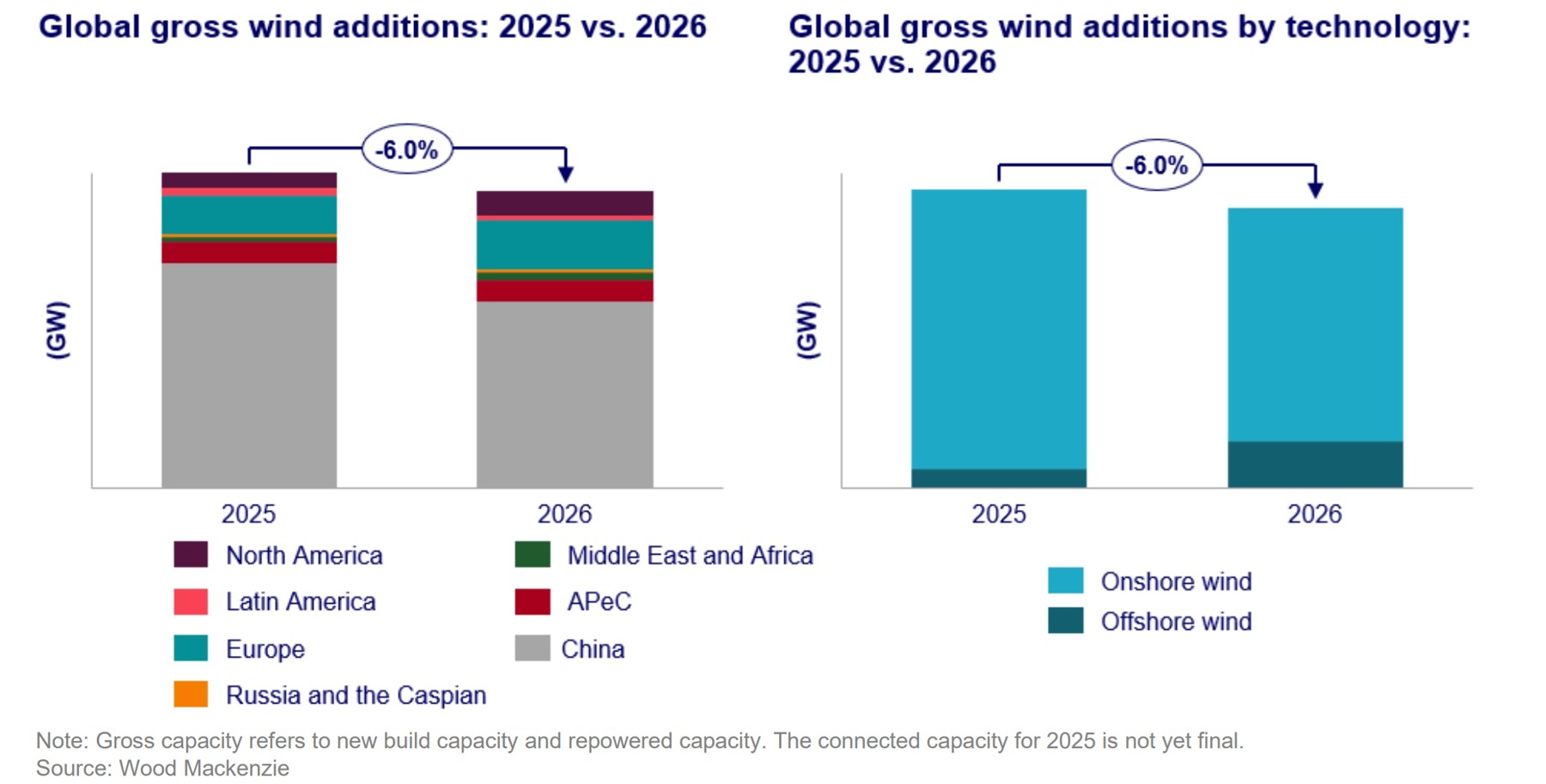
Chart of the week
This comes from our new note, ‘Wind power: what to look for in 2026’. It shows expected wind power installations worldwide for 2025 and 2026. Wood Mackenzie is forecasting substantial wind capacity additions this year, but about 6% less than in 2025, which was a record for global installations. The forecast year-on-year decline in China, due to the end of its 14th Five-Year Plan, is the single largest factor behind this slowdown, as the rest of the world will see strong year-on-year growth.

Get The Inside Track
Ed Crooks’ Energy Pulse is featured in our weekly newsletter, the Inside Track, alongside more news and views from our global energy and natural resources experts. Sign up today via the form at the top of the page to ensure you don’t miss a thing.