




Sign up today to get the best of our expert insight in your inbox.
Boiling a frog – could oil prices test US$200/bbl?
Prolonged disruption of Gulf exports will necessitate demand destruction
1 minute read

Simon Flowers
Chairman, Chief Analyst

Simon Flowers
Chairman, Chief Analyst
Simon is our Chief Analyst; he provides thought leadership on the trends and innovations shaping the energy industry.
Latest articles by Simon
-
The Edge
How war in the Middle East is hitting Asia hard
-
The Edge
The energy crisis is coming to the boil
-
The Edge
Boiling a frog – could oil prices test US$200/bbl?
-
The Edge
War is once again reshaping gas and LNG
-
Opinion
Middle East conflict set to drive oil and LNG prices significantly higher
-
The Edge
Can natural hydrogen deliver its potential?

Alan Gelder
SVP Refining, Chemicals & Oil Markets

Alan Gelder
SVP Refining, Chemicals & Oil Markets
Alan is responsible for formulating our research outlook and cross-sector perspectives on the global downstream sector.
Latest articles by Alan
-
The Edge
The energy crisis is coming to the boil
-
The Edge
Boiling a frog – could oil prices test US$200/bbl?
-
Opinion
Middle East conflict set to drive oil and LNG prices significantly higher
-
The Edge
How Venezuela complicates the oil market’s delicate rebalancing
-
Opinion
Venezuela regime change: what it means for oil production, crude and product markets
-
The Edge
Oil’s resilience in the energy system

Douglas Thyne
Research Director, Oil Supply

Douglas Thyne
Research Director, Oil Supply
Douglas manages our global oil supply research and forecasts.
Latest articles by Douglas
-
The Edge
Boiling a frog – could oil prices test US$200/bbl?
-
The Edge
How Venezuela complicates the oil market’s delicate rebalancing
-
Opinion
Venezuela regime change: what it means for oil production, crude and product markets
-
The Edge
Oil’s resilience in the energy system
-
Opinion
Trump’s tariff plan: implications for the future of global liquids trade
-
The Edge
Can China’s recovery turn the oil market around?

Isabelle Gilks
Principal Analyst, Retail Fuels

Isabelle Gilks
Principal Analyst, Retail Fuels
Isabelle is part of the Refining and Oil Products research team and manages the company’s Retail Fuels Service.
Latest articles by Isabelle
-
The Edge
Boiling a frog – could oil prices test US$200/bbl?
-
Opinion
Oil and refining market implications of Israel’s strike on Iran
-
Opinion
Are APAC’s retail markets full of Eastern promise for oil majors?

Andy Harbourne
Senior Analyst, Oil Markets

Andy Harbourne
Senior Analyst, Oil Markets
Latest articles by Andy
View Andy Harbourne's full profileBrent leapt US$30/bbl to over US$100/bbl in the 10 days since the start of the US/Israel war in Iran. As the conflict intensifies, the oil market is like the proverbial frog in a saucepan of gradually heating water. The water isn’t boiling yet, but it’s getting hotter by the day.
What’s next for the oil market and oil price? I asked our Macro Oils experts Alan Gelder, Isabelle Gilks, Andrew Harbourne and Douglas Thyne.
Have the prospects of restoring oil flows deteriorated in the last few days?
Yes. Immediately after the start of the conflict on 28 February, the Strait of Hormuz was effectively closed to 15 million b/d of crude and product exports, equal to 15% of global demand. Some cargoes, including shipments from Iran to China, are reported to have run the gauntlet. But Kuwait calling force majeure on its export contracts last Friday, 6 March, reflected the challenge confronting all Gulf exporters.
As Week 1 unfolded, Iran began targeting export infrastructure, hitting the UAE’s port in Fujairah (1.5 million b/d of capacity) and forcing the closure of the Iraq-Turkey oil pipeline (up to 0.2 million b/d). Disruption of Saudi Arabia’s East-West pipeline to the Red Sea (at least 5 million b/d of total capacity, with up to 2 million b/d spare at the start of the war) would seal off any remaining ‘leakage’ of Gulf volumes from the global market.
Storage varies by country, from 14 days in Kuwait to up to 30 days in Saudi Arabia and the UAE. But it’s already filling up, leading to problems further up the value chain. With no possibility of exports, oil production in the region can be maintained only if storage capacity is available. Iraq, with little or no storage, exported over 3 million b/d of liquids through February (behind only Saudi Arabia in the Gulf) and announced on Friday that it would have to shut down production. We’d expect a domino effect across other countries in the region in the coming days as storage capacity fills up.
Gulf countries in total produce 20 million b/d of liquids – the industry has never faced a shutdown of this scale. When the conflict ends, cranking up the supply chain won’t be swift. Product barrels in storage at refineries or in port might be moved on vessels quite quickly. But if wells are shut-in for a prolonged period, restarting production to full output could take weeks or even longer.
Is this crisis different to the pandemic’s impact on oil?
In terms of scale yes, but the fundamentals are the complete opposite. During the pandemic, global demand fell by 20 million b/d and supply had to adjust. That took time and the ensuing glut of oil led to prices collapsing, with Brent reaching a nadir of under US$20/bbl in April 2020. Eventually, OPEC had to step in to balance the market.
Today, 15 million b/d of supply is suddenly off the market and demand will have to adjust. Storage in the Gulf is already nearing full, while inventory in the rest of the world is rapidly being drawn down. Competition for available barrels of crude and product is intensifying, reflected in the surge in Brent prices to over US$100/bbl on Monday, 9 March.
The product market in Europe is one example of how markets dependent on imports are particularly exposed. In 2025, Gulf refineries supplied 60% of Europe’s jet fuel and 30% of diesel. These flows are now severed, and there’s a cascade effect onto India, Europe’s second-largest supplier of these products. Before the crisis, Indian refiners sourced 40% of their crude from the Gulf. They have now been given 30 days of grace to purchase sanctioned Russian feedstock, limited to cargoes stranded at sea.
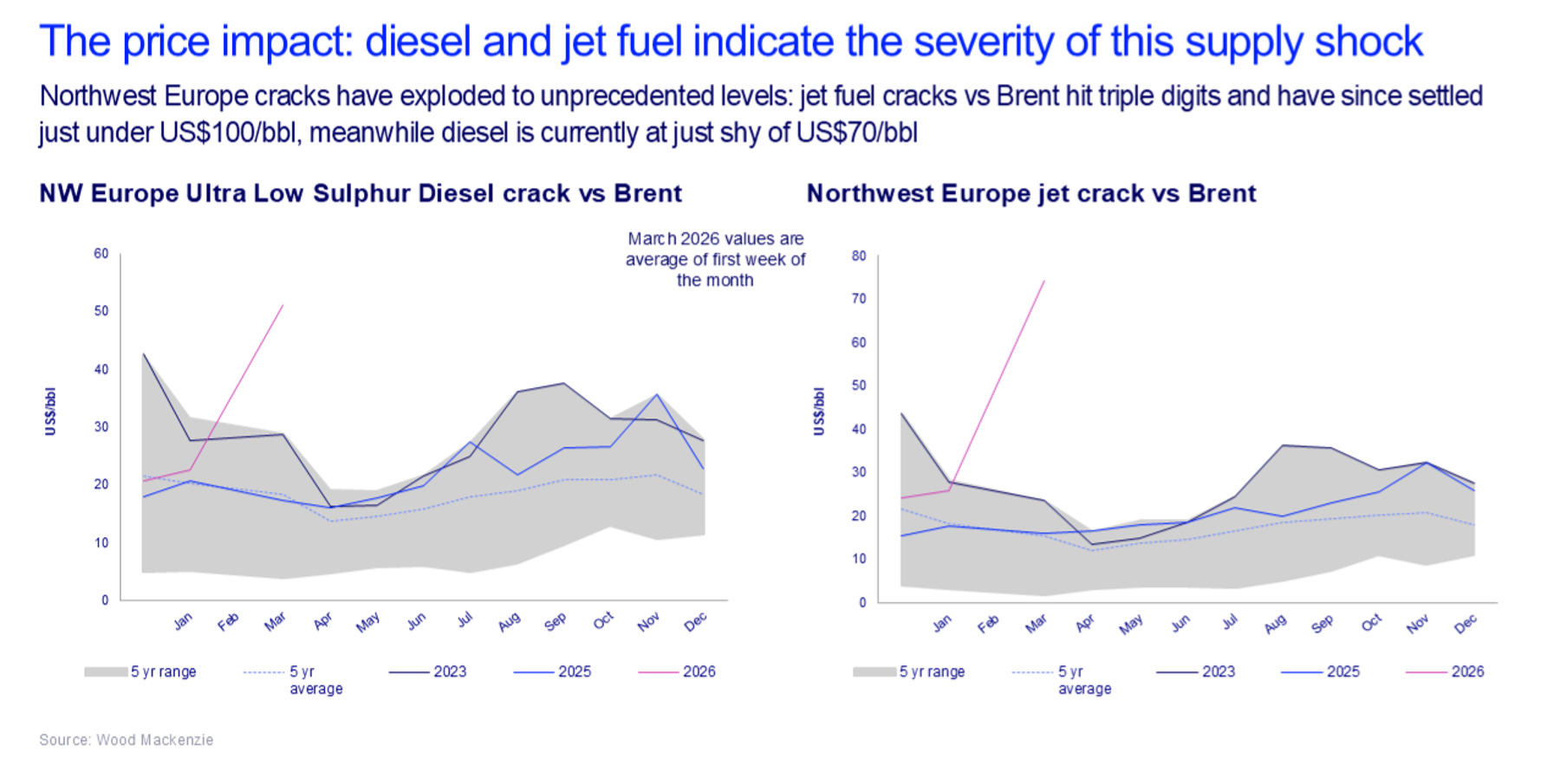
However, the prospect of extreme tightness in these product markets is reflected in super-high crack spreads. Jet-fuel cracks are currently trading at US$100/bbl (close to US$200/bbl Brent) and diesel US$70/bbl, four to five times pre-war levels.
How much higher could Brent go?
Certainly over US$150/bbl in the coming weeks as it did in 2022 (in real terms), when Russia invaded Ukraine. However, supply volumes at risk this time are dimensionally bigger – and real. In our view, US$200/bbl is not outside the realms of possibility in 2026.
Much will depend on how long the war lasts, how long the Strait of Hormuz remains closed and if the US Navy can ensure safe passage of vessels by escorting shipping. At this point, with the US and Israel openly suggesting weeks rather than days – and even the possibility of putting boots on the ground – there is no end in sight.
Meantime, consuming nations have little option but to draw down commercial and strategic inventory, as advocated by the International Energy Agency this last weekend. Global oil demand of 105 million b/d will still have to fall to balance the market and in our view, that will require Brent to push up at least to US$150/bbl in the coming weeks.

Make sure you get The Edge
Every week in The Edge, Simon Flowers curates unique insight into the hottest topics in the energy and natural resources world.
Sign up today using the form at the top of the page.