


Discuss your challenges with our solutions experts
The great power divide: the Middle East crisis is splitting global power markets into winners and losers
Fuel dependence is redrawing the global power landscape, exposing import-reliant markets to acute cost and reliability risks while insulating domestically resourced systems
1 minute read

Xizhou Zhou
Executive Vice President, Head of Power and Renewables

Xizhou Zhou
Executive Vice President, Head of Power and Renewables
Xizhou delivers value for clients by providing leading-edge insights and analytics.
Latest articles by Xizhou
-
Opinion
The great power divide: the Middle East crisis is splitting global power markets into winners and losers
-
Opinion
AI, power and the new geopolitics of energy
-
Opinion
Making the connection: the electric T&D supply chain challenge

Peter Osbaldstone
Research Director, Europe Power

Peter Osbaldstone
Research Director, Europe Power
Peter is a research director with more than a decade’s experience in European power and renewables markets.
Latest articles by Peter
-
Opinion
The great power divide: the Middle East crisis is splitting global power markets into winners and losers
-
Opinion
What’s shaping European power markets in 2026?
-
Opinion
The 2026 global power market outlook: a complex environment
-
Opinion
European Power & Renewables: what to look for in 2026
-
Opinion
2025 global power market outlook: divergent paths in a transforming energy landscape
-
Opinion
Iberian blackout: let the finger pointing begin

Allen Wang
Vice President, Head of Asia Pacific Power and Renewables Research

Allen Wang
Vice President, Head of Asia Pacific Power and Renewables Research
Dr. Allen Wang APAC Power & Renewables research team, with 16 years of global energy market experience.
Latest articles by Allen
View Allen Wang's full profileThe ongoing Middle East conflict is creating highly divergent outcomes across global power markets, with exposure determined primarily by generation mix and fuel import dependency.
Asia spot LNG prices have surged 94% and coal prices have increased 17-31% since the conflict began, yet the impact on electricity systems worldwide varies substantially. While some markets face significant cost escalation and potential supply constraints, others remain largely insulated from international fuel market volatility.
In our recent report The Great Power Divide: The Middle East crisis is splitting global power markets into winners and losers, available via Wood Mackenzie Lens Power & Renewables, we analyse how 13 representative power markets may be impacted by the ongoing crisis.
Energy security risk index: which countries are most exposed to Middle East fuel supply shocks
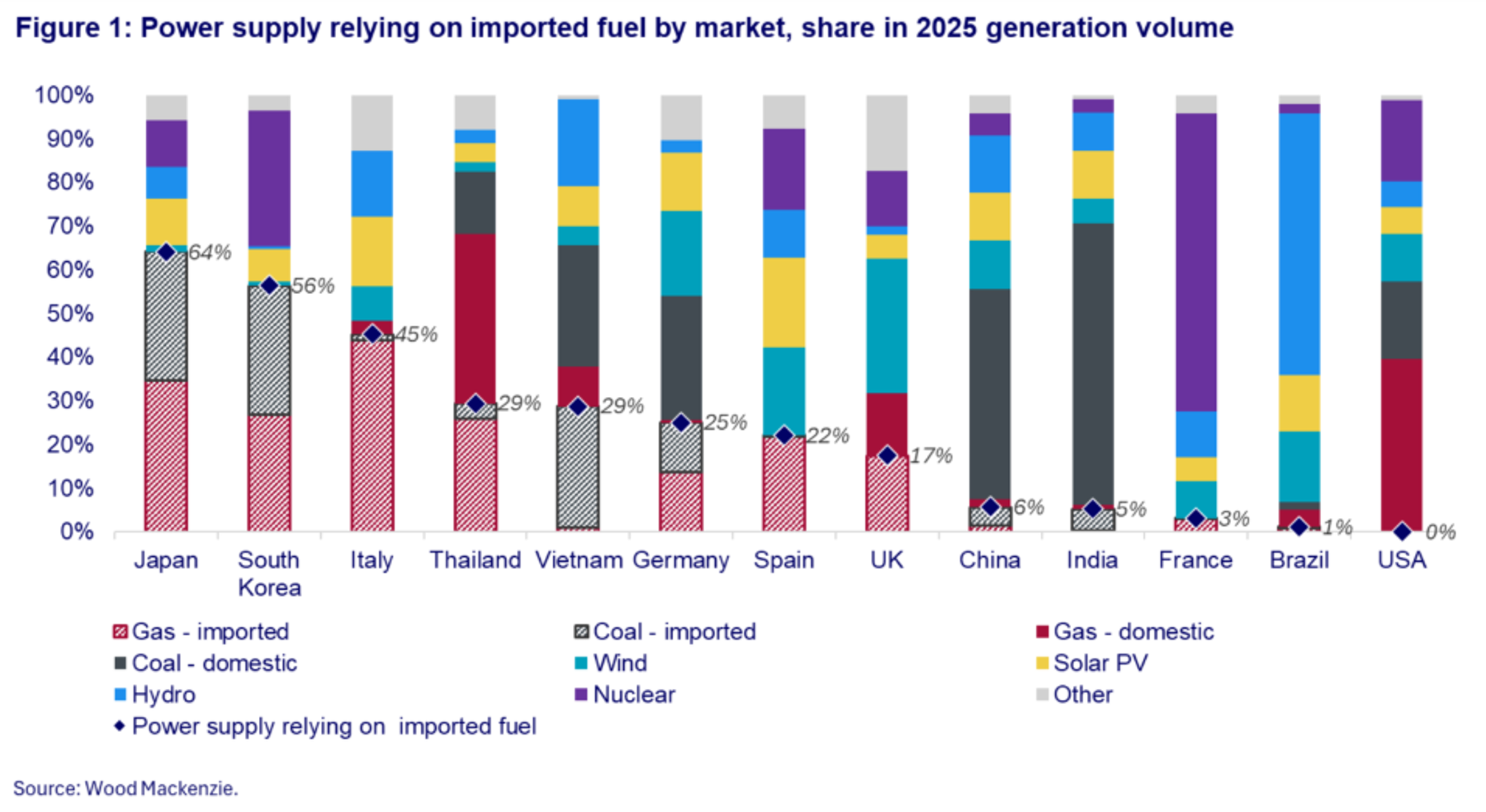
In our cohort of 13 power markets analysed, Japan represents the most exposed major power market globally, with 64% of electricity generation dependent on imported coal and gas - all of which must be sourced internationally. South Korea exhibits similarly elevated exposure at 56%, while Italy leads European markets at 47%.

By contrast, the United States and Brazil demonstrate minimal vulnerability. Brazil's generation mix - approaching 80% renewable penetration dominated by hydro - substantially reduces fossil fuel dependency, while US domestic natural gas and coal production insulates the power sector from international price volatility.
China and India, despite continued reliance on coal-fired generation, benefit from predominantly domestic coal supply. With over 90% of coal supply sourced domestically and gas-fired generation representing just 1-3% of total output in both countries, only 5-6% of power generation is exposed to imported fuel disruptions.
How the Middle East conflict is driving global power price increases and generation cost volatility
Under Wood Mackenzie's Base Case - which assumes geopolitical de-escalation enables fuel price moderation in the latter half of 2026 - average cost of generation increases by US$2.3/MWh across the 13 analysed markets. Italy, Japan, and South Korea experience the highest absolute impact with US$4.3/MWh in cost escalation.
Our High Fuel Price Sensitivity case presents a materially different outlook. Should current elevated price levels persist through 2026, average generation costs would increase 26% on average or about US$8.3/MWh, with the most exposed markets facing substantial cost escalation:
- Italy: US$22.4/MWh (80% increase)
- Japan: US$17.0/MWh (41% increase)
- South Korea: US$14.4/MWh (74% increase)
- UK: US$14.3/MWh (27% increase)

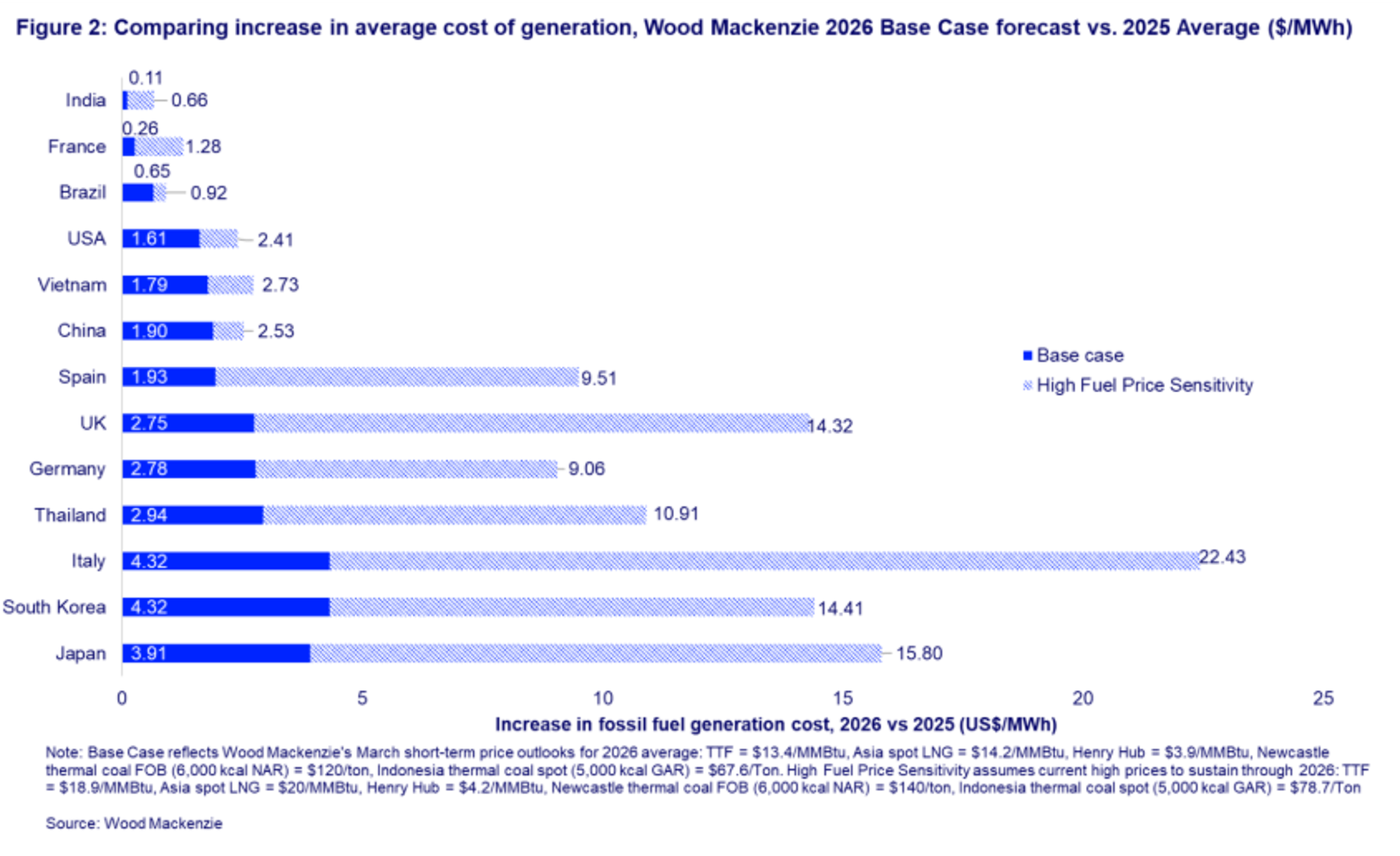
These cost increases represent significant policy challenges, requiring governments and utilities to navigate difficult trade-offs between financial support mechanisms, regulatory interventions, and retail tariff adjustments. For emerging markets with constrained fiscal capacity, elevated fuel costs also translate to heightened reliability risks as securing incremental fuel supplies becomes increasingly challenging during periods of market tightness.
Grid reliability risks from the Middle East crisis: fuel supply constraints and power system stability
Fuel supply constraints present direct reliability challenges in markets where fuel import-dependent thermal capacity is central to system adequacy.
South Korea faces the most acute exposure: import-linked thermal capacity equivalent to 87% of peak demand provides substantial baseload and mid-merit generation, meaning fuel disruptions directly threaten operational reliability. The government has already implemented electricity conservation policies, demand-side campaigns, and emergency fiscal support to reduce peak demand and limit exposure to higher fuel costs.
Europe's interconnected market architecture introduces additional complexity, as supply disruptions or price shocks transmit rapidly across borders, potentially converting localized challenges into regional supply concerns.
Emerging markets like Vietnam that have lower ability to pay for high fuel prices may also struggle with reliability should thermal units run low on coal stocks or gas storage and yet can’t compete with richer nations for limited fuel supply in the global market.
How the Middle East crisis is accelerating investment in renewable energy and domestic power supply
Repeated geopolitical supply shocks impacting oil and gas supply are elevating energy security to comparable or greater significance than climate policy as determinants of generation investment in thermal power versus low-carbon technologies.
Governments are accelerating deployment of domestic renewable generation, nuclear capacity additions, and grid infrastructure while strengthening regional market integration. However, even with this approach, careful policy calibration is being done. European policymakers, for example, face a strategic trade-off: reducing fossil fuel imports requires accepting some technology supply chain dependence (e.g., from China) - while recognising that already installed renewable assets can continue delivering power regardless of supply chain disruptions, whereas fuel dependencies create immediate operational vulnerabilities during geopolitical events.