






Trajectory
Trajectory
Higher economic growth, industrial expansion and artificial intelligence drive energy demand higher for longer, while affordability and accessibility take priority over decarbonisation.

Outlook
Outlook
Energy demand grows fastest in this scenario. Renewables continue to expand, but do not keep pace with rising demand, leaving fossil fuels embedded in the global energy system for longer.
The growth first scenario: what happens to the energy transition when economic growth takes priority?
In our growth first scenario, governments prioritise economic growth, infrastructure development and affordability.
Rising incomes and population increase consumption in developing markets, while reindustrialisation and advanced manufacturing support stronger growth in developed economies.
AI, data centres, robotics and other emerging technologies add further demand for electricity, materials and minerals.
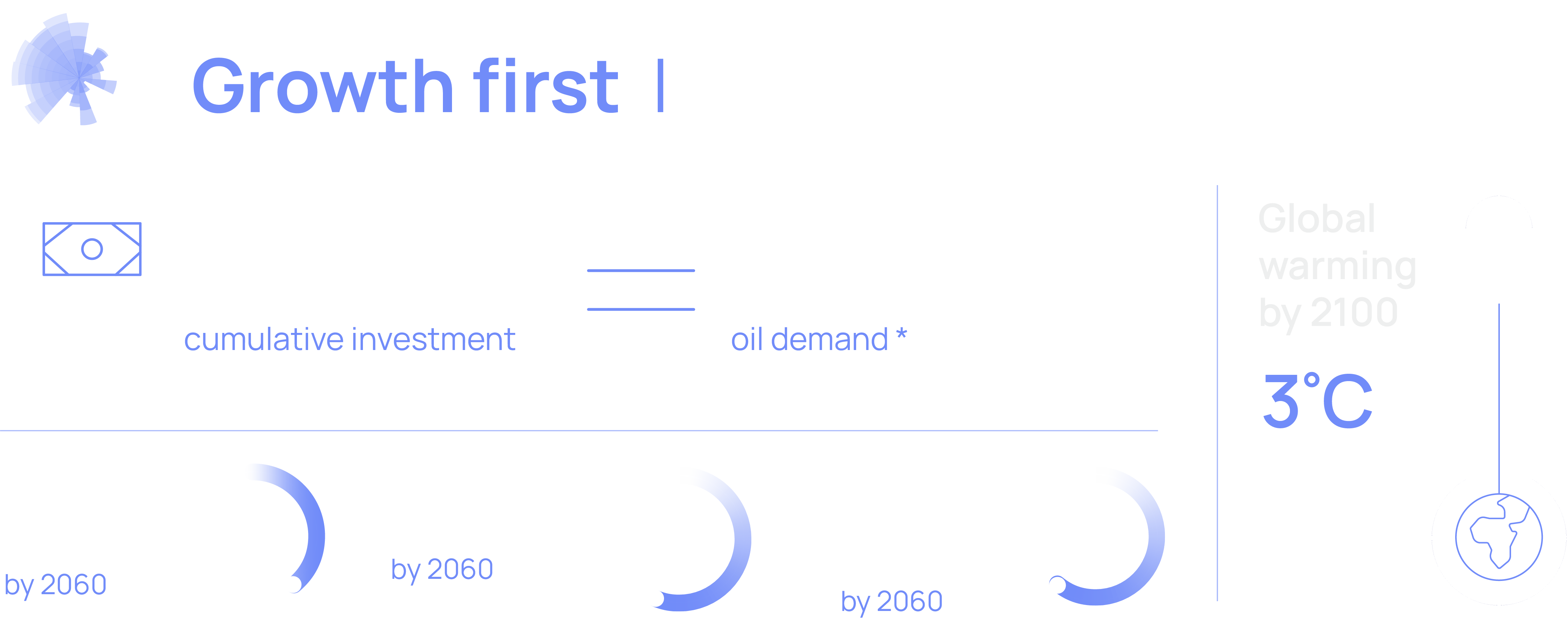
The result is our highest-energy-demand pathway and a warming trajectory of more than 3 °C.

What defines the growth first scenario?
Economic growth outweighs climate ambition
Policy focuses on improving living standards, expanding infrastructure and increasing economic output. Climate action continues, but does not take priority over growth and affordability.

Emerging technologies increase energy demand
AI, data centres, advanced manufacturing and other new technologies support productivity and growth while creating additional demand for power and materials.

Fossil fuels remain embedded in the energy mix
Renewables continue to expand, but growing energy needs keep oil, natural gas and coal in the system for longer.

Frequently asked questions
Demand rises across the energy system as higher incomes, industrialisation and new technologies increase consumption.
Unlike our Energy Security scenario, where electrification is used strategically to reduce dependence on imported fuels, Growth First is driven primarily by economic and commercial expansion.
Greater demand keeps existing energy assets working for longer and sustains demand for conventional fuels alongside growing electricity consumption.
Renewables continue to scale, but they do not keep pace with overall energy-demand growth.
Oil, gas and coal therefore remain significant parts of the global energy mix for longer. Low-carbon technologies also develop more slowly where cost, accessibility and economic returns take precedence over decarbonisation.
The Growth First pathway demonstrates that renewable growth alone does not determine the pace of the energy transition. The rate at which clean energy displaces incumbent fuels matters just as much.
See the bigger picture
Compare growth first with our four other pathways.

Base case
Our assessment of the most likely outcome of the energy system based on the evolution of current policies, technologies and market trends.
Learn more
Energy security
A security-first pathway where countries prioritise greater energy independence, accelerating electrification and ultimately lowering emissions longer-term compared with our Base Case.
Learn more
Country pledges
A faster transition in which countries achieve their announced long-term emissions reduction targets, corresponding to 2 °C global warming pathway.
Learn more
Net Zero
A pathway based on the most ambitious goals of the Paris Agreement, requiring extraordinary policy action, global cooperation, capital mobilisation and technological innovation to limit warming to around 1.5 °C by 2100, following an overshoot.
Learn more