





Trajectory
Trajectory
Extraordinary policy ambition, capital mobilisation and technology deployment fundamentally rewire the global energy system around greater efficiency, electrification and low-carbon.

Outlook
Outlook
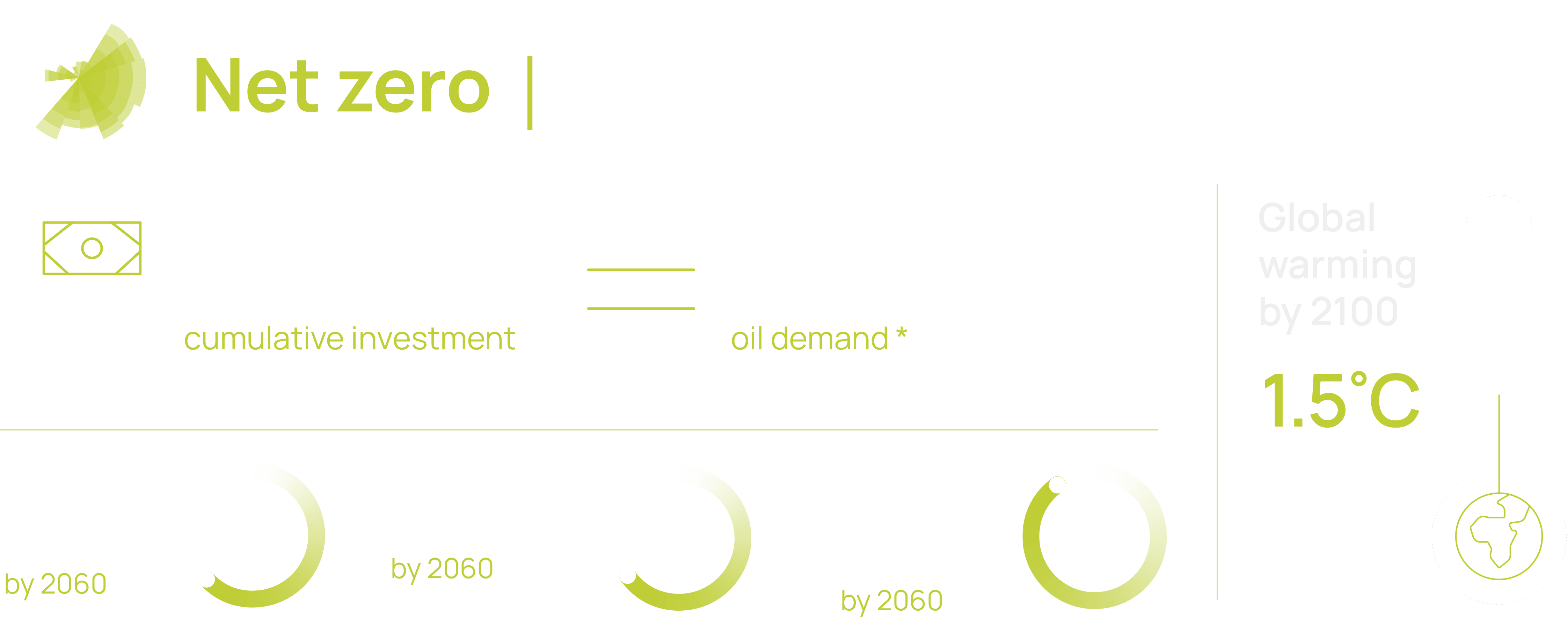
Rapid electrification and clean-energy deployment combine with solutions for hard-to-abate sectors in a pathway that returns warming to around 1.5 °C by 2100 following a temporary overshoot.
What would it take to limit global warming to around 1.5 °C by 2100 after a limited overshoot?
Our net zero scenario represents the most ambitious energy transition pathway in our outlook.
The world is set to exhaust the 1.5 °C carbon budget before 2030, making a pathway without overshooting that threshold practically unachievable.
Our scenario therefore explores a pathway in which warming temporarily exceeds 1.5 °C before returning to around that level by 2100. It’s worth mentioning that an overshoot scenario is extremely uncertain and carries unknown risks.
Delivering it requires a wholesale transformation of the way the world produces and consumes energy, including higher carbon prices than modelled under our base case and country pledges scenario.

What would a net zero energy system look like?
Energy becomes much more efficient
Efficiency improvements and behavioural change moderate overall energy demand, even as economic activity continues to grow.

Electrification accelerates dramatically
Transport, buildings and parts of industry shift towards electricity, helping displace direct fossil-fuel consumption.
Renewables dominate power generation
Solar and wind become fundamental to the electricity system as clean power expands rapidly.
Firm clean power becomes increasingly important
Nuclear and other low-carbon sources provide firm and balancing capacity as unabated fossil-fuel generation declines.
Hard-to-abate sectors require additional solutions
Where direct electrification is difficult, hydrogen, bioenergy and carbon capture play significantly greater roles.
Policy intervention reaches unprecedented levels
Stronger carbon pricing, faster coal retirement, support for clean-energy technologies and other measures are required to shift investment and behaviour at the necessary speed.
Frequently asked questions
The window has narrowed substantially.
Our outlook finds that the remaining 1.5 °C carbon budget is set to be exhausted before 2030.
A limited overshoot pathway could still see warming return to around 1.5 °C by 2100, but such a pathway is extremely demanding and carries significant uncertainty.
The net zero scenario is therefore not a prediction. It illustrates the scale of transformation required to pursue the most ambitious goal of the Paris Agreement.
Electricity becomes central to an increasingly integrated energy system.
By 2060, electricity accounts for a substantially greater share of energy use, and global electricity demand approaches three times today's level.
Fossil-fuel demand declines sharply as electrification, efficiency and alternative technologies expand.
But electrification cannot solve every challenge alone. Heavy industry, aviation, shipping and other hard-to-abate sectors require a broader portfolio of technologies, including low-carbon hydrogen, sustainable fuels, bioenergy and carbon capture.
The transition is therefore both an electrification challenge and a technology-deployment challenge.
Direction alone is not enough. Speed and scale matter.
Country pledges and net zero both move decisively towards lower-carbon energy. net zero, however, requires action to begin earlier and proceed faster across multiple parts of the system simultaneously.
Greater electrification, accelerated clean-power deployment and substantially wider adoption of technologies for hard-to-abate sectors must all progress together.
It represents the most extensive transformation of the global energy system across our five scenarios.
See the bigger picture
Compare net zero with our four other pathways.

Growth first
Economic growth and affordability take priority, keeping energy demand higher for longer.
Learn more
Base case
Our assessment of the most likely outcome of the energy system based on the evolution of current policies, technologies and market trends.
Learn more
Energy security
A security-first pathway where countries prioritise greater energy independence, accelerating electrification and ultimately lowering emissions longer-term compared with our Base Case.
Learn more
Country pledges
A faster transition in which countries achieve their announced long-term emissions reduction targets, corresponding to 2 °C global warming pathway.
Learn more