


Sign up today to get the best of our expert insight in your inbox.
Is Greenland Venezuela 2.0?
Remote, underexplored and high cost
1 minute read

Simon Flowers
Chairman, Chief Analyst and author of The Edge

Simon Flowers
Chairman, Chief Analyst and author of The Edge
Simon is our Chief Analyst; he provides thought leadership on the trends and innovations shaping the energy industry.
Latest articles by Simon
-
The Edge
Five themes shaping the energy world in 2026
-
Opinion
Venezuela regime change: what it means for oil production, crude and product markets
-
The Edge
Oil’s resilience in the energy system
-
Opinion
Five key takeaways from our Gastech 2025 Leadership Roundtables
-
The Edge
Five key takeaways from COP30
-
The Edge
Can copper supply keep up with surging demand?

Gavin Thompson
Vice Chairman, Energy – Europe, Middle East & Africa

Gavin Thompson
Vice Chairman, Energy – Europe, Middle East & Africa
Gavin oversees our Europe, Middle East and Africa research.
Latest articles by Gavin
-
Opinion
Five key takeaways from our Gastech 2025 Leadership Roundtables
-
The Edge
Five key takeaways from COP30
-
The Edge
Can copper supply keep up with surging demand?
-
The Edge
ADIPEC 2025: six key takeaways
-
The Edge
Slipping climate targets and the “energy addition”
-
The Edge
China renewables investment powers on
Following the capture of then-Venezuelan president Nicolás Maduro by US special forces on 3 January, the Trump administration swiftly ramped up its rhetoric on Greenland. Increasing US control over the island has long been a strategic objective of President Donald Trump and, in his words, “one way or the other, we are going to have Greenland”.
How do Greenland’s natural resources fit into this ambition? While the US president has been clear that Venezuelan oil was, in part, a catalyst for intervention, the Danish semi-autonomous territory is a different story. Despite its hydrocarbon and critical mineral potential, Greenland is not Venezuela 2.0.
Greenland’s upstream is not for the fainthearted
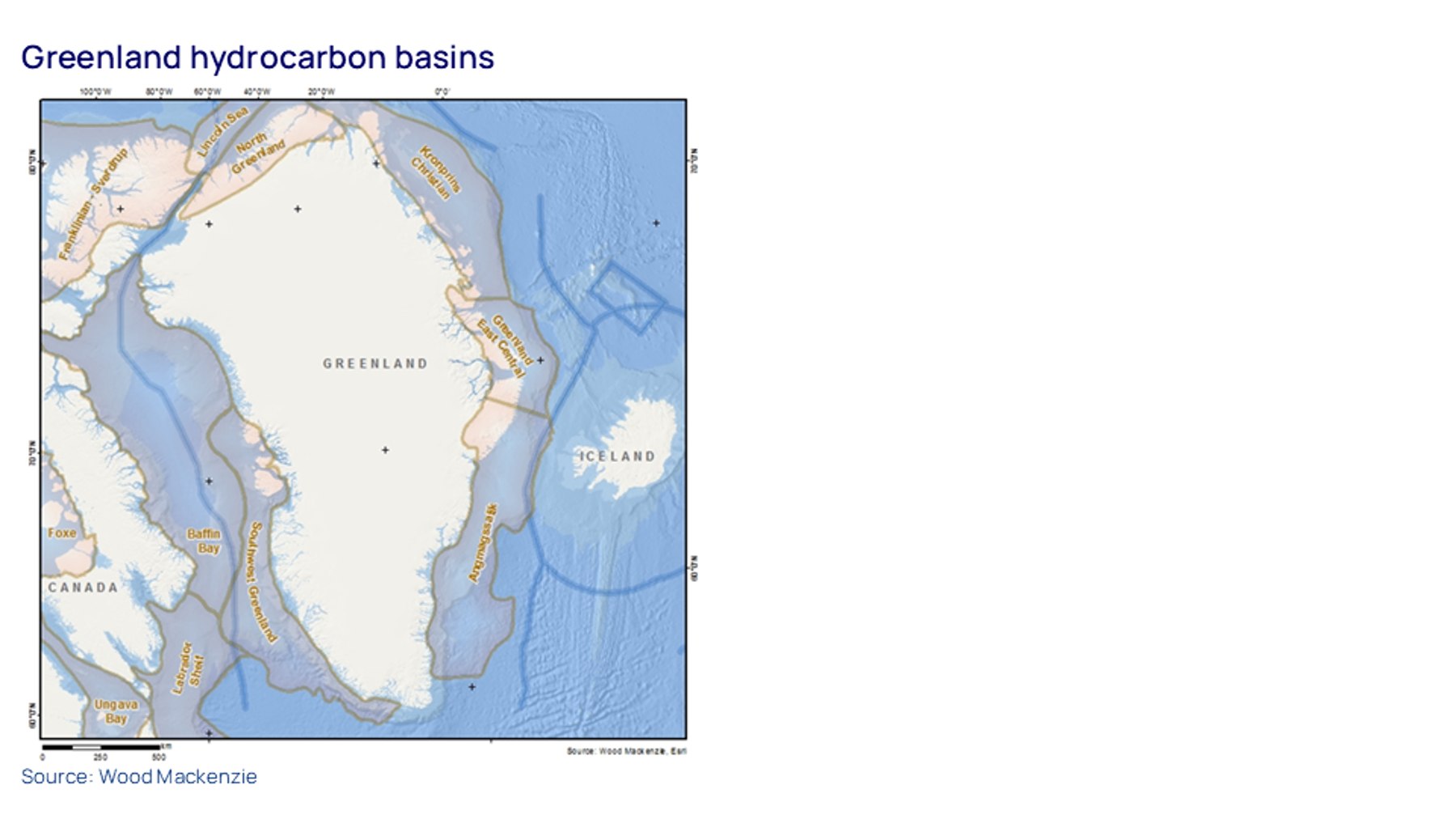
In contrast to Venezuela’s massive – though dilapidated – oil industry, Greenland’s hydrocarbon sector has barely scratched the surface. While the country has high subsurface potential and is an underexplored frontier area with appropriately attractive fiscal terms, its Arctic location poses extreme challenges for explorers. To date, just 25 exploration wells have been drilled, predominantly in Greenland’s Southwest basin. Each was unsuccessful. The most promising potential for oil and gas lies in the far less accessible offshore east. The US Geological Survey estimates around 31 billion boe of technically recoverable resources across eastern Greenland, though without any modern seismic data this appears highly optimistic.
The island’s remoteness, short summer drilling window and lack of infrastructure present technical and operational hurdles for both exploration and development. With a landmass roughly 25% that of the continental US, Greenland has fewer than 100 miles of paved roads. Most onshore exploration sites are accessible only by helicopter, significantly increasing costs and limiting equipment size. Offshore exploration would likely need powerful icebreakers – in short supply outside Russia – to clear paths for seismic surveys and drilling operations. Oil companies are at home in harsh environments, but Greenland is on another level.
Corporate appetite and activity have reflected the challenges. Majors including Shell, Eni, Equinor and ExxonMobil that previously held Greenland exploration acreage have all exited. Since 2021, Greenland’s government has banned new exploration licenses over environmental concerns, although licence extensions have been approved for its three existing licenses in the Jameson Land Basin, held by London-listed 80 Mile.
With the Trump administration’s fixation on Greenland, US companies’ appetite for investment could be tested, much like Venezuela but without the proven resource to exploit. In April 2025, US-based March GL entered into an agreement with 80 Mile to fund the costs of two exploration wells in the onshore Jameson Land Basin for a stake in any future project. Progress will be closely monitored.
Accessing Greenland’s critical minerals
Greenland’s mineral resources are vast, including deposits of iron ore, copper, graphite, zinc, gold and uranium. In addition, the Geological Survey of Denmark and Greenland identifies the Gardar alkaline province in southern Greenland as holding prolific rare earth elements (REE), along with lithium, tantalum, niobium and zirconium. It is these resources that have caught the attention of the Trump administration, with officials speaking publicly about Greenland’s REEs offering a solution to China’s dominance.
Here, ambition runs up against reality. Around 80% of the island is covered by the Greenland Ice Sheet, averaging a mile thick, meaning only limited work has been undertaken to quantify the true scale of Greenland’s deposits. Global mining companies might covet Greenland’s critical minerals, yet today there are only two operating mines across the entire country – the Nalunaq gold mine, operated by the TSX-listed Amaroq, and an anorthosite mine on Greenland’s west coast, operated by Lumina.
Environmental opposition and issues around co-location with uranium are also stalling REE development, while Greenland’s limited infrastructure and power supply don’t make mining any easier. Major mine development would also mean importing skilled workers on a large scale, problematic given Greenland’s desire to protect its indigenous communities and culture. Significant investment would also be required to separate REEs after mining, requiring large-scale use of reagents such as hydrochloric acid. Without domestic capacity, mined REE would need to be shipped overseas for processing, increasing costs and reducing competitiveness with China.
The US goal of opening alternative RRE supply chains to China is understandable, but given its harsh conditions and high costs, few miners are likely to put Greenland high on the list of options.
Could Greenland become the Arctic’s ‘power island’?
Untapped hydro power presents another resource opportunity in the longer term. More than 60 hydropower sites have been identified, with the government of Greenland estimating the country has 20,000 GWh of undeveloped hydro potential, though this is likely to be conservative as glacial meltwater increases. Aluminium smelters, Power-to-X projects and even data centres are among possible offtakers but commercial development faces Herculean challenges, not least dam construction and other infrastructure.
Greenland’s strategic location bests its natural resource opportunities
If Greenland offers limited immediate opportunities for energy and mineral development, its geostrategic and military importance is more obvious. This is in part due to its advantageous position relative to the Northwest Passage maritime routes connecting the Atlantic and Pacific oceans. Currently only navigable during a brief summer window, melting ice caps are opening these routes for longer periods, linking Asia and Europe with a distance 7,000 kilometres shorter than via the Panama Canal. Ship-tracking data shows an uptick in vessels completing the journey, at around 40 ships per year since 2022, double the average of the previous decade.
For all the hype around Greenland’s natural resources, it is its strategic High North location that holds the key to what happens next.

Make sure you get The Edge
Every week in The Edge, Simon Flowers curates unique insight into the hottest topics in the energy and natural resources world.