


Get in touch
-
Mark Thomtonmark.thomton@woodmac.com
+1 630 881 6885 -
Hla Myat Monhla.myatmon@woodmac.com
+65 8533 8860 -
Chris Bobachris.boba@woodmac.com
+44 7408 841129 -
Angélica Juárezangelica.juarez@woodmac.com
+5256 4171 1980
Eni and PETRONAS' Searah JV will reshape Southeast Asia's upstream landscape
4 minute read
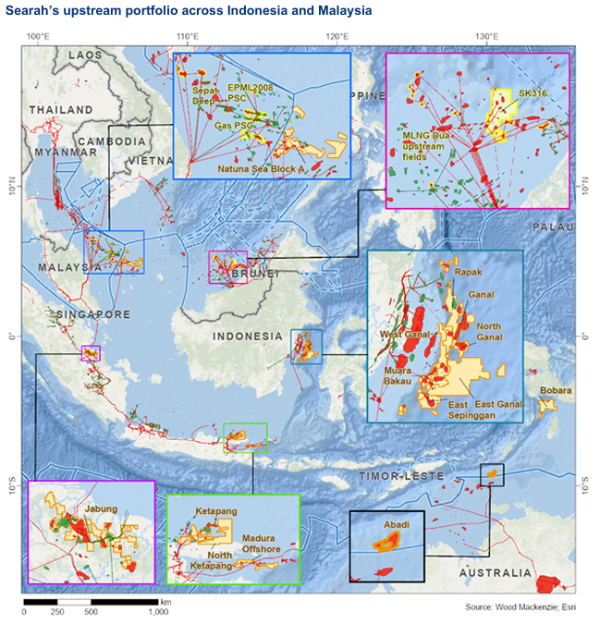
Eni and PETRONAS' launch of Searah, a new 50:50 strategic venture spanning 19 upstream assets across Indonesia and Malaysia, has the potential to reshape Southeast Asia's upstream sector, according to new analysis from Wood Mackenzie.
Producing more than 300,000 boe/d (barrels of oil equivalent per day) from day one, Searah is expected to exceed 500,000 boe/d (entitlement basis) by 2029, with longer-term production potential of over 800,000 boe/d. Wood Mackenzie's latest report, Searah: Eni and PETRONAS forge a new Southeast Asian major, concludes that the venture has the scale, capital and resource base to become one of the region's leading upstream operators.
“Searah's assets and capital are in place; the challenge is whether this newly formed operator can deliver multiple billion-dollar developments in parallel without losing schedule or cost discipline. That's going to be critical for its success as Southeast Asia's next major operator,” said Munish Kumar, PhD, senior research analyst for upstream at Wood Mackenzie.
Wood Mackenzie's modelling indicates Searah could become Southeast Asia's largest upstream producer by 2030, surpassing Pertamina, PETRONAS PTTEP, Shell and BP.
Beyond its initial investment programme, the venture's growth platform extends across the wider Kutei exploration portfolio, the Abadi LNG project and assets offshore Malaysia. Potential expansion into Vietnam, deepwater Sabah and the Andaman Sea could provide further upside.
Source: Wood Mackenzie Lens
Complementary portfolios, complementary strengths
The 50:50 ownership and the combined assets within the portfolio reflect the capabilities and strengths each partner contributes rather than an equal split of reserves or cash flow.
PETRONAS contributes near-term production, cash flow and established infrastructure in Malaysia, providing a stable financial base during the venture's early years. Eni brings its deepwater Kutei Basin gas portfolio in Indonesia, creating a pipeline of medium-term developments and exploration upside.
Together, Searah will supply gas to three LNG facilities including Bontang and the proposed Abadi LNG project in Indonesia, and MLNG in Malaysia, creating one of Southeast Asia's largest and most diversified equity LNG positions.
Scale supported by financial firepower
Searah plans to invest US$20 billion over the next five years, with capital expenditure peaking in 2027 as several major projects advance simultaneously. The venture launches on a foundation of producing assets in Malaysia and Indonesia that provide immediate borrowing capacity without reliance on parental funding. Monetisation of the Kutei discovered resources will drive annual cash flows above US$2 billion from 2030.
Eni's Kutei Basin portfolio contributes more than 12 trillion cubic feet of undeveloped gas across the Rapak, Ganal and North Ganal PSCs, Wood Mackenzie noted. The 2026 Geliga discovery, estimated at 5 tcf, adds approximately US$2 billion in value and underpins a third Kutei development hub.
Execution will define success
Wood Mackenzie identifies several factors that will determine whether Searah achieves its growth ambitions:
- Delivering the North, South and proposed Geliga development hubs while progressing Abadi towards FID.
- Managing capacity constraints at the ageing Bontang LNG complex as new Indonesian gas volumes come online.
- Executing multiple large offshore developments amid a tight global deepwater supply chain.
- Coordinating investment across Indonesian and Malaysian regulatory frameworks.
- Integrating Eni's exploration-led operating model with PETRONAS's established NOC operating approach.
A new chapter for the satellite model
Searah is the latest evolution of Eni's strategic venture model, following Vår Energi in Norway, Azule Energy in Angola and Ithaca Energy in the UK. It is Eni's first venture in Asia, its first with a national oil company partner, and its first built around an almost entirely growth-oriented portfolio.
Headquartered in London, Searah will operate as a standalone company with autonomy over investment decisions while receiving technical support through service agreements with Eni.
“Searah is the first real test of whether an IOC and an NOC can create a standalone regional champion by combining complementary portfolios rather than simply pooling assets. If it succeeds, it could establish a blueprint for how future upstream partnerships are structured across Asia,” said Farid Wajdi Mohamad Isa, senior research analyst for upstream at Wood Mackenzie.