



Get in touch
-
Mark Thomtonmark.thomton@woodmac.com
+1 630 881 6885 -
Hla Myat Monhla.myatmon@woodmac.com
+65 8533 8860 -
Chris Bobachris.boba@woodmac.com
+44 7408 841129 -
Angélica Juárezangelica.juarez@woodmac.com
+5256 4171 1980
India data centre capacity to reach 12 GW by 2030 as AI and digital economy drive infrastructure investment
New Wood Mackenzie research finds AI-dedicated capacity will increase nearly 24-fold by 2030, while electricity demand is projected to reach 191 TWh by 2040, making power strategy a key competitive differentiator for developers and investors
4 minute read
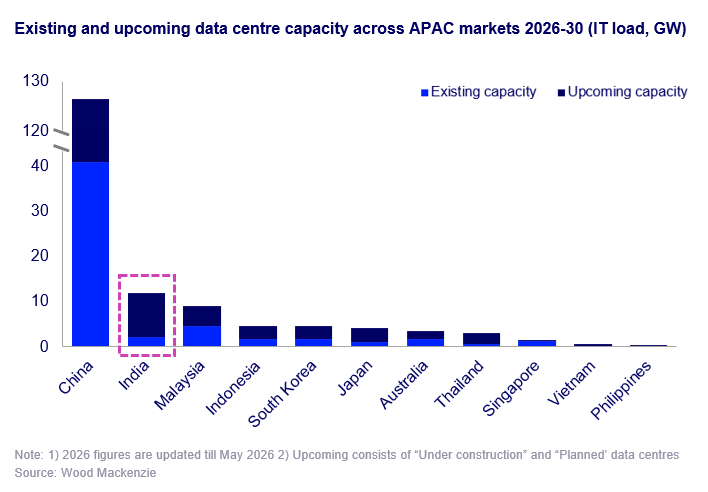
India's data centre market is entering a structural growth phase that positions the country as one of Asia-Pacific's most attractive infrastructure investment opportunities, according to Wood Mackenzie's latest report, India's Data Centre Landscape: Powering the Digital Economy.
The report forecasts India's operational data centre capacity will increase from 2.2 GW in 2025 to 12 GW by 2030, making a compound annual growth rate (CAGR) of approximately 40%. AI-dedicated capacity is expected to expand nearly 24-fold over the same period, rising from 275 MW to 6,546 MW, as hyperscale cloud providers, enterprise digitalisation and artificial intelligence accelerate demand for compute infrastructure.
“India's data centre market becomes a structural investment thesis,” said Souhardya Pal, Research Associate at Wood Mackenzie. “The convergence of hyperscale capital, AI workload growth and a decade of policy support have created the conditions for India to rival any market in Asia-Pacific. The question for developers and investors is no longer whether to enter India, but where and how.”
Digital economy accelerates infrastructure demand
India's expanding digital economy is underpinning unprecedented demand for data centre capacity. Valued at INR32 trillion in 2025 and contributing approximately 12% of GDP, the country's digital ecosystem serves more than 1.03 billion active internet users and processes around 22 billion UPI transactions each month. Meanwhile, India's domestic AI market is projected to reach INR11.7 trillion by 2032, further increasing demand for high-performance computing infrastructure.
According to Wood Mackenzie, data centre electricity demand is forecast to grow 20-fold by 2040 from 10 TWh in 2025 and would account for 7% of the total electricity demand.
The country’ six strategic hubs drive the next phase of growth
While Maharashtra and Tamil Nadu currently account for around 65% of installed IT load, Wood Mackenzie expects the next phase of investment to also expand across Andhra Pradesh, Telangana, Uttar Pradesh and Karnataka. These emerging markets are attracting significant commitments from global hyperscalers, including Amazon Web Services and Google, alongside domestic operators such as AdaniConnex, which has announced a development pipeline of 2.6GW.
The report features a detailed Hub Attractiveness Index that benchmarks India's data centre markets against a range of investment and operational criteria, including power economics, sustainability considerations, infrastructure ecosystem, and policy support. The findings offer stakeholders a data-driven perspective on the evolving landscape of data centre development in India.
Power strategy becomes a competitive differentiator
The report finds that reliable, cost-competitive power has become the defining factor in data centre development, overtaking land and capital as the industry's primary constraint.
Captive generation and long-term renewable power purchase agreements (PPAs) are becoming the preferred procurement strategies, enabling developers to reduce operating costs while supporting corporate decarbonisation goals. States with liberalised open-access frameworks and competitive intra-state transmission charges are positioning themselves as preferred hubs for new capacity, as power procurement strategy increasingly determines site selection
“Land and capital are no longer the limiting factors for data centre developers in India. What determines site selection and delivery timelines now is access to firm, round-the-clock power at the node level,” said Dr. Rashika Gupta, Vice President of Research at Wood Mackenzie. “Developers who secure their power strategy early through captive generation or long-term renewable PPAs, will lock in a structural cost and sustainability advantage for the life of their assets.”
Land and capital are no longer the limiting factors for data centre developers in India. What determines site selection and delivery timelines now is access to firm, round-the-clock power at the node level.
Water management emerges as a strategic risk
The report also identifies water availability as one of the sector's most underappreciated investment risks. As AI workloads increase rack densities and cooling requirements, water access is becoming an increasingly important site selection criterion, particularly in water-stressed markets such as Tamil Nadu and Karnataka.
Wood Mackenzie notes that developers adopting closed-loop cooling systems and zero liquid discharge technologies are already reducing freshwater consumption and positioning themselves ahead of potential future regulation.
Investment outlook
The report concludes that India's combination of strong digital demand, supportive policy, expanding renewable energy markets and accelerating AI adoption is creating one of the world's fastest-growing data centre markets. However, long-term success will increasingly depend on developers' ability to secure reliable power, manage water resources and select locations that balance growth potential with infrastructure resilience.