



Get in touch
-
Mark Thomtonmark.thomton@woodmac.com
+1 630 881 6885 -
Hla Myat Monhla.myatmon@woodmac.com
+65 8533 8860 -
Chris Bobachris.boba@woodmac.com
+44 7408 841129 -
Angélica Juárezangelica.juarez@woodmac.com
+5256 4171 1980
Malaysia's CRESS Acceleration Package improves project economics, but execution remains the critical test
New analysis finds revised grid access framework competitive against utility tariffs, but compressed 2028 deadline will separate market leaders from the rest
4 minute read
Malaysia’s Corporate Renewable Energy Supply Scheme (CRESS)’s revised grid access framework improves project bankability and keeps renewable procurement cost-effective against utility tariffs. But with a hard commissioning deadline of 31 December 2028 and no extensions on the table, Wood Mackenzie says the window for action is narrowing fast. For developers and offtakers without a credible execution plan, the revised economics are beside the point.
On 18 September 2026, the Ministry of Energy Transition and Water Transformation (PETRA) announced the CRESS Acceleration Package, reducing the System Access Charge (SAC) for developers from MYR200/MWh (US$49/MWh) to MYR140/MWh (US$34/MWh). While this initially appeared to be a straightforward cost reduction, the Energy Commission later clarified that green consumers must pay an additional MYR40/MWh (US$10/MWh) charge, which is subject to revision under future Regulatory Period tariff reviews. This brings the effective grid access charge to MYR180/MWh (US$44/MWh).
The fixed MYR140/MWh developer charge offers lenders and project sponsors predictable cash flow for the first ten years of operations. The variable MYR40/MWh consumer charge shifts tariff reset risk to offtakers during this period. As RP4 ends in December 2027, a ten-year agreement will cover multiple tariff review cycles. If future guidelines maintain the 15% cap on adjustments, the green consumer charge may rise by about MYR20–30/MWh (US$4.9–7.3/MWh) over the contract term.
"The most significant design feature is the revised structure’s reallocation of risk" said Alvin Tan, research analyst, Southeast Asia power and renewable at Wood Mackenzie. Now, developers gain ten years of cost certainty. Offtakers absorb the exposure to future tariff resets. Commercial discussions will increasingly focus on how that risk is shared.
Beyond the near-term window, Wood Mackenzie said that many Corporate Power Purchase Agreements (CPPAs) run for 15 to 21 years, extending well beyond the fixed-rate window. PETRA has not clarified how the SAC will be treated after year ten, and we expect developers and lenders to build post-year-ten cost assumptions into long-term return assessments regardless.
CRESS total delivered costs remain below High Voltage and Ultra High Voltage tariffs through 2038
CRESS total delivered costs remain competitive against utility tariffs. Comparing the SAC to conventional network charges alone is misleading, Tan warned. On this basis, Wood Mackenzie estimates CRESS procurement costs at US$95/MWh in 2026, making it competitive with both High Voltage (HV) and Ultra High Voltage (UHV) electricity tariffs. Despite periodic network tariff reviews, procurement costs are projected to increase by only around 8% through 2038, underscoring the role of renewable generation costs as the primary driver of CRESS competitiveness.
Comparison of UHV and HV ToU tariffs with estimated CRESS procurement costs in 2026, 2029 and 2038 (US$/MWh)
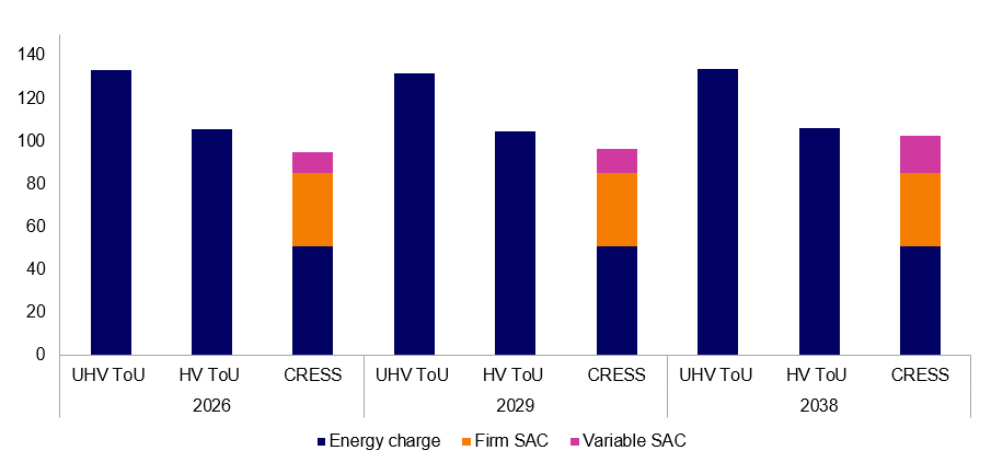
Source: Southeast Asia end-user tariff dataset 2026; Asia Pacific levelised cost of electricity (LCOE) 2026 Dataset. Estimated CRESS costs comprise the new-build LCOE, fixed SAC and variable SAC components, assuming the maximum permitted 15% increase at each RP review over the 10-year contract tenure. Energy charge outlook for UHV ToU and HV ToU are displayed in US$ real terms.
Project readiness will determine who benefits
Project readiness is emerging as the key constraint. Although 3,148 MW has been registered across 11 developers and eight buyers, the maturity of these projects remains unclear. With only 26 months until the 2028 COD deadline and utility-scale solar projects typically requiring 18-24 months from construction to commissioning, developers face a narrow window to secure permits, land, financing and grid access.
This structural difference is compounded by competition: CRESS developers must identify grid injection points and cover network reinforcement costs. Competition with the Large Scale Solar (LSS) programme for land and transmission capacity further increases this pressure, Wood Mackenzie noted.
“The lower SAC improves project economics, but it does not create additional land or transmission capacity,” said Tan. “Developers with secured sites and a clear path to grid connection are best positioned to deliver. For offtakers, delaying procurement is not a neutral decision. The most advanced projects will be secured quickly, and negotiating leverage will follow.”