





Get in touch
-
Mark Thomtonmark.thomton@woodmac.com
+1 630 881 6885 -
Hla Myat Monhla.myatmon@woodmac.com
+65 8533 8860 -
Chris Bobachris.boba@woodmac.com
+44 7408 841129 -
Angélica Juárezangelica.juarez@woodmac.com
+5256 4171 1980
Middle East conflict extension cuts global Q4 2026 crude run forecast by 1.4 million b/d
Post-conflict era forces Asian refiners to focus on their competitiveness; deep chemical integration and energy efficiency the keys to surviving peak demand and a new world order
5 minute read
Extending the Middle East conflict to year end cuts global crude runs by an estimated 1.4 million barrels per day (b/d) in Q4 2026, led by Asia, according to new analysis presented by Wood Mackenzie at its Asian Oil, Refining and Chemical Markets briefing today.
During the briefing, Wood Mackenzie noted that the disruption has sent shockwaves through Asian refining, fundamentally altering crude supply routes, product market dynamics and the long-term competitive landscape for the region's refiners. Persistent Ukrainian drone attacks on Russian refineries have compounded the disruption, with unit outages at 3.5 million b/d in August, tightening the global refining system further.
"The scale of disruption to global crude runs is without modern precedent," said Alan Gelder, SVP refining, chemicals and oil markets research at Wood Mackenzie. "While Asian refiners are navigating an immediate margin opportunity, the more important question is how they choose to respond."
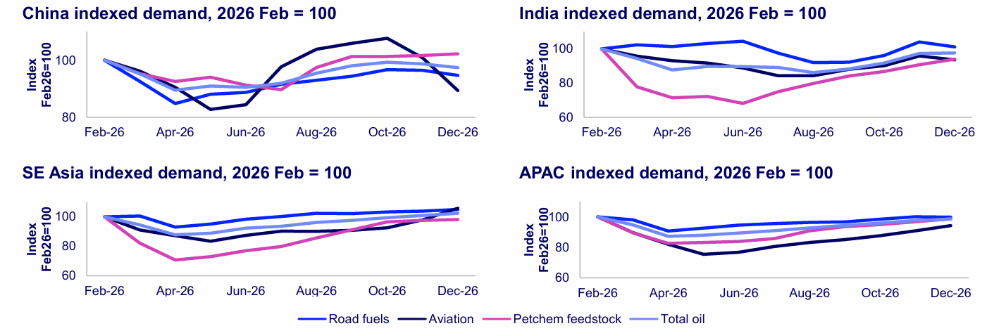
Source: Wood Mackenzie
Note: Road fuels includes gasoline and diesel, Aviation includes jet/kerosene and Petchem feedstock includes LPG and naphtha. SE Asia includes Indonesia, Malaysia, Philippines, Singapore and Thailand
Margins: elevated for now, a $50/bbl world ahead
The Middle East and Russia/Ukraine conflicts have limited crude runs, driving refining margins to elevated levels across the region, with US and European refiners deferring scheduled maintenance into 2027, Wood Mackenzie noted. Diesel markets remain strong due to Russian export constraints, continued inventory reductions, and increased winter heating demand. Gasoline prices are likely to decline seasonally, but limited supply in the Atlantic Basin should support margins through the end of the year.
Asian refining margins are expected to ease once flows through the Strait of Hormuz (SoH) resume. As non-OPEC production growth is set to exceed global demand growth in 2027 and 2028, Wood Mackenzie forecasts Dated Brent will decline to the $50–60 per barrel range when transits are fully restored.
"Refiners must treat today’s windfall as a down payment on transformation," said Gelder. "A lower oil price environment combined with approaching peak oil demand will quickly expose the gap between competitive and uncompetitive assets."
Demand: scarred and slow to recover
The SoH disruption has significantly changed Asia's oil demand trajectory. Asia Pacific oil demand is not expected to return to pre-conflict levels until late 2027, after a projected 1.24 million b/d decline in 2026, according to Wood Mackenzie. Petrochemical feedstocks, especially LPG and naphtha in markets reliant on SoH transit flows, have been most affected, while road fuels have remained more resilient. India is leading the regional recovery, surpassing pre-conflict demand levels first, with Southeast Asia following. China's oil demand likely peaked before the conflict began.
Crude supply: recovering, but Asia's import dependency rising to 82%
Middle East crude production is recovering, supported by shuttle transits and ship-to-ship transfers that have made the current blockade less effective. In China, commercial inventories indicate a drawdown of strategic stocks, and the pace of China’s inventory rebuilding remains a key uncertainty for price forecasts. Wood Mackenzie highlighted that Asia’s crude import dependency is expected to reach 82%, with an additional 1.5 million b/d of imports by 2030. This will shift the supply mix toward long-haul barrels from the US and Latin America, while the Middle East’s share of Asian crude imports is projected to decline from over 65% today.
"The conflict has accelerated the structural diversification of Asia’s crude supply base," said Sushant Gupta, director, oils and refining research at Wood Mackenzie. "Refiners that can optimise across a wider crude slate particularly grades with higher middle-distillate yields will be best positioned to capture value in this evolving environment."
Refinery competitiveness: deep integration and energy efficiency are the decisive levers
As peak oil demand nears and prices decline, Wood Mackenzie's Refinery Evaluation Model highlights deep chemical integration as the primary margin driver for Asian refiners. Second-generation integrated sites with chemical yields above 40% achieve much higher net cash margins than first-generation sites. By 2035, nearly 80% of top-performing refineries are expected to be Chinese assets with extensive chemical integration. Partial integration is not sufficient for first quartile competitiveness.
Currently, about 55% of refineries exceed the global benchmark for energy intensity, indicating considerable potential for improvement. The least competitive refineries also tend to have higher energy intensity, making efficiency investments essential for both margin improvement and sustainability.
"Looking ahead to our 2035 outlook, refiners need to ask hard questions about where their assets sit on the competitiveness curve," said Gelder. "Global peers are actively reshaping portfolios. For many refiners, import substitution and margin competitiveness are the same investment decision."
Notes to editors
Wood Mackenzie's Asian Oil, Refining and Chemical Markets Briefing was presented 8 September 2026 by Alan Gelder (SVP Refining, Chemicals and Oil Markets Research), Sushant Gupta (Director, Oils and Refining Research), Jim Mitchell (SME, Trading Analytics) and Kendrick Ng (Senior Research Analyst, Oils and Chemicals). Analysis draws on Wood Mackenzie's Refinery Evaluation Model (REM-Chems), PetroPlan, Product Markets Service Short Term, Crude Trade Service and VesselTracker. Real-time refinery monitoring coverage is expanding across Asia Pacific, with Malaysia, Indonesia and Thailand to be added by end-2026. All forecasts are subject to Wood Mackenzie's standard disclaimer.