





Get in touch
-
Mark Thomtonmark.thomton@woodmac.com
+1 630 881 6885 -
Hla Myat Monhla.myatmon@woodmac.com
+65 8533 8860 -
Chris Bobachris.boba@woodmac.com
+44 7408 841129 -
Angélica Juárezangelica.juarez@woodmac.com
+5256 4171 1980
New gas power policy of China’s Guangdong province drives structural shift from baseload to peak-only dispatch, resulting in reduced running hours
3 minute read
A major shift in Guangdong's gas power dispatch policy is changing the role of gas-fired generation. Fleets are moving from baseload to mostly peak-only operations, which may reduce long-term gas demand growth in the power sector, according to new analysis by Wood Mackenzie. Kai Dong, Principal Analyst for Asia Pacific Gas and LNG, presented these findings at Gastech 2026, highlighting the "Guangdong Model" as a guide for how China's largest gas power market is adapting to a high-renewable grid.
Guangdong accounts for 10% of China's GDP and around one-third of the country's total gas power capacity. In 2025, Guangdong consumed 41 bcm of gas and had LNG demand of 18 Mt, representing 10% and 28% of the national totals, respectively. Wood Mackenzie noted that this makes Guangdong a key indicator of the direction of China's gas and LNG market.
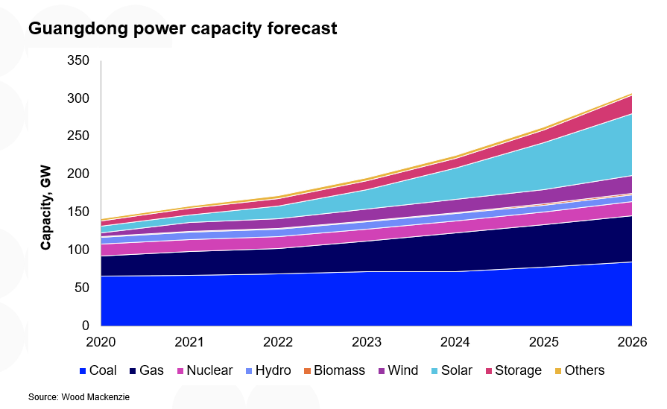
" Between 2020 and 2026, gas-fired capacity more than doubled in the province while renewable capacity grew almost eightfold. Guangdong's experience tells us that gas power fleets can successfully reposition themselves in the grid of increasing renewables," said Kai Dong, principal analyst, Asia Pacific gas & LNG at Wood Mackenzie. " With China’s other provinces following similar framework, the key question for the global LNG market is how much less demand growth this could mean than previously anticipated."
Renewables surge forces gas into a new role
Solar and wind capacity in Guangdong increased from 14 GW to 105 GW between 2020 and 2026, driving demand for flexible, dispatchable generation to balance intermittent output. Gas power capacity more than doubled in response, rising from 27 GW to 61 GW over the same period. Coal and nuclear grew more slowly, supporting baseload demand.
Growth in intermittent capacity has strengthened gas's role increasingly serving as a system regulator. The new policy framework now formalises this distinction.
New policy: from guaranteed hours to pure economic dispatch
Guangdong’s July 2025 gas power policy reform marks a significant shift from the previous model. Gas plants previously operated with guaranteed dispatch hours, an approved on-grid tariff, and additional subsidy when system-wide weighted average cost of gas (WACOG) is beyond certain level. The new policy introduces pure economic dispatch, requiring plants to bid to recover fuel costs..
In exchange, capacity payments have increased significantly, now covering full capital expenditure instead of only partial recovery. The policy compensates plants for availability rather than generation, reinforcing the shift to peaking roles.
Coal-to-gas switching: viable only below $6/mmbtu
Guangdong's power sector could see higher gas demand, but it depends on market conditions. Wood Mackenzie’s analysis indicates that, after accounting for taxes, regasification, and pipeline tariffs, spot LNG prices must fall to about US$6/mmbtu before efficient gas power fleets can economically replace subcritical coal plants based on a US$95/ton coal price. Until then, most fleets are likely to remain primarily in peaking roles., restricting their impact on total power gas demand.
National replication creates a structural downside for gas demand
These implications reach beyond Guangdong. Wood Mackenzie forecasts that shifting to peak-only dispatch will slow the growth of China’s power gas demand compared to maintaining baseload operations.
"Gas-fired power capacity in China will continue to grow to support grid stability in a high-renewable system," said Dong. " The policy shift means plants will run fewer hours, and that distinction matters enormously for China’s gas market."