



Get in touch
-
Mark Thomtonmark.thomton@woodmac.com
+1 630 881 6885 -
Hla Myat Monhla.myatmon@woodmac.com
+65 8533 8860 -
Chris Bobachris.boba@woodmac.com
+44 7408 841129 -
Angélica Juárezangelica.juarez@woodmac.com
+5256 4171 1980
Wood Mackenzie Mid-Year Outlook: oil and gas industry cash-rich but capital-cautious as nearly half a trillion-dollar windfall fails to trigger a spending surge
4 minute read
Wood Mackenzie's mid-year upstream and corporate outlook finds the global upstream sector could accumulate a cash windfall of US$495 billion this year, assuming Brent prices average US$90 per barrel, more than double cash flow expectations based on initial planning assumptions of around US$60 per barrel.
The 49 largest IOCs and NOCs in Wood Mackenzie's corporate coverage net US$272 billion of this, which is equivalent to 70% of their combined investment for the year. Yet to date, investment budgets remain flat and the windfall has not triggered a surge in buybacks.
The oil and gas industry came into 2026 bracing for a difficult year. What it got was a price surge, an unplanned cash windfall, and a set of strategic pressures that, if anything, have grown more urgent.
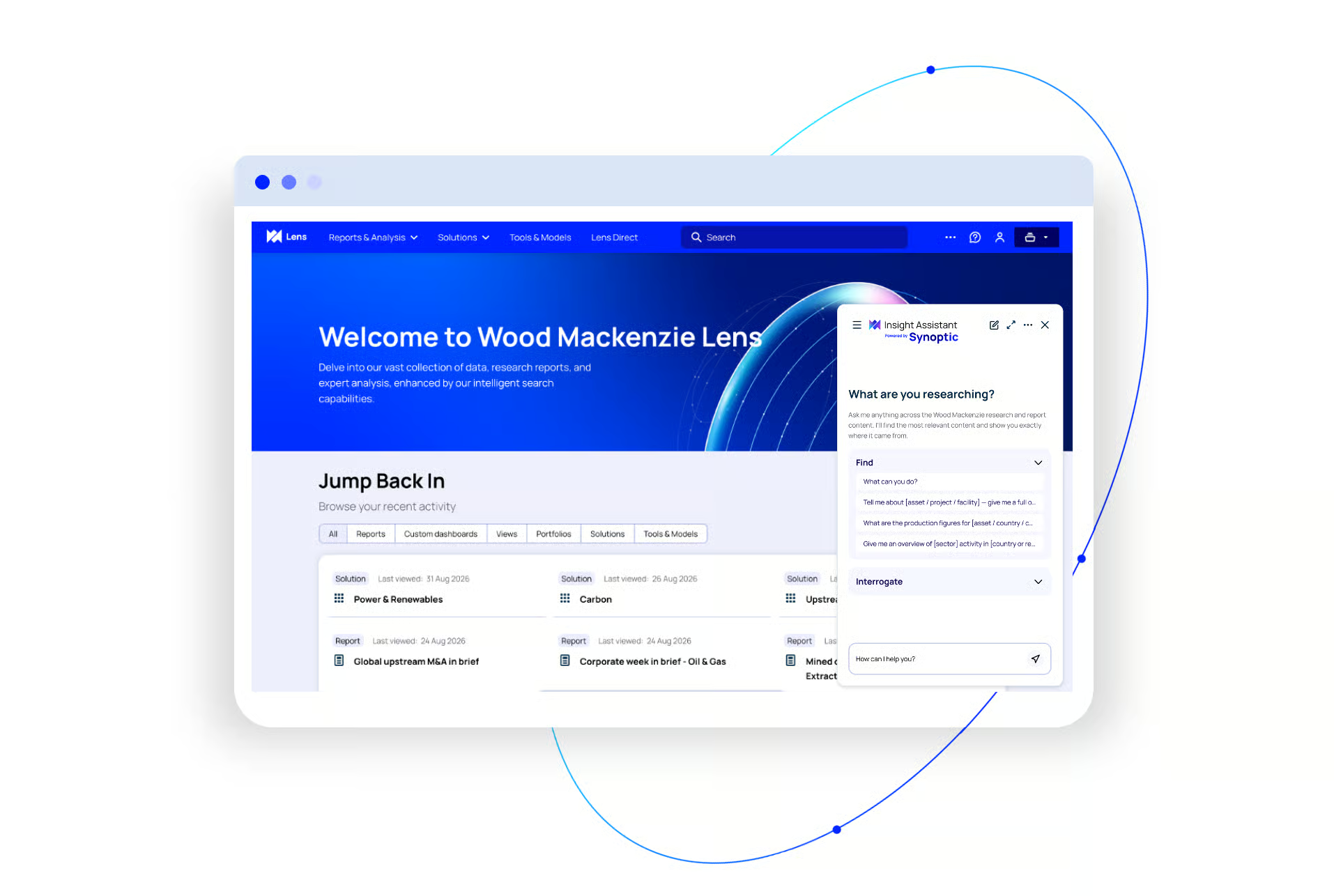
Drawing on its Lens Upstream platform and Corporate Strategy and Analytics Service, Wood Mackenzie's mid-year outlook covers 49 of the world's largest IOCs and NOCs, assessing how the year is tracking against forecasts set at the start of 2026.
Companies entered the year expecting Brent crude to average around US$60 per barrel. With dated Brent prices averaging US$91 per barrel through H1, capital budgets have barely moved. Companies have broadly maintained their original shareholder return frameworks against a backdrop of increasing equity values. Wood Mackenzie forecasts buybacks for the peer group will be down around 5% year-on-year in 2026, based on announced plans ahead of the Q2 reporting season.
“What is perhaps most telling about the corporate response to the turbulent macro forces impacting the oil and gas sector is just how little changed. Most players have adopted a wait-and-see approach to the market turmoil, preferring to accumulate cash on the balance sheet rather than return it to shareholders or increase investment. Capital discipline has proved more durable than either the bears or bulls expected.” said Tom Ellacott, Senior Vice President, Corporate Research at Wood Mackenzie.
"High prices ease the financial pressure. They do not solve the next-decade production challenge. The second half of 2026 will show whether the strategic response catches up with the financial firepower."
Key Findings
- The next-decade production challenge is immense. 155 companies tracked by Wood Mackenzie face an average 30% production decline between 2030 and 2040, equivalent to 32 million boe per day (excluding Middle Eastern NOCs). Over 70 face declines of 50% or more out to 2040.
- Capex discipline is holding, but corporate resolve could be tested. Global upstream development spend is on course for a second consecutive year of slight decline. Operators have prioritised maintenance deferral, optimisation and low-capital activities over new major commitments to capture near-term upside.
- The cash is staying on the balance sheet. Most of the peer group has accumulated rather than deployed its windfall, with elevated prices accelerating deleveraging for more leveraged operators.
- M&A has defied expectations. Despite price volatility, H1 deal spend reached its highest total in two years. Shell's US$16 billion acquisition of ARC, Devon's US$25 billion merger with Coterra and Mitsubishi's US$7.5 billion acquisition of Aethon were among the defining transactions.
- The global supply picture has deteriorated sharply. Oil output is expected to be down at least 3% in 2026, against a forecast increase of similar magnitude. Though given the ongoing conflicts, these estimates remain tentative. In the Middle East, Iraq has been hardest hit, with up to around 3 million barrels per day offline. Global LNG supply will be down at least 2%, against an earlier forecast rise of 8%, with Qatar taking the hit.
- The Middle East remains critical for portfolio renewal. Despite near-term disruption, no region matches it for scale and cost advantage. Wood Mackenzie expects it to remain central to the longer-term plans of the world's largest operators.
"This is not a natural commodity cycle,” said Fraser McKay, Head of Upstream Analysis at Wood Mackenzie. “The price surge reflects geopolitical conflict, not underlying demand, and companies are well aware of it. Balance sheets are stronger than they have been in years, but the instinct is to preserve that resilience and position for the future rather than spend now. If prices hold through H2, the pressure to deploy capital via buybacks, M&A or new investment will intensify. How boards navigate that tension will shape the industry's strategic direction into 2027."