





Get in touch
-
Mark Thomtonmark.thomton@woodmac.com
+1 630 881 6885 -
Hla Myat Monhla.myatmon@woodmac.com
+65 8533 8860 -
Chris Bobachris.boba@woodmac.com
+44 7408 841129 -
Angélica Juárezangelica.juarez@woodmac.com
+5256 4171 1980
Vaca Muerta requires US$22 billion and 1,000 new wells to meet export targets
Major investment required by 2032 as M&A reshapes basin ownership
1 minute read
Vaca Muerta operators will need to deploy an estimated US$22 billion in additional capital expenditure by 2032 to meet planned export capacity targets. The operators must also drill approximately 1,000 more wells, according to Wood Mackenzie's report “A new chapter for Vaca Muerta.”
The infrastructure challenge comes as the play’s assets undergo dramatic ownership changes, with 18 major transactions in the last two years reshaping the competitive landscape. International majors have monetised legacy positions amid improved valuations, while domestic players increasingly dominate Argentina's most valuable unconventional resources.

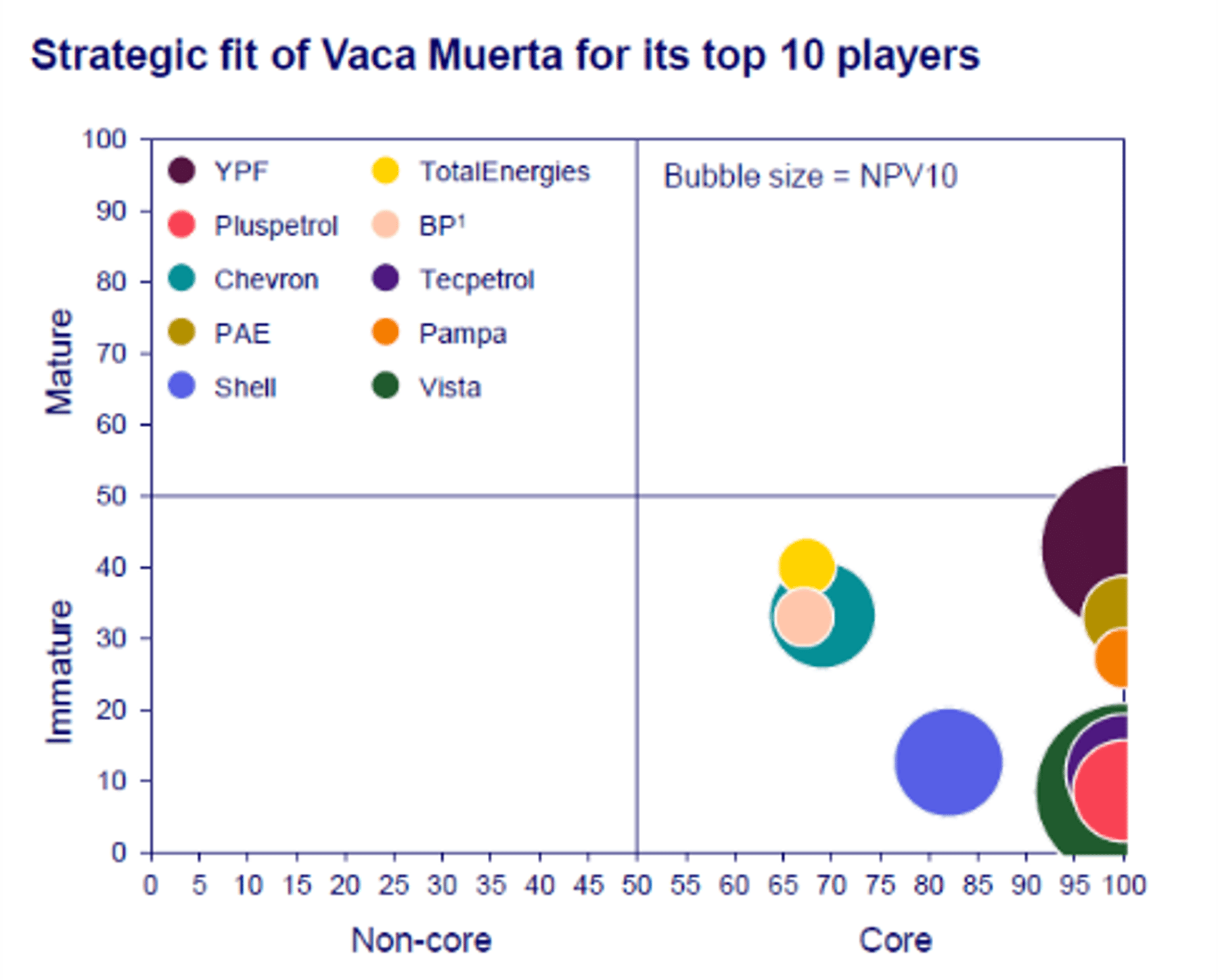
Major deals include ExxonMobil's exit through asset sales to Pluspetrol and YPF, and Shell's withdrawal from Argentina Liquefied Natural Gas (LNG) Phase 2. “These moves reflect international operators' strategic realignment as they prioritise capital allocation toward core assets. Meanwhile, domestic players capitalise on their operational expertise and market knowledge,” said Maria Eugênia Ditzel, Senior Corporate Analyst at Wood Mackenzie.
Domestic consolidation accelerates as international participation becomes strategic
Argentina's energy landscape now reflects strong domestic control. YPF leads as the country's dominant Exploration & Production (E&P) company while Vista emerges as a leading pure-play consolidator. Tecpetrol maintains its position as the second-largest gas producer while keeping M&A and LNG optionality open. Pampa is diversifying into oil while investing in LNG infrastructure, and Pluspetrol actively rebalances its portfolio following major acquisitions.
International participation remains selective but strategic. Continental entered Vaca Muerta via acquisitions in 2025-26, leveraging its private ownership, balance-sheet flexibility, and deep unconventional expertise. Meanwhile, Eni and ADNOC have partnered with YPF in Argentina LNG, representing a pivotal step towards monetising long-term gas resources with first LNG expected in H2 2026.
Argentina's regulatory framework, particularly the investment incentive scheme (RIGI), has become crucial for attracting international capital. The regime offers corporate tax stability and import duty exemptions for qualifying projects. This makes it essential for large-scale international investment decisions.
“Broader participation from US shale-focused E&P companies will depend on several factors,” said Ditzel. "These include sustained fiscal and regulatory stability, demonstrated success under the RIGI framework, completion of key infrastructure, and policy continuity beyond the current administration”.