



Find out how our Consulting team can help you and your organisation
Strait of Hormuz blockade bites global chemicals sector
Millions of tonnes of chemical feedstocks stranded as petrochemical and polymer prices spike—how force majeure declarations and supply disruptions are accelerating long-term feedstock diversification
4 minute read

Lee Andrew Fagg
Vice President for Chemicals Consulting

Lee Andrew Fagg
Vice President for Chemicals Consulting
Latest articles by Lee Andrew
-
Opinion
Strait of Hormuz blockade bites global chemicals sector
-
Opinion
Petrochemicals in peril: oversupply crisis and energy transition threaten industry survival
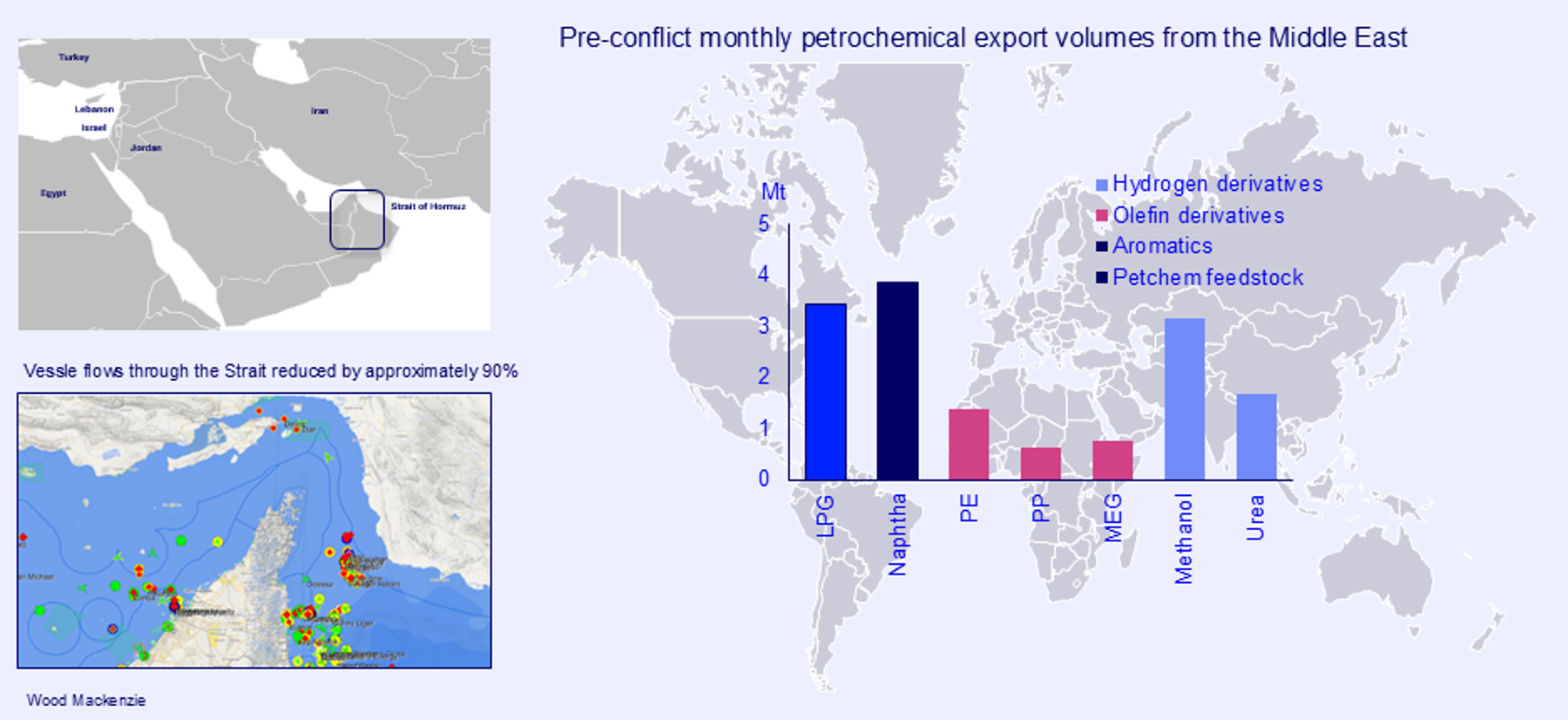
Restricted vessel movements through the Strait of Hormuz continue to disrupt the entire energy value chain. This vital shipping route for oil and gas is also a critical trade artery for global chemicals, fertilisers, and polymers. In line with other energy-linked commodities, petrochemical prices are spiking as feedstock supply restrictions force many producers to halt production and declare force majeure. Prior to the flare-up, the Strait handled around 138 vessels per day; that figure has now collapsed to fewer than 10 transits. For the global chemicals sector, a one-month disruption alone is estimated to have stalled exports of roughly seven million tonnes of cracker feedstocks, two million tonnes of plastics, and four million tonnes of gas-based products such as methanol, ammonia, and urea. These are unprecedented times and arguably the most disruptive event for a petrochemicals sector already navigating one of the worst downturns in its history. Condition critical.

Shock upon shock for a depressed industry
The blockade hits at a moment when chemical producers can least afford it. The sector has spent the past two years in a deep cyclical depression—driven by chronic oversupply, slow demand recovery, and higher energy costs. Operators in Asia and Europe have been running at near and below breakeven economics. Before this crisis, the industry was hoping for gradual stabilisation through 2026. Instead, the collapse in Middle East feedstock logistics has jolted global trade flows overnight.
Benchmark olefins and polyolefins prices surged over 30% within days, following similar spikes in naphtha and LPG. Producers in Asia and Europe who rely heavily on Middle Eastern imports for cracker feed are facing immediate production curtailments. In some cases, plants that had barely restarted after extended maintenance periods during the downturn are again being idled. The situation is further worsening container freight availability, as operators divert vessels around the Cape of Good Hope or seek alternative sourcing from the United States.
Force majeures spread as supply chains fracture
Several producers in Saudi Arabia, Qatar, and the UAE have reportedly declared force majeure on contracted deliveries of ethylene glycol, polyethylene, and methanol. Even integrated petrochemical hubs, such as Singapore and South Korea, are feeling the pressure: feedstock shortfalls are tightening local balances and stretching inventories of basic chemicals. Markets for fertilisers, particularly ammonia and urea, are similarly exposed, aggravating worries around global food-cost inflation.
For consumers and downstream manufacturers—automotive, packaging, construction—the immediate concern is price volatility and uncertainty of supply. However, for chemical producers themselves, the shock may carry longer-term strategic implications.
A painful acceleration of structural change
Crises of this kind often act as catalysts for deferred restructuring. When COVID-19 paralysed global demand in 2020, many companies opted to bring forward permanent plant closures, especially older refinery and chemicals facilities in Europe, USA and North Asia. They realised that short-term recovery was unlikely and used the disruption to "clean house." The current Hormuz blockade, though very different in nature, could play a similar role in further restructuring in global petrochemicals.
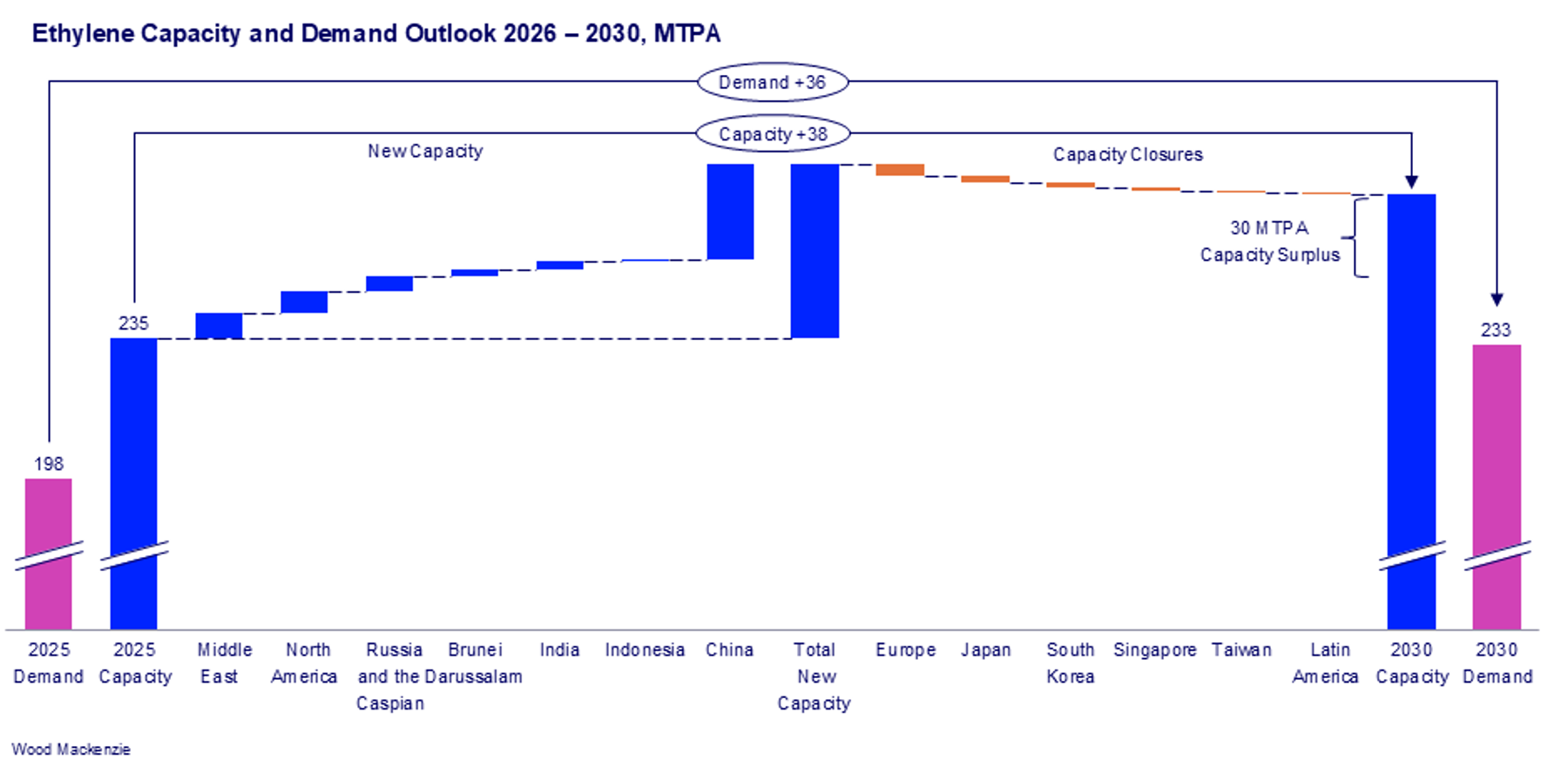
Some producers—especially those with high-cost assets depending on imported Middle Eastern naphtha or LPG—may treat this as the final signal to exit. Plants that have been struggling for cashflow since 2022 may simply not restart if feedstock supply or logistics don't normalise quickly. In this sense, the blockade may compress years of supply rationalisation into months, hastening an inevitable rebalancing of global production capacity.

Long-term realignment: towards diversified feedstocks
Beyond the near-term chaos, one likely outcome is a more geographically diversified chemical supply base. The crisis underscores the vulnerability of feedstock supply chains dependent on Middle Eastern exports. For many players, this reinforces the case for shifting to U.S.-sourced ethane and LPG, where shale-linked feedstock offers both cost and security advantages. Several Asian and European players were already re-evaluating long-term contracts with U.S. exporters; those discussions will now gain new urgency.
At the same time, governments and companies will reassess alternative domestic pathways. China, already the global leader in coal-to-chemicals, will double down on that route to insulate itself from maritime chokepoint risks. Analysts expect a fresh wave of investment in methanol to olefins (MTO) and coal-based ammonia projects, particularly in Inner Mongolia and Shaanxi. India and Indonesia, too, are likely to revisit shelved coal-to-chemicals proposals, which could now appear strategically prudent even if environmentally contentious.
Short-term pain, long-term gain?
In the near term, the industry faces acute stress: production losses, margin compression, and unpredictable logistics. Yet paradoxically, such pain may lay the groundwork for a healthier market balance later. A prolonged disruption could remove surplus capacity and push marginal producers out, thereby tightening supply just as demand begins to recover towards the end of the decade. This would mirror the post-COVID pattern, when capacity rationalisation and demand normalisation together restored profitability in several segments by 2022.
Moreover, the event acts as a wakeup call for global supply chain resilience. Chemical producers, traders, and policymakers will likely accelerate diversification strategies—through multi-feedstock flexibility, regional integration, and increased storage and redundancy along critical routes. Over time, these moves should help smooth volatility and reduce systemic dependency on any single geopolitical flashpoint.
Outlook: reshaping global chemicals for the next cycle
For now, the numbers remain grim: trade analytics show throughput volumes through Hormuz down more than 90%, with spot freight rates and insurance premiums spiralling. Inventories across Asia are being drawn down at unsustainable rates. But when the blockade eventually eases, a structurally leaner, more efficient chemical industry may emerge—one better aligned with demand realities and less dependent on the Middle East.
"Condition critical," as noted at the outset, is not just a statement of current distress—it may also mark the start of a necessary transformation. Every major downturn in the past three decades has reset the chemical industry's structure. The Strait of Hormuz blockade could prove no different, serving as the shock that finally restores balance to a market long trapped in oversupply.
The immediate challenge for investors, traders, and producers is navigating today's volatility and supply chain disruptions. But beyond the crisis lies an opportunity: those who can anticipate and adapt to the structural shifts reshaping global petrochemicals will emerge better positioned for the decade ahead.
Explore strategic insights into Energy & Chemicals
This analysis was brought to you by our Energy & Chemicals Consulting team. Fill out the form at the top of the page to get in touch with our specialists to understand how these critical shifts may impact your business and strategy.
Discover Wood Mackenzie Chemicals: Oils & Chemicals — an integrated view across the full oils and chemicals value chain to make data-driven decisions.