



Get in touch
-
Mark Thomtonmark.thomton@woodmac.com
+1 630 881 6885 -
Hla Myat Monhla.myatmon@woodmac.com
+65 8533 8860 -
Chris Bobachris.boba@woodmac.com
+44 7408 841129 -
Angélica Juárezangelica.juarez@woodmac.com
+5256 4171 1980
Australia's power market shows resilience amid Iran crisis as renewable energy transition delivers energy security dividend
Wholesale electricity prices remain stable despite 60% surge in oil prices and doubling of gas prices, marking stark contrast to 2022 volatility
3 minute read
Australia’s electricity sector is showing significantly greater resilience to global energy shocks compared to the 2022 crisis, despite escalating geopolitical tensions in Iran driving sharp increases in global fuel prices, according to Wood Mackenzie.
Despite oil prices surging more than 60% and Asian spot gas prices doubling compared to last year, Australian wholesale electricity prices have remained relatively subdued at around AUD $70/MWh in Q1-Q2 2026. This represents a stark contrast to the 2022 Russia-Ukraine crisis, when similar global fuel price shocks drove National Electricity Market (NEM) wholesale prices up by around 200% to average above AUD $250/MWh.
“The divergence reflects a structural shift in Australia’s power system. Growth in renewables and batteries, reduced reliance on gas-fired generation, and the rise of distributed energy resources are materially lowering exposure to international fossil fuel markets,” said Natalie Thompson, senior research analyst, energy storage and solar at Wood Mackenzie. “Australia’s energy transition is now delivering tangible energy security benefits alongside emissions reductions. While vulnerabilities remain to particularly from extreme weather events and supply-demand imbalances, the country's power sector is steadily decoupling from global fossil fuel market volatility.”
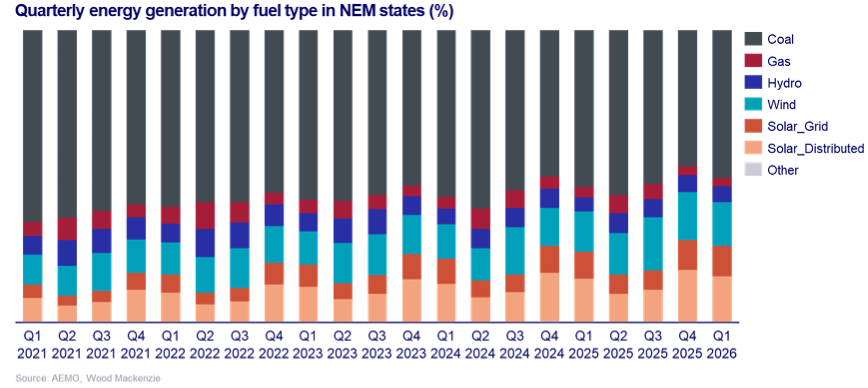
Battery storage has emerged as a critical factor in this transformation, Wood Mackenzie noted. Batteries' share of price-setting has risen from around 2% in early 2022 to roughly 20% by late 2025, while gas has decreased from 10% to less than 5%. Battery output tripled in Q4 2025 compared to Q4 2024, whilst gas generation declined almost 30% year-on-year during the same period, according to the report.
The December quarter of 2025 saw renewable energy reach record penetration levels across the NEM. Midday solar oversupply now routinely drives wholesale prices to near-zero and, in some states, into negative territory, enabling battery systems to charge at minimal cost and discharge during evening peaks to replace traditional gas-fired generation.
Wood Mackenzie's analysis highlights that Australia's distributed solar revolution has reached material scale, with more than 4.3 million rooftop solar systems installed nationally. Combined residential solar capacity now exceeds the total capacity of existing coal-fired power plants, reducing grid demand during the middle of the day and contributing to enhance the country’s ‘energy sovereignty.’
The current fuel crisis may also accelerate transport electrification. March 2026 sales figures show battery electric vehicles capturing over 14% of new car sales, with total electric vehicle share exceeding 20%, double the figures recorded in March 2025.
However, residual vulnerabilities remain. "Dark doldrums," or extended periods with little sun or wind, still require dispatchable backup generation currently dominated by gas-fired plants. “Today’s batteries are highly effective for short-duration storage, but they cannot sustain the system through multi-day low renewable periods,” Thompson said. “Longer-duration storage solutions, such as pumped hydro and extended-duration batteries, will be critical to ensuring reliability.”
Thompson adds: "The key question now is whether Australia can maintain the momentum of renewable and storage deployment to address remaining vulnerabilities before scheduled coal plant closures, to ensure the energy security dividend can be sustained."
Wood Mackenzie notes that addressing these challenges requires coordinated rollout of generation, storage, and network infrastructure investments, including longer duration storage technologies such as 8-hour-plus batteries and pumped hydro to provide extended firming capacity during unfavorable weather patterns.