


Get in touch
-
Mark Thomtonmark.thomton@woodmac.com
+1 630 881 6885 -
Hla Myat Monhla.myatmon@woodmac.com
+65 8533 8860 -
Chris Bobachris.boba@woodmac.com
+44 7408 841129 -
Angélica Juárezangelica.juarez@woodmac.com
+5256 4171 1980
China sets to control 39% of global lithium extraction by 2030
New Wood Mackenzie analysis finds Africa’s lithium production is surging, but ownership remains concentrated in China
3 minute read
Chinese companies are on course to control 39% of all lithium extracted globally by 2030, up from approximately one third in 2020, according to new analysis published by Wood Mackenzie.
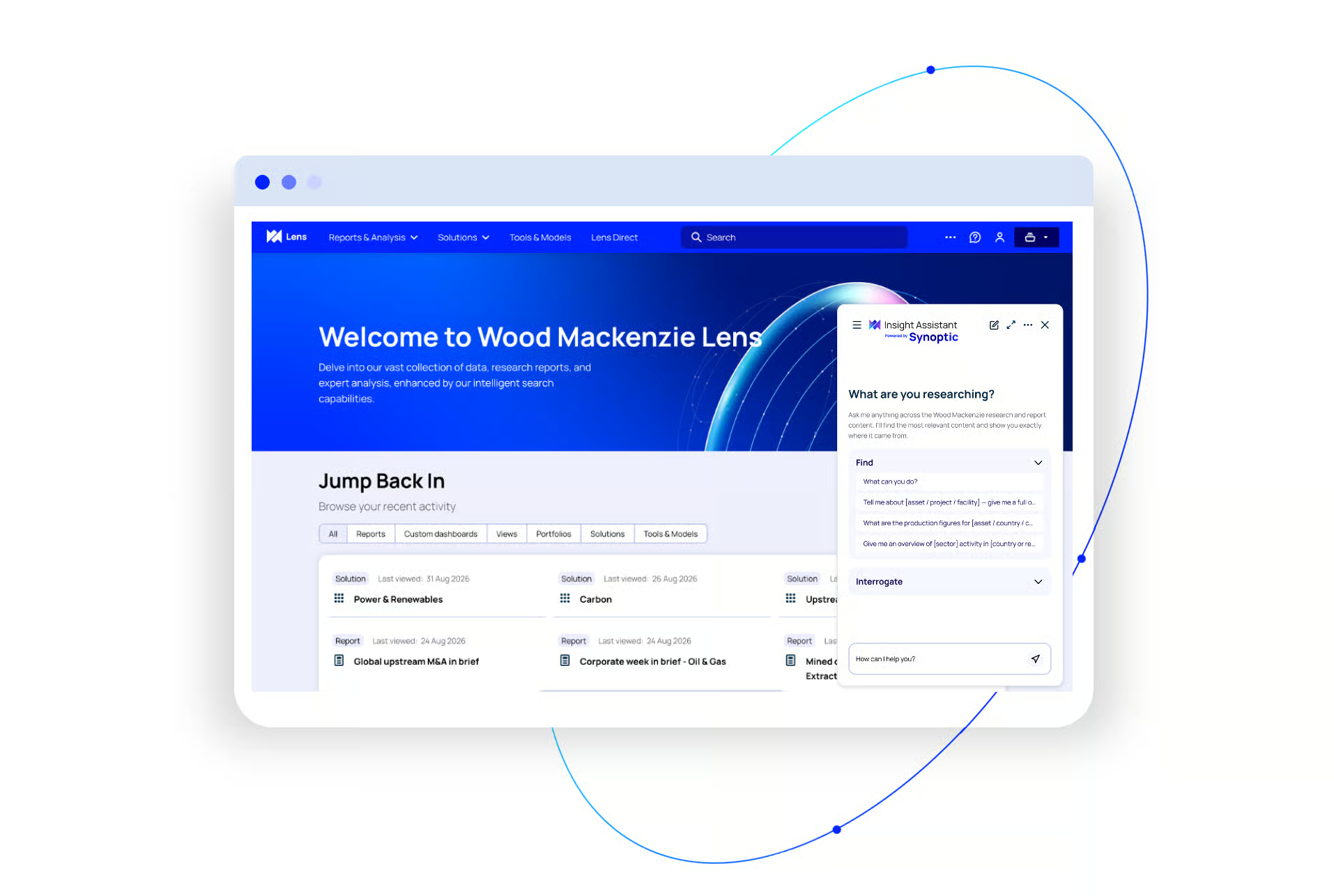
The findings, drawn from Wood Mackenzie’s Lens Metals & Mining platform, highlight a growing divergence between the geography of lithium production and the nationality of asset owners.
Australia, long the dominant force in lithium supply, accounted for 43% of global extraction in 2020. By 2030, that share is forecast to fall to 25%, driven not by declining investment, but by faster growth elsewhere particularly across Africa. The continent’s share of global lithium extraction is expected to rise from near zero in 2020 to 13% by 2030, marking one of the most significant regional supply shifts in the sector.
“Lithium production and lithium ownership are increasingly diverging, and it is reshaping the global critical mineral supply chains,” said Allan Pedersen, research director, energy transition & battery materials – lithium at Wood Mackenzie “While production growth is becoming more geographically diverse, ownership remains concentrated among a relatively small group of companies, mostly led by China.”
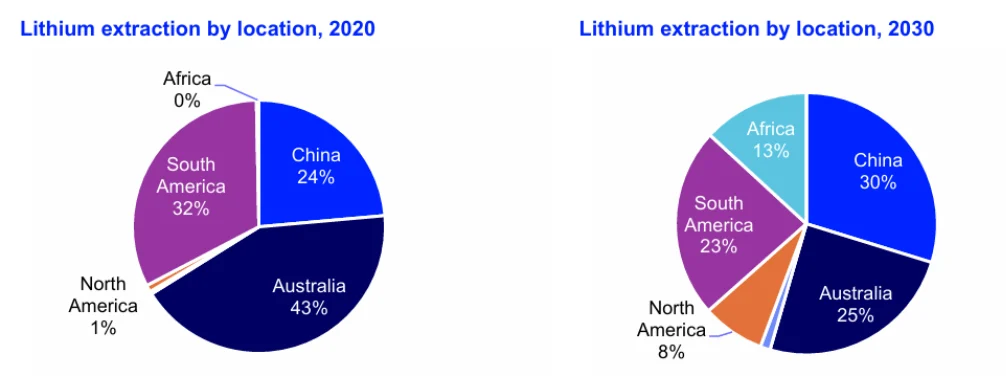
Source: Wood Mackenzie Lens Metals & Mining Markets Forecast
China’s ownership position extends well beyond its domestic production base. Chinese firms have built significant stakes in Australian and Argentine assets while deploying capital at scale across Africa, filling a vacuum left by increasingly cautious Western investors.
Huayou Cobalt’s proposed acquisition of Atlantic Lithium, alongside co-investment in the Ewoyaa project in Ghana, is the latest in a series of transactions that underscore China’s expanding role in global lithium ownership. Earlier deals, including Tianqi Lithium’s 51% stake in the Greenbushes mine in Western Australia, which was later reduced through a deal with Australian IGO, and Hainan Mining’s investment in Kodal Mining’s Bougouni project in Mali, have further strengthened China’s position across key producing regions.
According to Wood Mackenzie, Africa illustrates the growing disconnect between production and ownership most clearly. Although the continent is expected to account for 13% of global lithium extraction by 2030, African-headquartered companies are forecast to own just 1% of global output.
“With few exceptions, Africa’s lithium growth has been financed by Chinese capital,” said Pedersen. “That raises important questions around ownership, value capture and long-term supply chain influence as production continues to scale.”
South America also faces mounting competitive pressure. Despite continued investment, the region’s share of global lithium supply is expected to fall to below a quarter by 2030. The constraint is structural: brine-based production is slower and more complex to scale than hard-rock alternatives, while new spodumene and lepidolite capacity elsewhere continues to expand rapidly.
Elsewhere, Europe’s ownership share is rising following Rio Tinto’s acquisition of Arcadium Lithium and Equinor’s entry into battery materials, while North America’s share has declined following the divestment of US-held assets to Rio Tinto. Australian-headquartered companies are expected to retain approximately 21% ownership of global lithium output in 2030, supported by both domestic assets and overseas investment.
As governments intensify efforts to secure critical mineral supply chains, the concentration of lithium ownership across multiple producing regions is likely to remain a growing strategic and policy concern.
The full analysis is available through Wood Mackenzie’s Lens Metals & Mining platform.