



Get in touch
-
Mark Thomtonmark.thomton@woodmac.com
+1 630 881 6885 -
Hla Myat Monhla.myatmon@woodmac.com
+65 8533 8860 -
Chris Bobachris.boba@woodmac.com
+44 7408 841129 -
Angélica Juárezangelica.juarez@woodmac.com
+5256 4171 1980
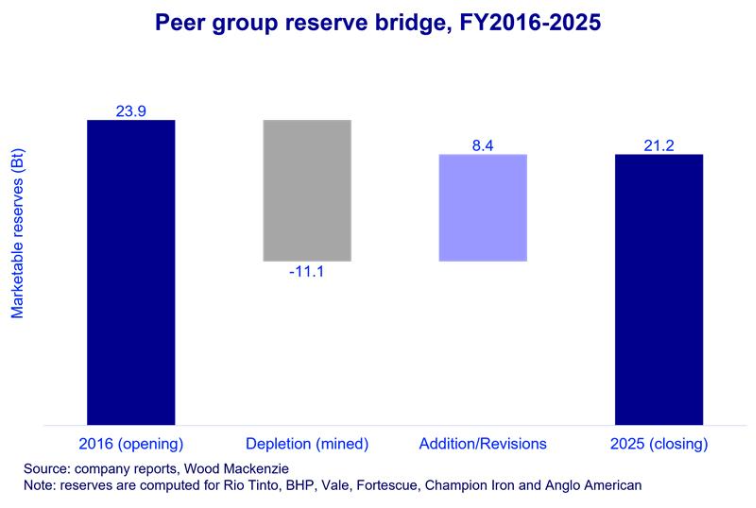
Major iron ore producers have used 11.1 billion tonnes of reserves over the past decade replacing three-fourths of tonnes mined
New analysis finds rising strip ratios, eroding ore quality, and a fivefold gap in replacement costs are quietly reshaping the long-term economics of iron ore supply
6 minute read
The world's major iron ore producers are consuming their reserve bases faster than they are replenishing them, while the cost and complexity of replacing those reserves is rising. The quality of some replacement resources is also declining, putting further pressure on margins and product premiums. Those are the central findings of Iron Ore Reserve Depletion and Replacement Analysis, a Wood Mackenzie report published in September 2026.
Between FY2016 and FY2025, the six largest iron ore producers collectively depleted 11.1 billion tonnes of marketable reserves. However, only three of them replaced what they mined over the period, according to Wood Mackenzie. Net reserve replacement ratios across the peer group ranged from 28% to 159%, reflecting differences in reserve conversion, capital allocation and operational disruptions.
"Many producers still have long reserve lives, with those carrying 15 or more years retaining a meaningful buffer" said Mihir Vora, Director, Research for Metals and Mining at Wood Mackenzie. "But the direction of travel is clear: as mine lives shorten, the margin for error narrows, and each successive tonne becomes more challenging and costly to replace."
The cost of standing still is rising
C1 cash costs have risen sharply across the industry since FY2016, roughly doubling for some producers over the period. As ore bodies mature, more waste material must be moved to access the same volume of ore. This reflects the natural progression of mine maturity and is expected to persist.
Cash margins, which peaked across the industry in FY2021, have since been compressed by cost inflation. By FY2025, margins across the peer group had converged to approximately US$50–60 per tonne, according to Wood Mackenzie. The narrowing of this buffer reduces the industry's capacity to absorb further input cost increases or sustained periods of price weakness without affecting investment decisions.
Grade erosion adds a new dimension to the supply challenge
The overall quality of iron reserves has stayed mostly steady, but the mix that makes up this stability is changing. Wood Mackenzie's analysis finds that reserve grade has fallen by as much as 1.6 percentage points among some peers since 2016. Higher-grade material is increasingly required to offset the depletion of lower-grade ore bodies, while impurity levels, particularly alumina, are rising in some product streams.
Alumina attracts specific penalties in blast furnace operations, independent of overall iron content. Producers whose product quality is drifting toward higher impurity levels therefore face a structural pricing headwind that compounds rising production costs.
Wood Mackenzie's analysis finds that some producers have moved from a modest, realised premium to a persistent discount to the 62% Fe benchmark over the past five years, driven by a combination of falling product iron content and rising impurity levels.
The premium segment of the market remains concentrated among a small number of producers. New entrants seeking to compete in this segment face a high bar, with achieving consistent benchmark quality requiring operational maturity that takes time to establish.
“Reserve replacement ratios tell only part of the story. While several producers have successfully replenished depleted tonnes, the quality of those replacement resources is not always equivalent, with some operations experiencing grade erosion and rising impurity levels over time.” said Mayank Maheshwari, Senior Research Analyst, Metals and Mining at Wood Mackenzie.
Replacing reserves is becoming more capital intensive
The capital intensity of reserve replacement has also emerged as a significant differentiator across the major producers. Wood Mackenzie's analysis of cumulative growth capital expenditure per tonne of reserve added between 2016 and 2025 found outcomes ranging from approximately US$2 per tonne up to US$10 per tonne.
This fivefold difference reflects the varying quality of remaining resource pipelines, as well as the operational and regulatory challenges experienced across the peer group. As existing ore bodies mature, producers face a growing need to invest not simply to expand supply, but to replace what they have already mined.
Investment pipelines sustain output but do not change the structural direction
Several major producers have committed billions of dollars to brownfield expansions and sustaining projects over the coming decade. These projects are designed to replace depleting ore bodies and maintain production on a broadly like-for-like volume basis.
However, Wood Mackenzie's analysis characterises this investment as largely sustaining in nature. It is designed to maintain existing production levels as legacy ore bodies deplete, rather than deliver a step-change in available supply.
The iron ore industry is therefore entering a period in which the effort, capital and technical complexity required to hold output flat is materially greater than it was a decade ago.
Key findings:
- The six largest iron ore producers depleted 11.1 billion tonnes of marketable reserves between FY2016 and FY2025, with only three achieving full replacement.
- Net reserve replacement ratios ranged from 28% to 159%, reflecting differences in reserve conversion, capital allocation and operational disruptions.
- C1 cash costs have roughly doubled for some producers since FY2016, driven primarily by rising strip ratios as existing ore bodies mature.
- Cash margins peaked in FY2021 and converged to approximately US$50–60 per tonne by FY2025, reducing the buffer against further cost or price pressure.
- Reserve grades have declined by up to 1.6 percentage points among some peers since 2016, while rising alumina is creating additional pressure on product value.
- Reserve replacement is becoming more capital intensive, with growth capex per tonne of reserve added ranging from approximately US$2 to US$10 across the peer group.
- Major investment pipelines are substantial but largely sustaining in nature, highlighting the increasing capital and technical effort required to maintain existing production.
"The main challenge for the current iron ore industry is rising costs to maintain existing production," said Vora. "As producers work through their existing reserves, replacement is becoming more capital-intensive and, in some cases, the quality of what is being added is declining. The industry is investing to sustain production, but it is having to work harder to stand still."