





Get in touch
-
Mark Thomtonmark.thomton@woodmac.com
+1 630 881 6885 -
Hla Myat Monhla.myatmon@woodmac.com
+65 8533 8860 -
Chris Bobachris.boba@woodmac.com
+44 7408 841129 -
Angélica Juárezangelica.juarez@woodmac.com
+5256 4171 1980
Prolonged Middle East supply disruption drives thermal coal demand and price
3 minute read
- FOB Newcastle 6,000 kcal/kg coal averaged US$126/t in March 2026, with prices rising to US$132/t in recent trades, up from US$114/t in February
- For every US$10/bbl increase in crude oil prices, coal mine site costs increase by US$1–3 per tonne, placing additional pressure on already tight supply
Prolonged disruption to Middle East energy supplies is triggering a rebound in global thermal coal demand, as countries scramble to secure power amid constrained LNG flows through the Strait of Hormuz, according to Wood Mackenzie.
“In supply shocks of this scale, coal becomes a critical fallback for energy security,” Sushmita Vazirani, Principal Analyst, Bulk Commodities at Wood Mackenzie. “Despite decarbonisation commitments across Asia, tightening LNG supply and elevated prices are accelerating fuel switching back to coal.”
While the Strait of Hormuz remains the world’s most critical chokepoint for oil and gas, relatively little thermal coal trade passes through it directly. Major coal exporters including Australia, Indonesia, Russia, South Africa and Colombia are not directly exposed to the route. However, disruption to LNG supply is creating significant spillover effects, as higher gas prices drive fuel switching toward coal in price-sensitive markets across Asia and Europe.
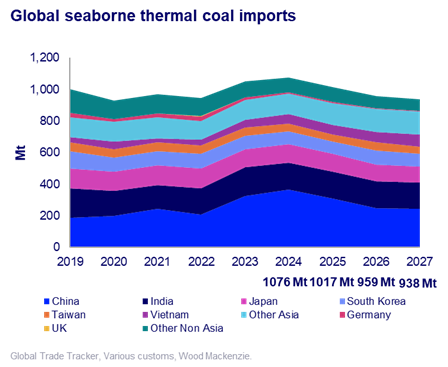
Regional markets respond with fuel switching and policy shifts:
Northeast Asia: Coal-fired generation remains firm despite seasonal demand weakness in the region, supported by rising LNG prices. Taiwan is preparing to restart the 2.1 GW Hsinta coal-fired power plant, which could consume approximately 5.5 Mt annually. South Korea has increased guidance for Russian coal imports, while Japan is expected to rely more on nuclear generation, including restarts such as Kashiwazaki-Kariwa Unit 6.
China: With gas accounting for less than 3% of power generation, China remains relatively insulated and is shifting toward domestic coal supply.
India: Elevated LNG and petcoke prices are pushing industrial consumers back toward coal as a primary fuel source.
Europe: Countries including Italy are considering restarting coal-fired capacity, with the Amsterdam-Rotterdam-Antwerp (ARA) market particularly exposed due to its reliance on gas.
Rising diesel prices constrain supply response
Coal prices have increased significantly across major benchmarks:
- FOB Newcastle 6,000 kcal/kg averaged US$126/t in March
- FOB Richards Bay 6,000 kcal/kg averaged approximately US$110/t
- CFR ARA prices reached US$123/t amid gas market volatility
According to Wood Mackenzie, pre-conflict marginal costs of around US$112/t are expected to rise further, driven in part by higher crude oil prices.
“Rising diesel prices are creating a cost squeeze for coal producers, just as markets call for more supply. In Australia, heavy reliance on imported diesel adds an additional layer of risk, potentially constraining output and tightening global markets,” said Vazirani.