



Get in touch
-
Mark Thomtonmark.thomton@woodmac.com
+1 630 881 6885 -
Hla Myat Monhla.myatmon@woodmac.com
+65 8533 8860 -
Chris Bobachris.boba@woodmac.com
+44 7408 841129 -
Angélica Juárezangelica.juarez@woodmac.com
+5256 4171 1980
U.S. energy storage market posts record 18.9 GWh in Q2 as longer-duration systems drive growth
5 minute read
- The U.S. installed 5.4 GW/18.9 GWh of battery energy storage systems in Q2 2026.
- Total GW installations down 7%, but GWh up 17% year-over-year. A new record.
- National average duration of systems increased from 2.8 hours to 3.5 hours year-over-year.
- Annual US energy storage installations to grow over 50% in MW terms over the next five years, reaching 207 GW/715 GWh installed cumulatively by 2031.
The U.S. energy storage market installed a record 18.9 GWh of battery energy storage systems in Q2 2026, driven by a shift toward longer-duration storage systems and stronger residential energy capacity. Energy market growth went up 17% year-over-year (y-o-y), despite a 7% overall decline in installed power capacity y-o-y, according to the latest U.S. Energy Storage Monitor report released today by the American Clean Power Association (ACP) and Wood Mackenzie.
The national average duration of installed battery energy storage systems increased from 2.8 hours to 3.5 hours, driven by resource adequacy needs.
Utility-scale deployments totaled 4.7 GW/17.6 GWh in Q2, down 8% y-o-y in MW terms as key markets become increasingly saturated. However, in the first half of 2026, installations were up 5% y-o-y, signaling that 2026 installations will remain on par with last year. Average project duration continued to climb in Q2 2026, driven in part by a long-duration project in California designed to meet state targets and utility-contracted storage assets deployed in Texas.
The Community, Commercial and Industrial (CCI) sector installed 48 MW, returning to historical deployment levels after California's record Q1 driven by the state’s Net Energy Metering 2.0 grandfathering deadline. Overall, the market saw a slight decline of 2% year-over-year, but above average growth in Hawaii, New Mexico and Texas helped offset some of this contraction.
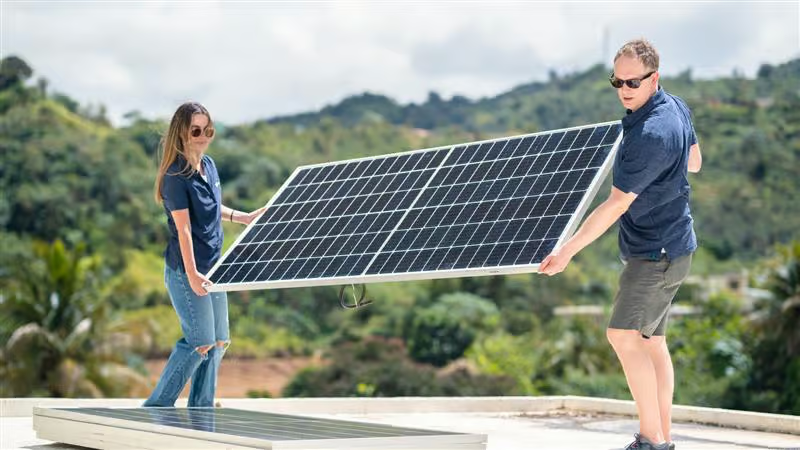
The residential sector recorded its fourth largest quarter on record in Q2 2026, installing 676 MW, a 15% quarter-over-quarter (q-o-q) decline, and 3% y-o-y increase. Overall, the national residential storage market is expected to contract by 4% in 2026 amid tax credit elimination, consumer hesitancy, and a challenging third-party-ownership transition.
The top five U.S. markets, California, Texas, Puerto Rico, Arizona and Illinois, accounted for 88% of residential storage capacity installed in Q2, though all five declined q-o-q. Puerto Rico contracted the most in absolute terms, falling from 129 MW in Q1 to 73 MW in Q2.
Battery storage is one of the most important tools we have to meet growing electricity demand,” said John Hensley, Senior Vice President of Markets and Policy Analysis at American Clean Power. “Storage can be deployed quickly, strengthens reliability, and helps the grid make better use of both existing and new generation. With a strong pipeline and continued technology improvements, the outlook for storage remains exceptionally strong.”
Annual U.S. Energy Storage Installations to Grow Over 50% in MW Terms Over the Next Five Years
As data center demand increases, utility-scale storage will see 8% average annual growth over the next five years. The CCI sector is projected to grow 27% between 2026 and 2031 as deployment expands beyond California into emerging markets such as Maryland and Texas. The residential market is expected to rebound between 2027 and 2031, growing at an average annual rate of 9%. In total, the market will reach 207 GW and 715 GWh installed cumulatively by 2031.
"Data center buildout strengthens the U.S. storage outlook across all sectors. Storage can provide needed capacity faster, cheaper and more reliably than gas alone," said Allison Feeney, research analyst at Wood Mackenzie. "As hyperscalers increasingly face grid-connection bottlenecks, utility-scale storage will enable speed to power for data centers."
Distributed storage's value proposition is also broadening beyond customer-centric benefits. The industry is increasingly positioning virtual power plants (VPPs) as a key enabler of load growth, unlocking new participation pathways for the CCI and residential segments alike.
Supply chain dynamics, including potential trade restrictions, could cause near-term bottlenecks. The utility-scale segment may see some stagnation in 2026 and 2027 as the industry adapts. However, growth is forecast to resume in 2028, scaling at 11% on average annually through 2031 as domestic cell manufacturing ramps up.
"The slowdown in EV demand has become an unexpected tailwind for storage. Manufacturers are repurposing idle EV cell capacity, accelerating the domestic supply base just as trade policy makes it most valuable," said Allison Weis, Global Head of Energy Storage at Wood Mackenzie.
Read the Energy Storage Monitor report here.
Notable Market Developments:
- The national residential solar-plus-storage attachment rate reached 46% in Q2 2026, up from 41% in Q2 2025, reflecting continued consumer demand for paired solar and storage installations despite broader residential market headwinds.
- The share of hybrid utility-scale installations shrank to 33% in Q2 2026, down from 45% in Q2 2025, due to a contraction in the California market.
- Utility-scale battery system prices fell 2% year-over-year to $916/kW in Q2 2026, continuing a downward cost trend that is helping storage compete across more regions and use cases.