


Get Ed Crooks' Energy Pulse in your inbox every week
Higher energy prices raise stagflation fears
Oil and gas production makes the US more resilient to shocks, but it still faces economic impacts
1 minute read

Ed Crooks
Vice Chair Americas and host of Energy Gang podcast

Ed Crooks
Vice Chair Americas and host of Energy Gang podcast
Ed examines the forces shaping the energy industry globally.
Latest articles by Ed
-
Opinion
A power producer’s view of keeping the lights on. What does rising electricity demand from data centers mean for the US grid?
-
Opinion
Oil prices rise despite IEA reserves release
-
Opinion
The war with Iran: what does the disruption in the Strait of Hormuz mean for global energy?
-
Opinion
Iran conflict a test of US energy supply response
-
Opinion
Are VPPs really a viable solution for easing strain on the grid?
-
Opinion
Data centers are adding an extra 220 gigawatts of electricity demand in the US. How can the grid cope?
Gasoline prices were one of the clear success stories for US consumers from the first year of President Donald Trump’s second term. The retail price of regular conventional gasoline averaged about US$3.01 a gallon on the president’s inauguration day in January 2025, and a year later was down 10% to about US$2.70 a gallon.
The conflict in the Middle East has sent gasoline prices back up again. Regular gasoline averaged about US$3.98 a gallon on Thursday, according to the Automobile Association of America. That is still significantly lower than its all-time high of around US$5 a gallon, hit during the Biden administration in June 2022. But it is about 33% above its level of just a month ago.
Diesel, meanwhile, averaged about US$5.38 a gallon at the start of the week, according to the US Energy Information Administration. That is only about 7% below its all-time high, also reached in June 2022.
Fuel prices are becoming both a political problem for the Trump administration and a potential economic problem for the US.
If traffic through the Strait of Hormuz remains as severely disrupted as it is today, the upward pressure on crude and oil products prices will continue to grow. This week, questions about the potential impact of higher fuel costs on the US and world economy have snapped into focus.
President Trump argues that the strength of the US as an oil and gas producer will shield it from the adverse consequences of higher energy prices.
“The amazing thing is, we don’t need the Hormuz Strait,” he said on Thursday. “We have so much oil, our country is not affected by this.”
Scott Bessent, the Treasury secretary, conceded that there would be some pressure on US consumers, but suggested that the cost was worth paying for long-term security.
“Many people, especially the Democrats, underestimate the will of the American people for short-term volatility for 50 years of safety that we are going to have on the other side of this,” he said. “I believe energy prices will be lower, inflation will be lower.”
However, there are already signs that inflationary pressures are building as a result of higher oil prices. The Organisation for Economic Co-operation and Development this week forecast that US headline inflation would be 4.2% in 2026. Its previous forecast, from last December, was that it would be 3%.
US 30-year mortgage rates have been on the rise, hitting their highest level since last October. Speculation that the Federal Reserve could start raising rates again has been one of the reasons.
Austan Goolsbee, chairman of the Federal Reserve Bank of Chicago, said in a television interview this week that interest rates could be cut again several times this year, “if inflation behaves”. But he added: “I could see circumstances where we would need to raise rates if it was going a different way and inflation was getting out of control.”
On Thursday, President Trump set a new deadline of 6 April for Iran to reopen the Strait of Hormuz, threatening to destroy the country’s power plants if it does not comply. If the threat to the strait is lifted, oil prices could fall quickly. If it remains closed, then a rise in oil prices to US$150 a barrel and beyond is quite possible.
The Trump administration has reportedly been assessing the implications of oil reaching US$200 a barrel. President Trump said this week he had expected the price of oil to rise more sharply as a result of the war. Brent crude was trading at about US$111 a barrel on Friday morning. But it seems the president’s team has been preparing for the possibility that the unexpectedly calm response in the oil market may prove to be only temporary.
The Wood Mackenzie view
President Trump is right to say that the strength of the US as an energy producer shields it from many of the adverse economic consequences of the commodity price shock caused by the closure of the Strait of Hormuz.
As natural gas prices have jumped higher in Europe, they have remained quiescent in the US. Front-month futures for European benchmark TTF gas have been trading at the equivalent of about US$18 per mmbtu this week. The equivalent futures for Henry Hub gas in the US were trading on Friday morning at about US$3.05/mmbtu.
Because US LNG export plants were already running at close to full capacity, strong demand for additional gas supplies to replace suspended shipments from Qatar has not translated into additional demand in the US.
For oil products, where the US is fully integrated into world markets, higher global prices are translating into higher prices for American consumers.
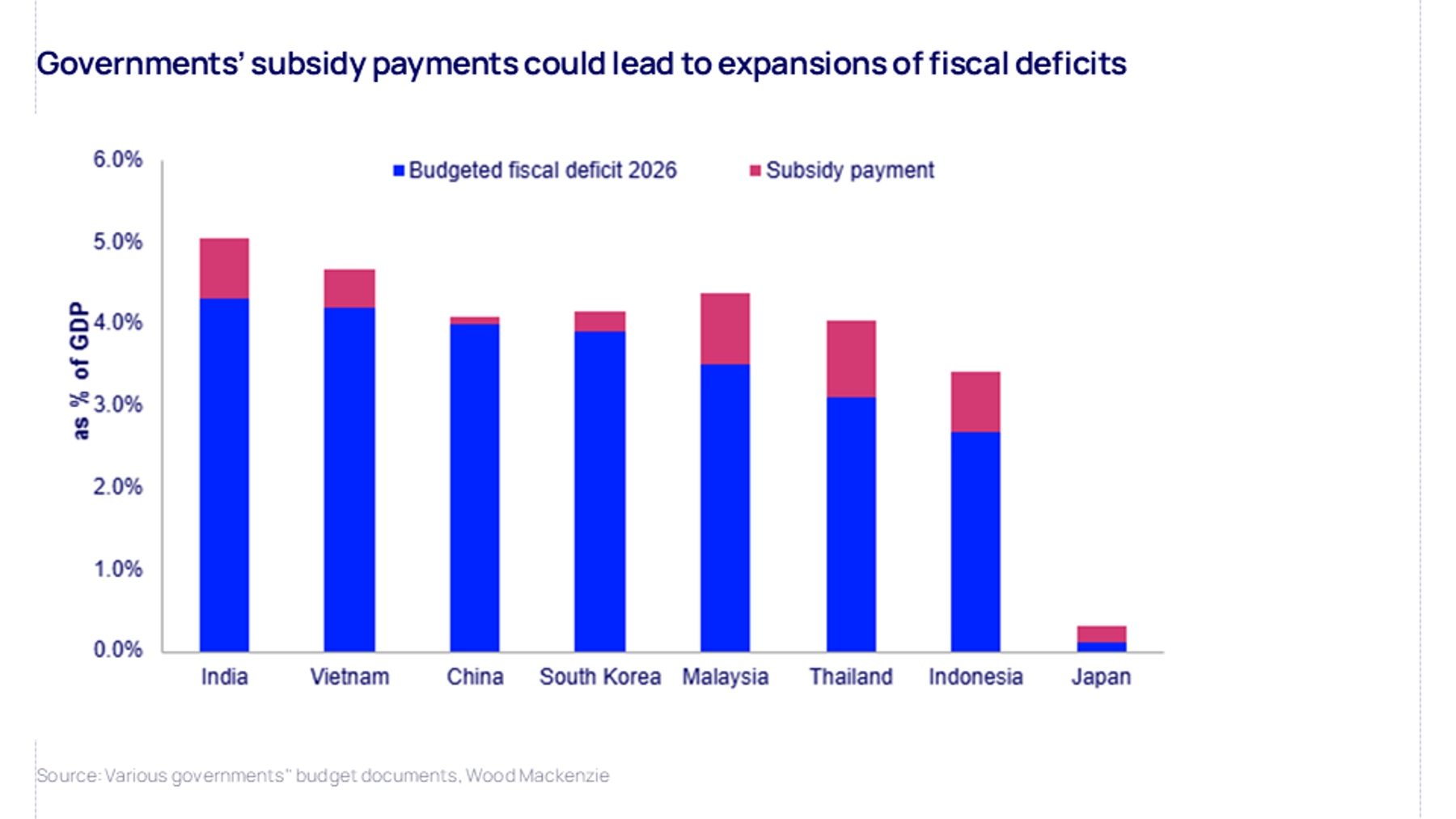
As a net oil exporter, the US does not have to increase payments to other countries when prices rise. As my colleague Simon Flowers and others point out in this week’s Edge column, the oil-importing economies of Asia are among those feeling the pain of higher prices most acutely.
However, that is not to say that the US can afford to be entirely indifferent to the level of oil prices. Although the nation as a whole may gain from higher prices, there will be potentially damaging distributional impacts within it.
A higher oil price creates a transfer away from American consumers who drive or fly, or who buy any goods that have been moved by truck, ship or aircraft, and towards people who work or invest in the oil industry. That transfer will be politically unwelcome for the government, which may be blamed for the squeeze on consumers’ living standards. And it may create economic problems, by creating a mix of higher inflation and slower growth: the dreaded “stagflation”.
“High oil prices as they get passed on to US consumers will hit consumption quite significantly,” says Peter Martin, Wood Mackenzie’s head of economics. “The US labour market was already showing signs of weakness, and economic growth slowed in the fourth quarter of last year. The last thing the economy needs is consumers being squeezed even further.”
Raising interest rates may not necessarily be the right policy response to the inflationary pressures created by rising fuel costs. “Higher interest rates won’t make any more oil flow through the Strait of Hormuz,” Martin says.
So long as inflationary expectations do not become entrenched, it is possible that the price shock will be transient. A slowdown in growth will create offsetting downward pressure on inflation.
But a higher oil price will still put the US economy under strain. Particularly if crude remains about the level of around US$125 a barrel that Wood Mackenzie analysts believe would lead to a global recession.
It could also have a significant political impact. Gasoline prices give a very visible verdict on the success of the administration’s strategy. With midterm elections in November now only seven months away, they will loom ever larger in politicians’ minds.
A crude price of US$200 a barrel would mean an average US retail gasoline price of about US$5.50 a gallon, says Wood Mackenzie’s Edgar Manzano. That level would be a new record high, possibly provoking a strong reaction from voters when they go to the polls.
That is an outcome that President Trump and Republicans in Congress will want to avoid.
In brief
A lease sale for the National Petroleum Reserve-Alaska (NPR-A) last week achieved record results, in a sign of revived interest in the state’s potential for oil development. Eleven companies participated, and US$164 million of high bids were received for 187 tracts, covering 1.34 million acres. Wood Mackenzie analysts said the sale was highly competitive, with 95 tracts receiving more than one bid and 30 tracts receiving over five competing bids.
A partnership between Shell and Repsol had the biggest impact, winning 42 tracts with a total high bid value of about US$94 million. Wood Mackenzie’s Robert Clarke said the lease results signalled “immense confidence in Alaska’s geology”. However, he added, fiscal stability would be important to support future resource development
TotalEnergies has pledged not to develop any more offshore wind projects in the US, in response to efforts from the Trump administration to shut the industry down. The company says it will invest about $1 billion in oil, gas and LNG in the US. It will be repaid that amount by the US government for the offshore wind leases off the east coast that it will not be using now.
Laura Swett, the chairman of the Federal Energy Regulatory Committee, has urged big tech companies to talk to her about their needs for power as they build out their data centre capacity. She said the hyperscalers had shown “a lack of understanding” of the electricity system, adding: “I think it's improving, but I don't know, because I don't talk to them as much as I [thought] I would.”
Other views
Port Arthur refinery explosion removes 415k bpd from market – Jake Eubank
Critical risk: cracking down on the use of forced and child labour in supply chains – Cliff Moore
AMERIPEC: Towards an energy alliance for the Western Hemisphere – ‘Usonius’
Europe forgot the lesson the 1970s oil shocks once taught
Quote of the week
“One of the most significant own goals in the next decade is ceding the EV space to China. They have 70% of the global EV market. It’s about statecraft with them. It’s about supply chains. They’re flooding the zone, all round the globe, including now right on the border into Canada I It’s a stack play. It’s a national security play. And I really fear what’s going to happen to American legacy automobile manufacturers. Elon was the one accelerating that. Now he’s put the brakes on his own innovation in that space, and now shifted to robotics.”
Gavin Newson, the governor of California who aspires to be the next president of the US, described Elon Musk as “the Edison of our time”, but said the Tesla CEO’s shift of focus away from electric vehicles “breaks my heart”.
Chart of the week
The US Supreme Court’s ruled last month that the legal basis used by the Trump administration to justify much of its tariff strategy was invalid. The landmark 6-3 decision held that the International Emergency Economic Powers Act (IEEPA) did not create legal authority for the administration to impose tariffs. It created a fresh wave of uncertainty over the costs of US imports, amplified swiftly afterwards when President Trump announced a new 10% tariff on most goods, based on a different law.
Benjamin Boucher, a senior analyst in Wood Mackenzie’s Supply Chain team, has been running the numbers to work out what the impacts on the energy industry could be. He has published a new note on the implications of the ruling, which is the source for this chart.
It shows key exporters to the US, by value, and the percentage change in their average tariff rates resulting from the decision. Brazil and Switzerland are among the biggest winners, while for the UK and Singapore there is no impact at all. The benefit for the EU is also relatively small. It is a complicated picture, however, and the impacts vary widely across sectors.
For more details, take a look at the complimentary extract from the latest report by Boucher and his team, available as a free download.

Get The Inside Track
Ed Crooks’ Energy Pulse is featured in our weekly newsletter, the Inside Track, alongside more news and views from our global energy and natural resources experts. Sign up today via the form at the top of the page to ensure you don’t miss a thing.