



Get Ed Crooks' Energy Pulse in your inbox every week
How the US power system coped with the threat from Winter Storm Fern
Strong performances from gas and coal-fired generation prevented blackouts for most American consumers
1 minute read

Ed Crooks
Vice Chair Americas and host of Energy Gang podcast

Ed Crooks
Vice Chair Americas and host of Energy Gang podcast
Ed examines the forces shaping the energy industry globally.
Latest articles by Ed
-
Opinion
The mother of all disruptions
-
Opinion
Higher energy prices raise stagflation fears
-
Opinion
A power producer’s view of keeping the lights on. What does rising electricity demand from data centers mean for the US grid?
-
Opinion
Oil prices rise despite IEA reserves release
-
Opinion
The war with Iran: what does the disruption in the Strait of Hormuz mean for global energy?
-
Opinion
Iran conflict a test of US energy supply response
“Those who cannot remember the past are condemned to repeat it,” wrote the Spanish philosopher George Santayana. The massive winter storm that hit the US last weekend, informally named Fern, was a reminder for the power industry of the truth of that quote.
We are approaching the five-year anniversary of Winter Storm Uri in February 2021, which left millions without power, many of them for several days, and caused hundreds of deaths. The brutally cold conditions and heavy snowfall in much of the US over the past few days forced electricity companies to demonstrate that they had learned from that disaster.
Overall, the industry rose to that challenge impressively. Despite being hit by one of the most widespread winter storms since Uri, power markets across the US were for the most part able to maintain reliable operations.
There will certainly be more lessons to be absorbed as the full picture of Fern becomes clearer. And the challenging conditions are not over yet, with another winter storm and some low temperatures expected this weekend. But some key conclusions have already become apparent.
Winter storm Fern covered a vast area, from New Mexico to Ontario, and broke numerous records for low temperatures, particularly in the southern US. In several cities, the snowfall was the heaviest seen for many years.
However, the impact on the electricity system was not as severe as some had feared. At the worst of the impact, over 1 million homes and businesses were estimated to be without power, most of them in the southeastern US. That is significantly fewer than during Uri, which led to more than 5 million customers being hit by blackouts, the great majority of them in Texas.
Many of the fatalities from Uri, estimated at more than 700, were linked to the loss of power, which caused deaths from hypothermia and carbon monoxide poisoning from portable generators. Winter Storm Fern is already known to have caused more than 100 deaths. But for the resilience of the electricity system this week, the toll could have been much higher.
The Wood Mackenzie view
A key factor in Winter Storm Uri in 2021 was that power generation on the ERCOT grid in Texas collapsed, principally because of unplanned outages and reductions in output at gas-fired plants. Output from wind power and coal plants also fell sharply. This time, however, thermal generation performed well across the US.
On Sunday, 25 January, at the height of the storm, gas-fired plants in the Lower 48 states supplied about 5.6 terawatt hours (TWh), up 25% from the Sunday a week earlier, Energy Information Administration data show. Coal plants supplied about 3.1 TWh, up 30% over the same period. Output from wind and solar power was lower.
Wood Mackenzie’s Power Trading Analytics service provides real-time visibility into the granular detail behind these national changes, and the implications for electricity pricing and profitability.
During Uri, our monitors picked up 12 individual trips on the ERCOT grid in the first 48 hours of the emergency. During Fern, we saw only one. Stephen Ryan, a Wood Mackenzie power market analyst, commented: “The gas, coal and nuclear fleet was all significantly more reliable this time around. More resources successfully remained online when the grid needed them to.”
State legislation was passed in 2021 requiring electricity facilities to be prepared to run in very cold and very hot temperatures. ERCOT has been active in inspecting plants to ensure they comply with those rules.
There was still extreme price volatility across the US, but day-ahead prices were often much higher than real-time prices. Unexpectedly strong generation, with fewer outages and higher output than expected from both thermal plants and renewables, meant that real-time prices were lower.
In ERCOT, the highest price in the day-ahead market reached $1,900 per megawatt hour (MWh). The real-time price for the same period was only $300/MWh. The position was similar in PJM, where the highest price in the day-ahead market was $2,300/MWh, while the real-time price for the same period was $700/MWh.
The resilience of gas-fired generation came as freeze-offs of gas production were close to record levels. Freeze-offs reached a single-day high of 17 billion cubic feet (bcf) on 25 January, approaching the record 18 bcf seen during Uri.
Meanwhile, weaker-than-expected power demand also helped ease some of the strain on grids. NYISO and ISO-NE were the only two markets to break their 2025 winter demand records, says Rebekah Llamas, Wood Mackenzie’s head of market intelligence for power market research.
In ERCOT and PJM, the independent system operators faced demand on their peak days that was sharply lower than expected, by about 10 gigawatts in both cases.
Part of that reduction may have been due to large loads dropping out, but the evidence is mixed. Wood Mackenzie’s sensor network showed a range of responses, from some crypto facilities cutting electricity consumption through the storm in response to higher prices, to some data centres in Virginia maintaining a steady load even as prices soared.
Although the US electricity system has appeared to cope relatively well with storm Fern, the pressures on the grid are set to grow. The North American Electric Reliability Corporation (NERC), warned this week that projections for generation and transmission capacity in the US over the next 10 years fall short of what will be needed to support increased demand from data centres and other new large loads.
Most of the new supply capacity that will be added over the next five years will be solar and battery storage, while more fossil fuel generation is set to retire. NERC concluded: “The continuing shift in the resource mix toward weather-dependent resources and less fuel diversity increases risks of supply shortfalls during winter months.”
More investment, more innovation, and possibly more delays in plant retirements will be needed. The industry, governments and regulators will have to plan carefully to maintain the reliability and resilience of US electricity supplies, as they take on the dual challenges of rising demand and increased reliance on variable renewables.
In brief
Oil prices continued to rise during the week, with Brent crude approaching US$72 a barrel at one point on Thursday. Speculation is growing that the US is about to launch a strike on Iran, with forces including the USS Abraham Lincoln aircraft carrier moving into the region. President Donald Trump described the force as a “massive armada”, and said it was prepared to act “with speed and violence, if necessary”.
The US is seeking an agreement from Iran to end its nuclear programme, stop enriching uranium, limit its ballistic missile capabilities and end support for proxy groups in the region. On Friday morning, Brent crude was trading at about US$70 a barrel.
The US has eased some sanctions on Venezuela, making it easier for international companies to transport, sell and refine the country’s crude. The US Treasury’s Office of Foreign Asset Control issued a general licence allowing transactions that are “ordinarily incident and necessary to the lifting, exportation, re-exportation, sale, resale, supply, storage, marketing, purchase, delivery, or transportation of Venezuelan origin oil”. The Venezuelan government and PDVSA are still under sanction, and any revenue from sales of the country’s oil must be paid into the special accounts controlled by the US.
Venezuela’s National Assembly has passed reforms that will make it easier for international companies to operate there.
GE Vernova reported soaring orders for its power division, which makes gas turbines and other equipment for electricity generation. The segment booked US$32.8 billion of orders last year, up 51% from 2024. Its order backlog stood at US$94.4 billion at the end of 2025, up 29% over the year. The company said the buildout of data centres would be a significant driver of gas turbine demand, and it was continuing to expand its customer relationships with hyperscalers and other electricity-intensive industries.
However, results from GE Vernova’s wind turbine business were weaker. Orders rose only 8%, to US$7.7 billion, and revenues fell 6% to US$9.1 billion, in part because of policy uncertainty and delays to offshore wind projects in the US.
This week, the Vineyard Wind offshore project off the coast of Massachusetts became the latest to win a court decision against the US federal government to overturn a stop-work order. The project is 95% complete and already delivering power to the grid. The decision follows similar rulings won by the Coastal Virginia Offshore Wind, Revolution Wind and Empire Wind projects.
Orders for five offshore wind projects to stop construction were issued by the government in December. The Department of the Interior cited national security risks related to the possibility that the turbines could interfere with radar. The fifth project, Sunrise Wind off the coast of New York, is still waiting for a decision in its case.
Coterra Energy and Devon Energy are in advanced talks on a merger to create a company worth nearly US$60 billion, the Financial Times reported.
Other views
A wild week for gas markets – Simon Flowers, Gavin Thompson and Massimo Di Odoardo
The three challenges to exporting Greenland’s rare earths – Suzanne Shaw, Yue Wang and David Riley
India requires US$145 billion in annual energy investment to bridge growth and climate targets
India’s energy roadmap: 5 key themes for IEW 2026 – Joshua Ngu, Hetal Gandhi and Rashika Gupta
Wells to watch 2026 – Jessica Ciosek
Subsurface: 5 things to look for in 2026 – Rosanele Romero
Global corporate power and renewables: Five things to look for in 2026 – Akif Chaudhry
On technologies vs commodities – Brian Potter
Nuclear reactors are too expensive and slow to build – MV Ramana
Used EVs currently offer car buyers lowest lifetime cost of ownership
How China pulled off a great tech reversal – Kyle Chan
Quote of the week
“It has never been our policy to start trading less with the US, and we don’t want trade conflicts. But it is also clear that geopolitical turmoil … has been a wake-up call. We have to be able to take care of ourselves.”
Dan Jørgensen, the European Commissioner for energy and housing, told reporters at a briefing in Brussels that the EU was taking steps to find alternatives to imports of US LNG. He added that the EU aimed to deepen its energy relationships with Canada, Qatar and Algeria – all significant gas producers – in the months to come. The share of the EU’s gas market supplied by US LNG has risen sharply in the past five years and is expected to increase further.
Chart of the week
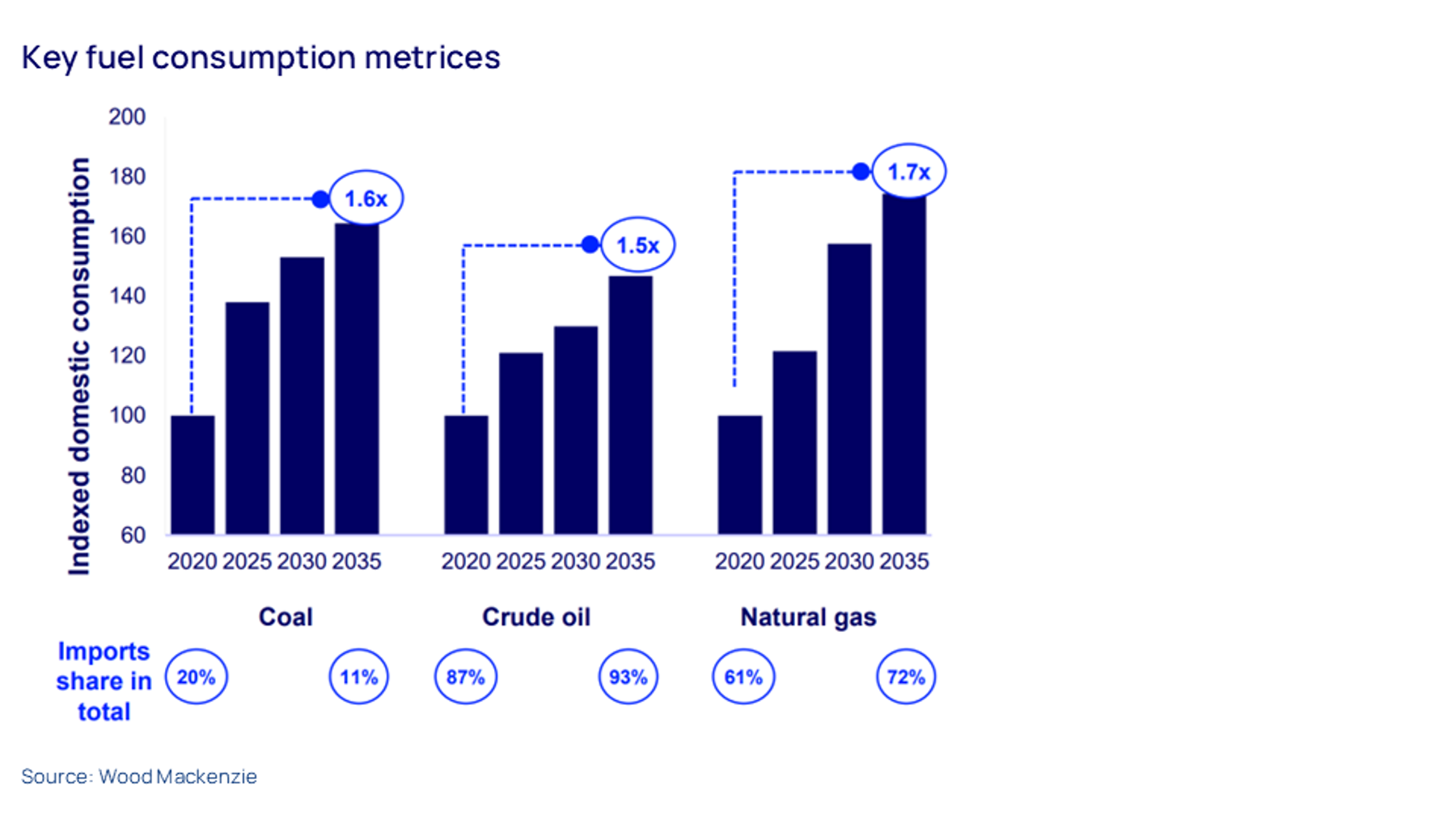
This comes from our briefing note for India Energy Week 2026, which ended in Goa on Friday. It shows the strong growth in demand for coal, oil and gas that is expected over the period from 2020 to 2035. The note addresses the question of how India can balance its energy trilemma of economic growth, security and transition. Download the full briefing for some answers, and some more great charts that illustrate the present and future of energy in India.

Get The Inside Track
Ed Crooks’ Energy Pulse is featured in our weekly newsletter, the Inside Track, alongside more news and views from our global energy and natural resources experts. Sign up today via the form at the top of the page to ensure you don’t miss a thing.