




Discuss your challenges with our solutions experts
International buyers find value in US gas assets
Deals in US unconventional gas last year reached levels last seen in the early 2010s. The M&A market is set to remain active
1 minute read

Ed Crooks
Vice Chair Americas and host of Energy Gang podcast

Ed Crooks
Vice Chair Americas and host of Energy Gang podcast
Ed examines the forces shaping the energy industry globally.
Latest articles by Ed
-
Opinion
A power producer’s view of keeping the lights on. What does rising electricity demand from data centers mean for the US grid?
-
Opinion
Oil prices rise despite IEA reserves release
-
Opinion
The war with Iran: what does the disruption in the Strait of Hormuz mean for global energy?
-
Opinion
Iran conflict a test of US energy supply response
-
Opinion
Are VPPs really a viable solution for easing strain on the grid?
-
Opinion
Data centers are adding an extra 220 gigawatts of electricity demand in the US. How can the grid cope?
“America is another name for opportunity,” the essayist Ralph Waldo Emerson said in 1844. Nearly two centuries later, it is still true in oil and gas.
Mitsubishi last week became the latest Japanese company to announce a deal for US gas assets, agreeing a US$7.5 billion deal to acquire Aethon, a Haynesville shale producer. The deal follows similar moves by Tokyo Gas and JERA in the past nine months.
In oil, meanwhile, Harbour Energy of the UK announced a US$3.2 billion deal to buy LLOG Exploration, a Gulf of America E&P business, shortly before Christmas. The deal is Harbour’s first move into the US, solidifying the Americas as its growth engine.
The interest in US assets from foreign companies is driven by some fundamental trends in the industry. More deals are likely in the months and years to come.
Mitsubishi’s strategy for the US is to build an integrated value chain, from upstream gas to power, data centres and chemicals.
It already has positions in LNG exports through the Cameron LNG plant in Louisiana, and electricity through its California-based Diamond Generating Corporation, an independent power producer.
JERA, which is Japan’s largest power generation company and one of the world’s largest LNG buyers, similarly cited diversification across the gas value chain as a key factor in its US$1.5 billion acquisition of assets in the Haynesville last October.
TG Natural Resources, which is majority-owned by Tokyo Gas, has also been doing deals to strengthen its integrated value chain in the US. Last year, it took a 70% stake in Chevron’s east Texas gas assets, for US$75 million in cash and US$450 million capital carry to fund development in the Haynesville formation. It first entered the play through its acquisition of Rockcliff Energy in 2023 for US$2.7 billion.
The Harbour/LLOG deal is different in that it is not gas-focused. Nor does it involve a Japanese buyer seeking upstream assets to balance a strong position in LNG. But it does reflect the attractiveness of US assets. Harbour is acquiring assets in the Gulf of America with high operating cash margins and low emissions, exactly the types of advantaged resources that companies want.
In his speech at the World Economic Forum this week, President Donald Trump hailed the gas investments and LNG contracts agreed with Japanese and South Korean companies as an example of the economic successes of the first year of his administration.
It is a trend that is set to continue into 2026.
The Wood Mackenzie view
The combination of soaring power demand from data centres for AI and a surge in construction of new LNG export facilities has led Wood Mackenzie to forecast rising US gas prices over the long term. And as Wood Mackenzie’s Greig Aitken and Scott Walker put it in a note published last week: “Where opportunity flows, deals follow.”
M&A activity in US gas has returned to levels last seen in the boom years of the early 2010s. Spending on North American unconventional gas assets last year reached its highest level since 2011, in nominal terms.
Some buyers have been taking the view that the prospect of higher gas prices made assets attractive at current valuations.
Some that are structurally short on North American gas – because they have committed to purchase LNG under long-term agreements – have been buying upstream assets to hedge against the risk of higher Henry Hub prices.
For these buyers, the Haynesville shale in Louisiana and eastern Texas is particularly attractive because it is close to many of the LNG export facilities of the Gulf coast. Wood Mackenzie estimates that once the Mitsubishi/Aethon deal closes, Japanese companies will control about a third of the production in that formation.
The position for US oil assets is somewhat different. Expectations that US liquids production will hit a plateau in the next 10 years or so may temper the enthusiasm of potential new entrants into tight oil plays, especially at the valuations seen in recent oil-weighted deals. Several US E&Ps have been looking abroad for long-term growth prospects.
The picture is similar offshore. Wood Mackenzie analysts commented that one of the attractions of LLOG for Harbour was that its portfolio “is one of the few in Gulf of America with a credible path for sustained growth” into the 2030s.
The queue of projects in the Gulf waiting for a final investment decision is thin. LLOG stands out because it has several viable projects in its portfolio that can contribute to production in the 2030s.
However, the scale and capabilities of the US industry mean that some acquisitions in US oil will make sense, both onshore and offshore.
Late last year, Japan Petroleum Exploration (JAPEX) announced a US$1.3 billion deal to buy Colorado-based tight oil producer Verdad Resources. JAPEX said the assets could support future growth opportunities, including gas development and potential collaboration with LNG projects.
The Haynesville play is a good example of how assets that might seem unattractive can be turned around. Its production rose rapidly in the first phase of the shale revolution, peaked around 2012 and declined into what looked like long-term stagnation.
Then, in 2017, operators mastered the techniques needed to unlock higher volumes from the formation. Output started to surge, and by 2023 was more than double its previous peak. Haynesville assets became the hot property they are today.
Similar breakthroughs to transform the prospects of other North American unconventional plays are still possible.
“That’s the great thing about US shale gas and tight oil,” says Robert Clarke, Wood Mackenzie’s vice president of Upstream research. “Once production gets going, it’s like a freight train. These plays have a tendency to overperform on volumes.”
In brief
US natural gas prices surged higher during the week, as weather forecasts projected a severe and prolonged winter storm across much of the country from Texas to New York. Henry Hub front-month gas futures were trading at about US$4.90 per mmbtu on Friday morning, up from about US$3/mmbtu a week ago. Wood Mackenzie’s Randall Collum suggested the weather could cause “the most impactful freeze-off” of US gas production in history.
The National Weather Service warned people to expect “crippling ice and sleet” in portions of the Southern Plains and Lower Mississippi Valley, and heavy snowfall northwards from the Ohio Valley, Mid-Atlantic, and New England.
Venezuela’s legislature has been making progress on reforms intended to encourage international companies to invest and help revive the country’s ailing oil industry. A proposed revision to the hydrocarbons law – allowing foreign companies to operate oil and gas assets, market their own production and collect the revenues – won enough votes to proceed to a second vote. Reforms to strengthen legal protections for international businesses were also supported by lawmakers.
Chris Wright, the US energy secretary, said the government would not provide on-the-ground security for oil companies operating in Venezuela.
When Darren Woods, CEO of ExxonMobil, discussed prospects for investing in Venezuela two weeks ago, he said legal changes – including reform of the hydrocarbons law and durable investment protections – would be essential for making the country investable. He also added that security guarantees would have to be in place for ExxonMobil to put a team on the ground there.
Other views
AI on wheels: autonomous EV fleets and their impact on the grid – Emil Koenig
Can Venezuela’s aluminium industry be revived? – Uday Patel and Edgardo Gelsomino
The growing free-market push to let data centers go off grid – Catherine Boudreau
The great oil head fake – Rana Foroohar
Do commodities get cheaper over time? – Brian Potter
Quote of the week
“We will quickly lose even the social permission to actually take something like energy, which is a scarce resource, and use it to generate these tokens, if these tokens are not improving health outcomes, education outcomes, public sector efficiency, private sector competitiveness across all sectors.”
Satya Nadella, CEO of Microsoft, spoke at the World Economic Forum in Davos about the need for “tokens”, the units of data processed by AI models, to be used efficiently and with positive impacts on society.
Chart of the week
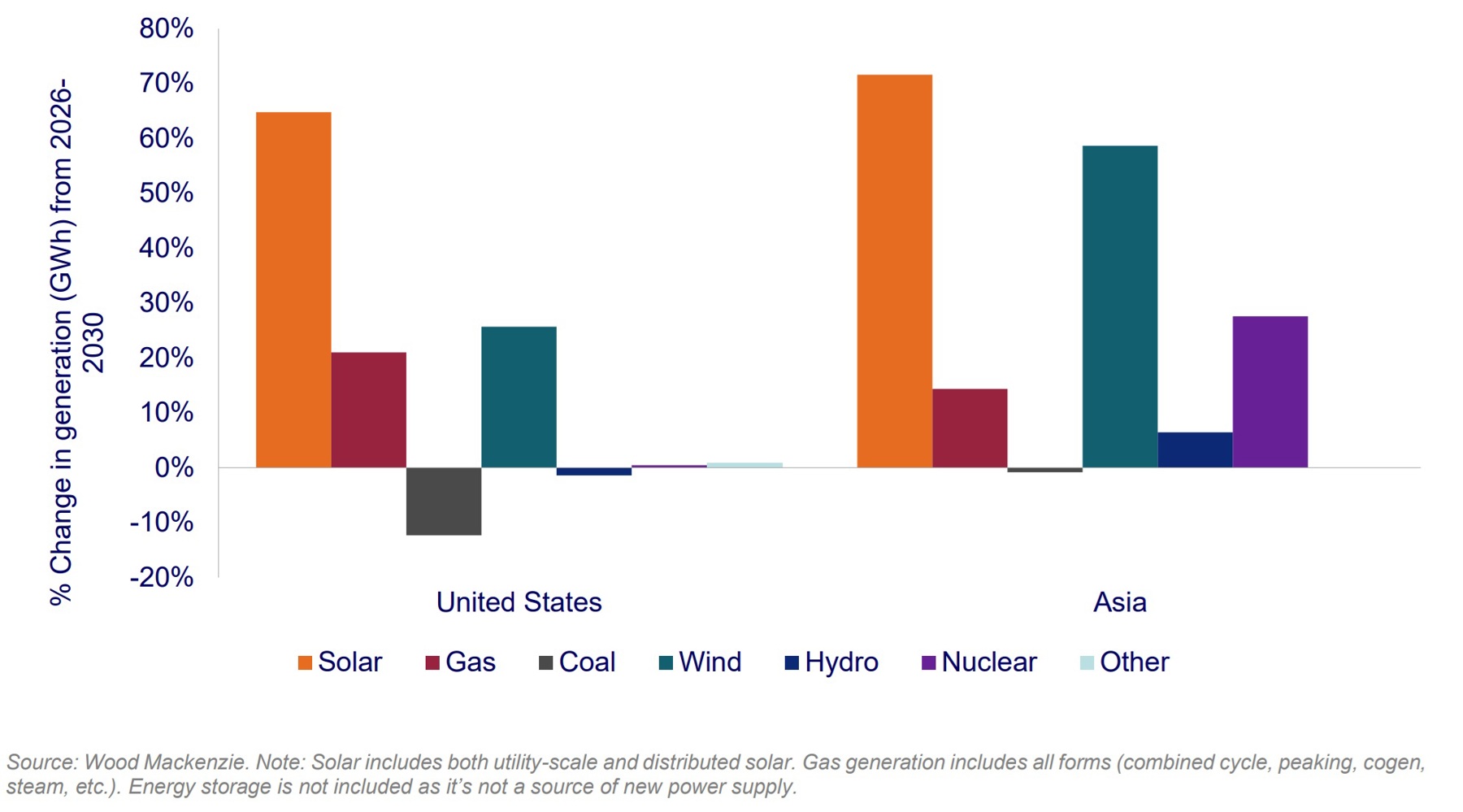
This chart, from Wood Mackenzie’s new note on what to look out for in the global solar industry this year, shows forecast growth rates for generation from different technologies from 2026 to 2030 for the US and Asia. In the US, solar is still a smaller proportion of the total generation mix than fossil fuels, so although it is growing faster than gas, in absolute terms it will not add as much additional power. However, the gap is closing. We are forecasting that annual solar generation in the US will grow by 232 GWh, or 65%, while annual gas-fired generation grows by about 340 GWh, or 21%.

Get The Inside Track
Ed Crooks’ Energy Pulse is featured in our weekly newsletter, the Inside Track, alongside more news and views from our global energy and natural resources experts. Sign up today via the form at the top of the page to ensure you don’t miss a thing.