



Get Ed Crooks' Energy Pulse in your inbox every week
Nuclear fusion power approaches critical moment
Five companies are aiming to have plants operational before 2030
1 minute read

Ed Crooks
Vice Chair Americas and host of Energy Gang podcast

Ed Crooks
Vice Chair Americas and host of Energy Gang podcast
Ed examines the forces shaping the energy industry globally.
Latest articles by Ed
-
Opinion
The mother of all disruptions
-
Opinion
Higher energy prices raise stagflation fears
-
Opinion
A power producer’s view of keeping the lights on. What does rising electricity demand from data centers mean for the US grid?
-
Opinion
Oil prices rise despite IEA reserves release
-
Opinion
The war with Iran: what does the disruption in the Strait of Hormuz mean for global energy?
-
Opinion
Iran conflict a test of US energy supply response
The crises of the 1970s stimulated a great wave of R&D and innovation in energy. The three technologies that today dominate investment in US power generation – solar, wind and shale gas – all took vital steps forward as a result of pioneering research undertaken in the 1970s. In the current crisis, nuclear fusion power could be a technology that takes a similar leap forward.
The Middle East conflict is spurring countries around the world to find alternatives to imported oil and gas. Now would be the perfect time for the fusion industry to show that it can be one of those solutions.
The challenges involved in harnessing fusion power are formidable. It is sometimes described as “making a star on earth” because it is nuclear fusion that releases energy from stars. The fusion startup Helion Energy last week reported a new record temperature of 150 million °C for the plasma in its fusion machine. That is about ten times the temperature at the centre of the sun.
If the challenges can be managed, the advantages of fusion power could be great. Fusion plants do not need uranium: they use deuterium, which can be extracted from water, and lithium as their fuel sources.
They are intrinsically safer, with no risk of meltdown. If system power is lost, the process will shut down automatically. They will produce less radioactive waste than today’s nuclear fission plants, and the waste they do produce will become safe much sooner. And the fusion power supply chain cannot be used to support a nuclear weapons programme.
But despite many decades of research, the fusion industry has still not delivered a single working power plant. Not even a prototype. The old joke is that commercial fusion power is 30 years away, and always will be.
However, recent breakthroughs in fusion technology have consigned that joke to history. There are several companies now aiming to start up commercial-scale fusion power plants not in 30 years, but within five.
Helion is aiming to deploy its first plant in 2028, and has agreed a deal with Microsoft for 50 megawatts of power from the project. It is also reportedly in talks with the artificial intelligence company OpenAI about a deal to supply 5 gigawatts by 2030.
Commonwealth Fusion Systems plans to have its first “commercially relevant” demonstration plant online next year, and to have grid-scale fusion generation in service in Virginia by the early 2030s. It has signed a 200-MW power purchase agreement with Google.
Inertia, a company building on fusion science pioneered at the Lawrence Livermore National Laboratory in California, raised US$450 million in a financing round in February. It aims to break ground on its first grid-scale pilot plant by 2030, and says its electricity will be competitive with the lowest-cost fossil-fuel generation.
If the fusion companies can deliver working plants on that timeline, they will be able to keep pace with suppliers of small modular reactors (SMRs), the new generation of fission plants. Those reactors often also use innovative technologies, and like fusion plants, are intended to avoid some of the problems that have impeded the nuclear industry in the past.
The US government, which played a crucial role in the development of wind, solar and shale gas, is backing fusion. The federal government’s Advanced Research Projects Agency-Energy (ARPA-E) this week announced its largest-ever investment in fusion power, making a US$135 million commitment to support research and the commercialisation of the technology.
However, what is more important for the fusion industry is that it is now attracting significant private sector investment. The Fusion Industry Association says private sector fusion companies have raised about US$10.5 billion worldwide. Of that, about US$9 billion has been raised by US companies.
The regulatory framework for fusion is coming together. In February, the US Nuclear Regulatory Commission published proposed rules for fusion machines.
The proposed regulations note that fusion does come with genuine safety issues. When operating, fusion machines are large radiation sources that require shielding and containment.
However, the rules emphasise that the radioactive hazards created by fusion are more like the risks associated with “byproduct materials”, such as waste from uranium processing, than those associated with running a nuclear power plant.
Other countries have also been pushing ahead with plans to develop fusion power. The UK set out its strategy last month. The EU is expected to publish its 2026 fusion strategy soon.
The world has been waiting for fusion power for so long that some scepticism about its prospects is understandable. A recent article in the journal Nature Energy suggested that fusion could remain a high-cost option for low-carbon power, compared to technologies such as nuclear fission, hydro power and geothermal.
The industry is now reaching a critical moment, where companies will have to demonstrate success or failure within the next five to ten years.
The Wood Mackenzie view
Wood Mackenzie has until now taken a cautious view on prospects for commercial deployment of fusion power. We have not built any contribution from fusion into our base case forecasts for electricity supply.
However, says Jun Yeang Tan, a Wood Mackenzie research analyst for scenarios and technologies, strong growth in global power demand is driving innovation in a range of new low-carbon sectors, including fusion.
Wood Mackenzie is forecasting that by the end of this year, total investment in fusion power will have reached about US$15 billion. Since 2022, the number of operational fusion machines has increased by 15%, while the number of fusion projects in the pipeline has risen by 53%.
Countries’ efforts to reduce their reliance on imported oil and gas will add fresh impetus to the sector’s growth. Accelerated electrification and investment in domestic power generation will be two of the key solutions for strengthening the resilience of energy systems.
In Wood Mackenzie’s scenario modeling the consequences of prolonged conflict in the Middle East, oil and gas import dependence is halved by 2050. Oil demand is reduced by 20% relative to our base case, and gas demand is reduced by 10%. Fusion power could make an initially small but growing contribution to that.
“All low-carbon technologies are going to play some part in helping to meet growing demand for electricity,” Jun Yeang says. “We are forecasting that worldwide next-generation nuclear capacity will rise to 523 GW by 2050, from a negligible amount today.
“While we expect most of that to be in SMRs, we think nuclear fusion plants will take some of the market too, especially after 2040.”
Given the potential advantages of fusion power, that modest contribution in the 2040s may be only the beginning. If fusion companies can prove that their technology works and is commercially viable, it could have a huge impact on the global energy system in the second half of the 21st century.
Look out for some in-depth research from Wood Mackenzie on the current state and future prospects of fusion power, coming soon.
Middle East ceasefire holds
At the time of writing on Friday morning, the ceasefire in the Middle East conflict was mostly holding, although there have been further attacks by both sides since the temporary cessation of hostilities was announced on Tuesday. US and Iranian representatives are scheduled to meet in Pakistan over the weekend to agree terms for a more lasting peace.
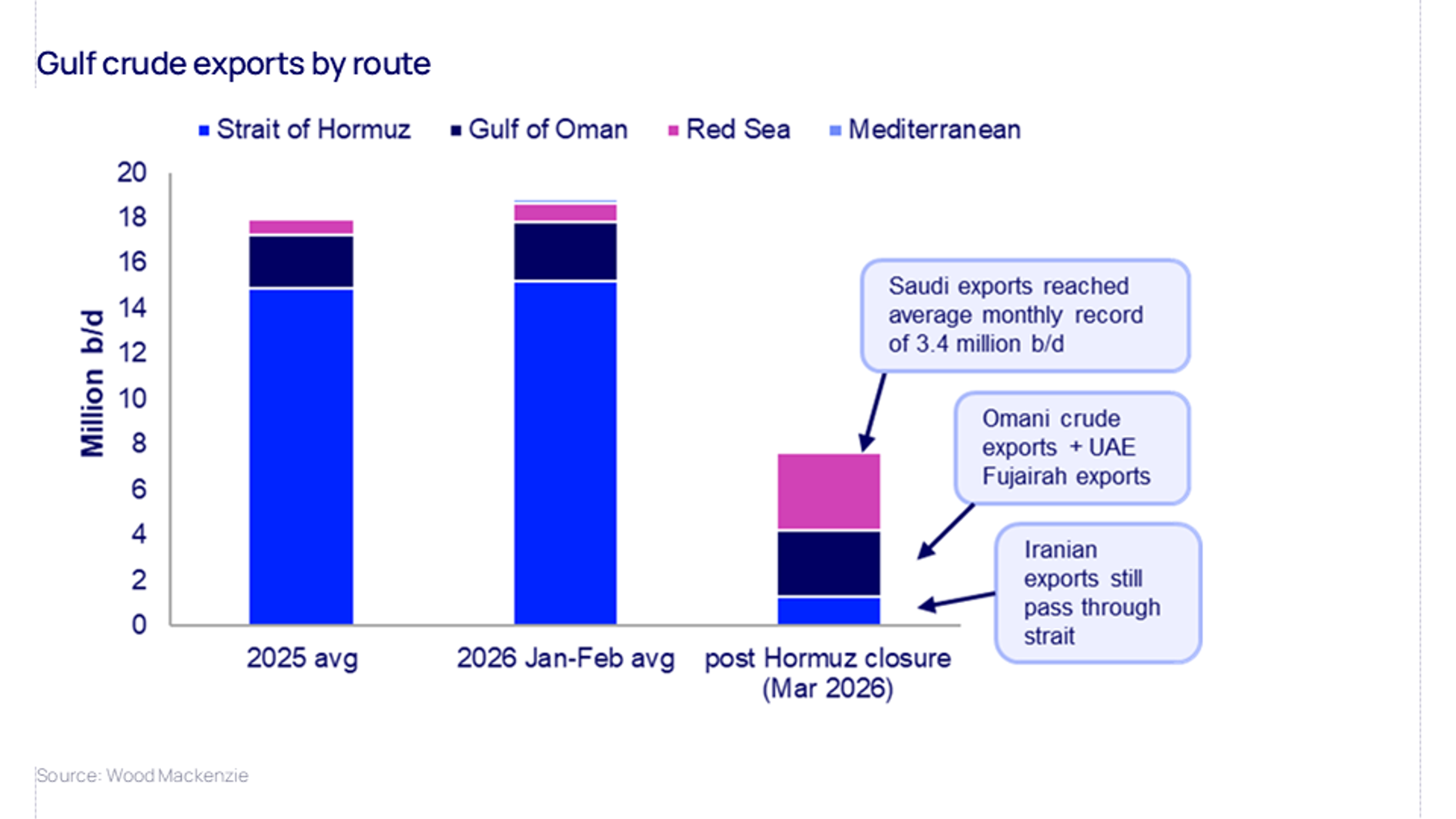
However, there was no sign that shipping traffic through the Strait of Hormuz had yet recovered to pre-war levels, even though reopening the strait was a key condition of the ceasefire. Iran’s Islamic Revolutionary Guard Corps (IRGC) published a map of the strait that it said showed areas that had been mined and were unsafe for shipping, and a purported safe corridor that all approved vessels should use. The IRGC has reportedly been demanding payments in cryptocurrency to allow ships to pass through the strait.
Dr Sultan Al Jaber, minister of industry and advanced technology for the UAE and managing director and group CEO for ADNOC, warned that “the Strait of Hormuz is not open”. In an article posted on LinkedIn, he sounded the alarm over the escalating impact of the crisis, which grows every day that the strait remains closed. “The Strait must be open – fully, unconditionally and without restriction,” he wrote. “Energy security and global economic stability depend on it.”
Separately, Saudi Arabia reported multiple attacks on its energy facilities. There was damage to a pumping station on the East-West pipeline, used as an exit route for Saudi crude exports to avoid the Strait of Hormuz. That will cut the flow on the pipeline by about 700,000 barrels a day.
A production facility at the Manifa field was also hit, cutting about 300,000 b/d from its production capacity. Added to earlier damage at the Khurais facility, that brings the total loss of the kingdom’s production capacity to about 600,000 b/d.
Saudi refineries on the Gulf and on the Red Sea have also been hit.
Brent crude was trading at about US$96 a barrel on Friday morning, well down from its peak at the end of March of about US$119 a barrel, but still significantly higher than its pre-war level of about US$70 a barrel.
For an overview of what the ceasefire could mean for global energy, take a look at the most recent The Edge column, by Wood Mackenzie’s chairman Simon Flowers and other colleagues.
In brief
Claudia Sheinbaum, Mexico’s president, has set a goal of increasing the country’s gas production to cut its dependence on US imports. “If we don’t do anything, we will be importing more and more,” President Sheinbaum said. “What’s the problem with importing? Just look at how lots of countries in the world are suffering because of what happened in Iran.”
Ramping up production from Mexico’s unconventional gas resource base would require increased use of hydraulic fracturing, a technique that has been highly controversial in the country.
Big tech companies, including Amazon, Google and Microsoft, are facing questions from investors about their energy use and carbon emissions. Trillium Asset Management is one of the fund managers that has raised concerns, reportedly filing a resolution with Alphabet seeking clarification on how the company plans to meet its climate goals.
Alphabet aims to halve its full value chain emissions from 2019 levels by 2030, but those emissions have been rising. Other organisations raising the issue with shareholder resolutions at tech companies and utilities include As You Sow and the Presbyterian Church USA.
Toshihiro Mibe, chief executive of Honda, recently visited China for a first-hand view of its car industry, and returned with a bleak message for his peers. After seeing a components supplier, he told Nikkei Asia: “We have no chance against this.”
His comment follows similar warnings from the CEOs of Ford and Toyota about the strength of the competition they face from Chinese manufacturers. The car industry in China is seen as having much greater agility and efficiency than its international rivals.
Other views
The energy security opportunity for North Sea oil & gas – Gail Anderson and Lewis Lawrence
US Rockies gas: right place, right time, right economics – Jennifer McNally
States are struggling to meet their clean energy goals. Data centers are to blame – Jessica Hill
EVs represent all that’s wrong with US industrial policy – Scott Lincicome
Quote of the week
“It’s helpful to recognize that the world’s economy is far larger and more diversified and far less reliant on energy as an input versus 20 years ago. Global energy consumption to the global gross domestic product (GDP) is only about 40% of what it was around 45 years ago, say in the early 1980s, and the United States, instead of being a major importer on a net basis, is now a major exporter. All of this may very well mean that the economy is more resilient”.
Jamie Dimon, chairman and CEO of JPMorganChase, used his annual letter to shareholders to assess the key risks for the world economy and markets, including the wars in Iran and Ukraine. He argued that the lower oil-intensity of global GDP should help make the world economy more resilient than in previous energy price shocks.
Dimon also highlighted JPMorganChase’s Security and Resiliency Initiative, its US$1.5 trillion programme of financing and investment for critical US industries, including energy.
Chart of the week
This comes from a new Wood Mackenzie note, ‘The Great Power divide – the Middle East crisis is splitting global power markets into winners and losers’. It shows the potential impact of higher gas and coal prices on electricity generation costs in the world’s leading economies.
The base case shows our forecast from late March, based on an assumption of a short conflict and a relatively rapid restoration of traffic through the Strait of Hormuz. The high-price sensitivity case shows what could happen if international gas and coal prices remain elevated until the end of 2026.
The impacts are greatest in countries with a high exposure to imported fuel, including Italy, Japan, the UK and South Korea. Among the most resilient are India and France, which both have very low shares for natural gas in their power generation mix.

Get The Inside Track
Ed Crooks’ Energy Pulse is featured in our weekly newsletter, the Inside Track, alongside more news and views from our global energy and natural resources experts. Sign up today via the form at the top of the page to ensure you don’t miss a thing.