


Get Ed Crooks' Energy Pulse in your inbox every week
What could change in Venezuela mean for oil production?
The country’s industry desperately needs operational and financial support
1 minute read

Ed Crooks
Vice Chair Americas and host of Energy Gang podcast

Ed Crooks
Vice Chair Americas and host of Energy Gang podcast
Ed examines the forces shaping the energy industry globally.
Latest articles by Ed
-
Opinion
The mother of all disruptions
-
Opinion
Higher energy prices raise stagflation fears
-
Opinion
A power producer’s view of keeping the lights on. What does rising electricity demand from data centers mean for the US grid?
-
Opinion
Oil prices rise despite IEA reserves release
-
Opinion
The war with Iran: what does the disruption in the Strait of Hormuz mean for global energy?
-
Opinion
Iran conflict a test of US energy supply response
President Donald Trump issued a message this week commemorating the anniversary of the Monroe Doctrine, set out by President James Monroe on 2 December 1823. The doctrine “confidently asserts United States leadership in the Western Hemisphere,” the White House said. It gave examples of the Trump administration putting the principle into practice, including restoring privileged US access through the Panama Canal, and blocking the flow of illegal drugs through Mexico.
The original Monroe Doctrine was focused mainly on non-intervention: the principle that European countries should not seek to exert greater control over any territory in the Americas.
It was strengthened in 1904 by President Theodore Roosevelt, who stated that the US might have a responsibility to intervene in Latin America and the Caribbean, in cases of societal breakdown or “chronic wrongdoing”. That principle became known as the “Roosevelt corollary”.
In his message this week, President Trump described his administration’s position as the “Trump corollary”, meaning that “American leadership is coming roaring back stronger than ever before.”
This is not just a historical or theoretical issue. As President Trump says, his position on intervention in Latin America to defend US interests has had practical consequences. The US has recently built up its strongest naval force in the southern Caribbean since the Cuban missile crisis of 1962. Speculation is swirling in Washington that the US could push for regime change in Venezuela.
From an energy perspective, the big question is what that might mean for the country’s oil production. Venezuela has one of the world’s largest oil resource bases. But the combined impact of domestic mismanagement and international sanctions has driven its production down from over 3 million barrels a day in the early 2000s to about 2 million b/d in 2017 and 0.9 million b/d in 2025.
Relations between Venezuela and the US over oil are complex. In 2022, after Brent crude had soared to over US$120 a barrel, the Biden administration gave Chevron a licence to produce and export oil from Venezuela. President Trump announced in February that the licence would be revoked, but in July it was renewed, with some restrictions. Chevron has accounted for roughly a quarter of Venezuela’s output this year.
A US agreement with Venezuela, including a commitment to free and fair elections – unlike last year’s – could mean sanctions being lifted and increased foreign investment in the country’s oil industry.
Scott Bessent, the Treasury secretary, last month raised the prospect that change in Venezuela, along with a peace agreement between Russia and Ukraine, could boost oil supplies and drive down prices to benefit US consumers.
“I think there’s a very good chance that if something happens with Russia-Ukraine, if something happens down in Venezuela, that we could really see oil prices go down even more,” he said. “Oil and gasoline prices are down substantially under President Trump. And really the key to affordability is lower energy [prices].”
There are large uncertainties in the outlook. It is not clear that the US will push for regime change in Venezuela, or how such an attempt might play out if it did. But for oil markets, it is clearly worth considering what the outcomes for Venezuela’s industry might be.
The Wood Mackenzie view
Venezuela’s upstream oil industry desperately needs more operational and financial support, Wood Mackenzie analysts say. If sanctions were lifted and that support became available, it could have a significant impact on the country’s production, in both the short and long term.
Some increase would be possible relatively quickly as a result of improved operational management, says Adrian Lara, Wood Mackenzie’s principal analyst for Latin America upstream. “Our assumption is that there are a lot of wells that just need a workover,” he says. “You can boost production through opex, without needing much new capex.”
Operational improvements and some modest investment in the Orinoco Belt heavy oil region could raise Venezuela’s production back to the levels of the mid-2010s at around 2 million b/d within about two years, given the most favourable conditions.
Going beyond that would require significant investment, probably focused on the Orinoco Belt. Most of the upgraders needed to process the region’s oil went offline between 2019 and 2021, and the ones that remain in service need consistent expenditure to keep running.
Wood Mackenzie estimates that the Orinoco Belt joint ventures between the national oil company PDVSA and international oil companies would need US$15 billion to US$20 billion of investment to ramp up over the next 10 years, to add another 500,000 b/d.
The example of Iraq shows that regime change and ending sanctions can lead to material changes in oil output. In 2002, shortly before the US-led invasion, Iraq’s production was about 2 million b/d. By 2019, it was more than double that, at about 4.7 million b/d.
But that growth came at a time of steadily increasing global oil demand, primarily driven by China, and a generally supportive price environment. 2025 has been a year of downward pressure on oil prices, created by expectations of slowing demand growth and increased OPEC+ production.
Venezuela’s OPEC membership also raises questions about possible restrictions on future production growth. International companies will need to be reassured that conditions are right before stepping up investment in Venezuela, after some bruising experiences over the past 25 years. Lifting sanctions may be a necessary but not sufficient condition for a long-term revival in the country’s oil industry.
New OPEC+ capacity audits launched
The members of the OPEC+ group of countries have finalised plans for annual independent assessments of their oil production capacity, to set baselines for future output agreements. The first round of audits, to be completed by September next year, will be used to set new OPEC+ production limits, from January 2027. The plans confirm an agreement on capacity assessments first announced in May.
Having independent audits will make assessments of production capacity more transparent and consistent. There will be a common standard for maximum sustainable capacity (MSC), defined as the maximum number of barrels per day of crude oil that can be produced within 90 days and sustained continuously for one year, including all planned maintenance. The audits will mostly be done by the US consulting firm DeGolyer and MacNaughton, news services said, except for those for Russia, Iran and Venezuela.
The plans were finalised at online meetings of OPEC and OPEC+ ministers over the weekend. Prince Abdulaziz bin Salman, Saudi Arabia’s energy minister, reportedly described the meetings as one of the most successful days in his career.
As a result of the new independent audits, the countries that have invested in capacity expansion in recent years will be looking to receive increased production targets. Wood Mackenzie analysts said in our latest Macro Oils Short-Term Outlook that the new policy would be expected to lead to a fairer and more transparent quota system, reducing division within the OPEC+ group. It will also encourage investment in overall supply capacity, helping to stabilise the market. This is most likely across the key Middle East producers, where low-cost development is more prevalent.
Big Tech and political leaders set out their views on grid connections for new large loads
The consultation period for the Trump administration’s proposed rules for connecting large loads to the grid ended on Friday 5 December. Businesses, politicians, regulators and lobby groups have been submitting their responses to the proposals, which are intended to expedite grid connections for new large loads such as data centres. The proposed rules would give the Federal Energy Regulatory Commission (FERC) authority over large loads connecting directly to the transmission grid.
The proposal has so far received mixed reactions. Governors Josh Shapiro of Pennsylvania and Glenn Youngkin of Virginia, two states that are hot spots for new data centres, submitted a joint statement supporting the administration’s plan overall, but raising concerns about setting the threshold for “large” loads at just 20 megawatts.
FirstEnergy, the utility group, suggested that the threshold for large loads should be increased tenfold, to 200 MW. It also urged FERC to limit the scope of any final rule, to “help mitigate unintended consequences” and avoid introducing broader, more complex regulations that could end up actually slowing the pace of large load interconnections.
Google welcomed the administration’s focus on powering data centres but urged FERC to facilitate investment in digital and power infrastructure “in the shortest time possible”. That could mean, it added, incentives for co-located generation at data centres, flexible loads and demand response.
Cold weather pushes US gas prices higher
US gas prices have been rising, with benchmark Henry Hub this week going over US$5/mmBTU for the first time in more than two years. Colder-than-normal weather in the Midwest and eastern US has been pushing prices higher, while LNG export plants have seen record flows of gas.
Other views
Oil’s resilience in the energy system – Simon Flowers, Alan Gelder and Douglas Thyne
Five key takeaways from COP30 – Simon Flowers and others
How surging demand from EVs and data centres is reshaping Europe's electricity grid – Oliver McHugh
Five key takeaways from our Gastech 2025 Leadership Roundtables
Large energy users want power. Here’s how to protect other ratepayers from the costs
Flexible data centers: a faster, more affordable path to power
Why energy traders are sceptical of the data centre build-out – Martha Muir
Quote of the week
“In the next six, seven years, I think you’re going to see a whole bunch of small nuclear reactors… We’ll all be power generators… It takes the burden off the grid, and you can build as much as you need.”
Jensen Huang, chief executive of Nvidia, told podcast host Joe Rogan that he expected distributed small modular nuclear reactors would become a standard power source for AI data centres in the near future.
Chart of the week
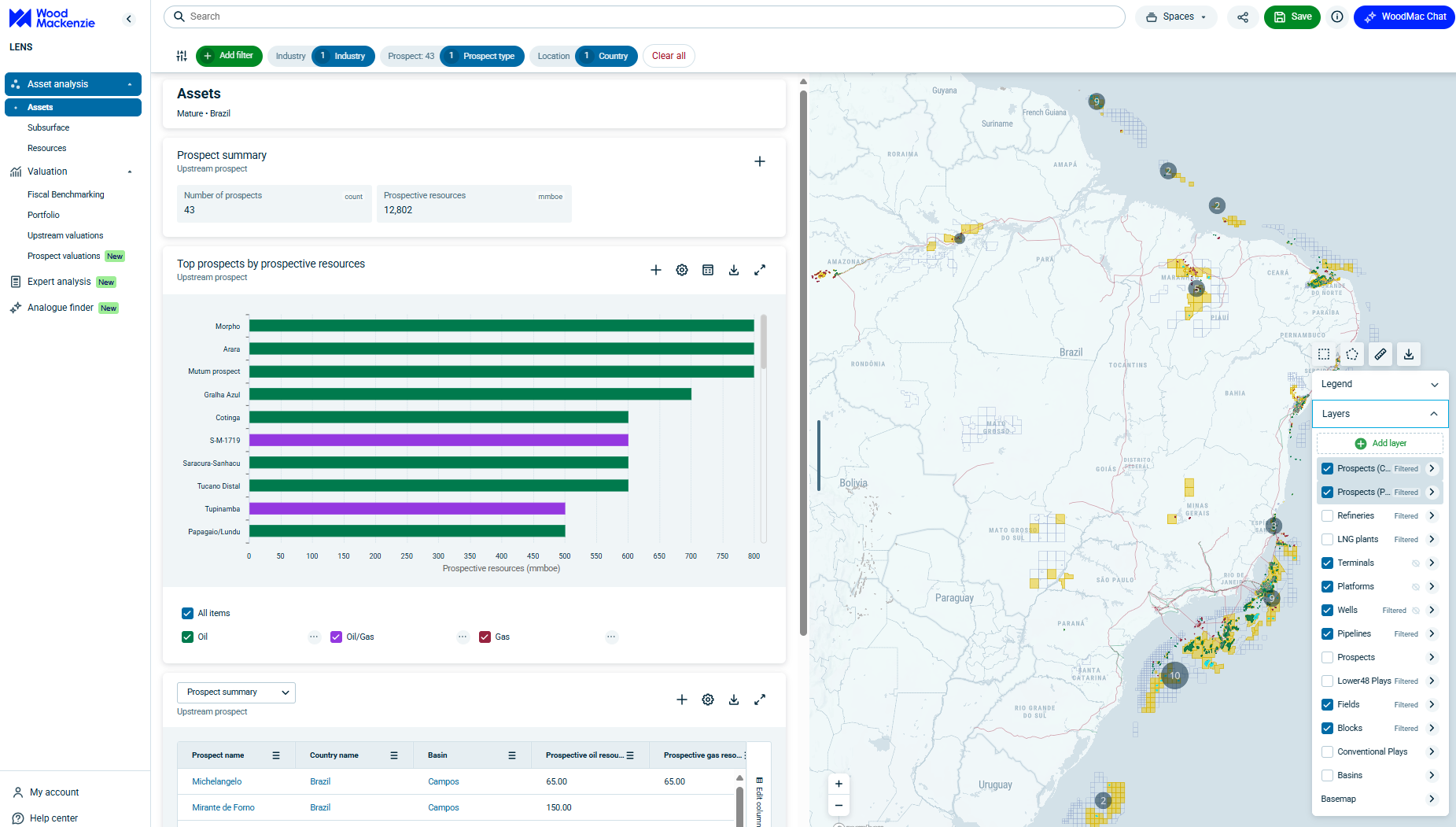
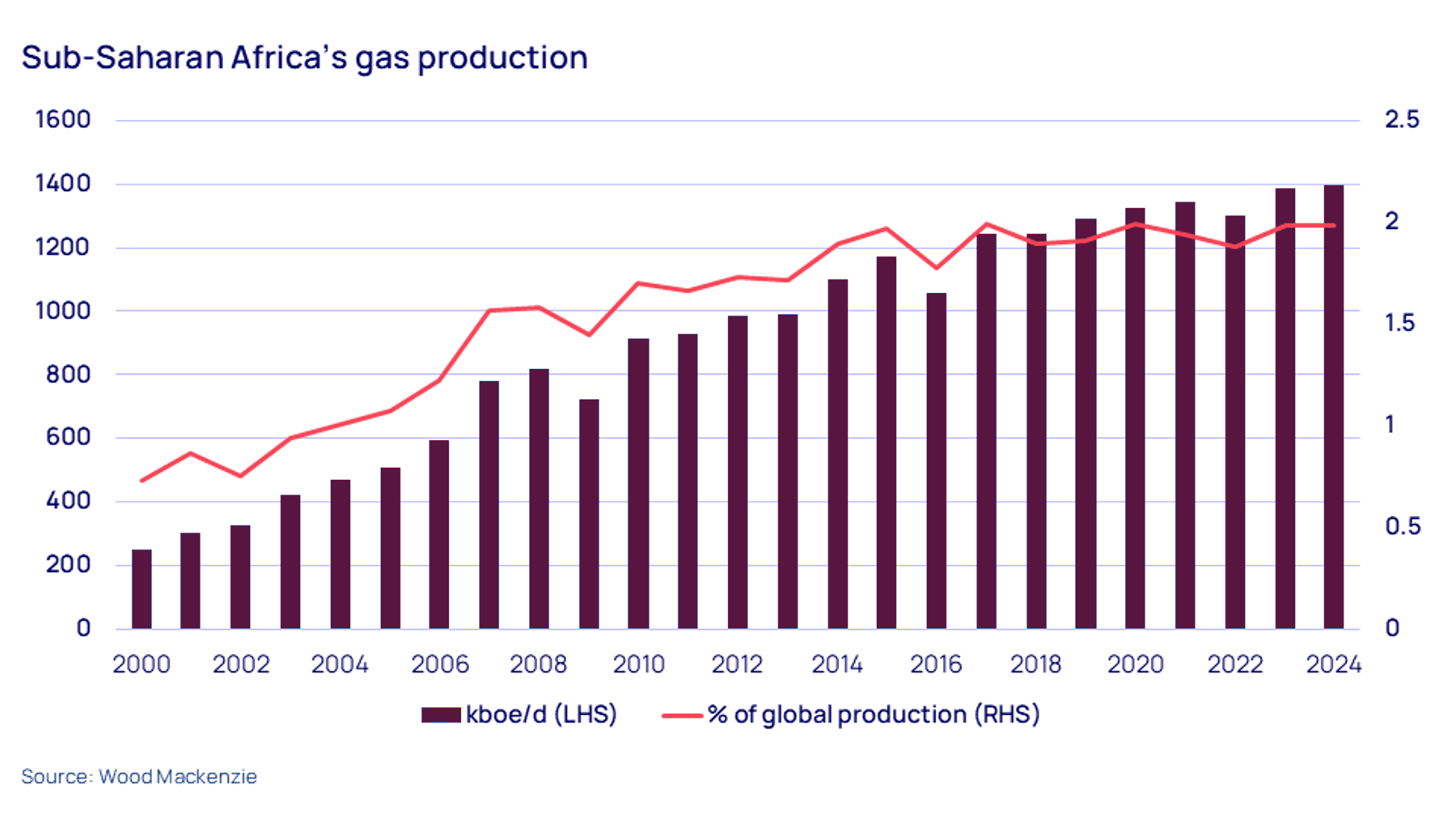
This is a version of a chart from our most recent Horizons report: ‘Asset rich, energy poor: maximising Africa’s natural resources to transform the continent’. It shows the natural gas production of sub-Saharan Africa, as shown on Wood Mackenzie’s Lens Upstream platform, both in absolute terms and as a percentage of global output.
The crucial point here is that although the region’s production has grown, it has stagnated as a share of the global total over the past 10 years. Wood Mackenzie’s Mansur Mohammed, the report’s author, argues that natural gas can play a greater role in Africa’s energy mix. LNG exports make sense for Africa, he says, but developing domestic gas markets, expanding gas power capacity and building out gas-based industries should also be used to help drive economic growth, displace oil products and reduce emissions.

Get The Inside Track
Ed Crooks’ Energy Pulse is featured in our weekly newsletter, the Inside Track, alongside more news and views from our global energy and natural resources experts. Sign up today via the form at the top of the page to ensure you don’t miss a thing.
Business as usual is over
Introducing the latest insight from our thought leaders, the book Connected: Bringing predictability to the increasingly uncertain world of energy.
As climate change accelerates and geopolitical tensions reshape global markets, the energy landscape has become increasingly interconnected. Connected explores why those interconnections have developed, and how they bring clarity to the most important decisions we make about the future of energy.
