



Discuss your challenges with our solutions experts
Powering the next economy: investment surge or cost surge?
Massive investment will be needed to meet expected electricity demand growth - how much of that growth is anchored by increasing costs?
1 minute read

Anna Shpitsberg
Vice President, Global Head of Research, Power and Renewables

Anna Shpitsberg
Vice President, Global Head of Research, Power and Renewables
Anna specialises in power markets, clean energy investment and supply chains.
Latest articles by Anna
View Anna Shpitsberg's full profileAmid electricity demand growth not seen in more than two decades, and in record volumes, the United States is attracting trillions of investment in generation and billions in electrical equipment. How certain is the opportunity and how much of this heightened investment is a result of higher costs that will need to be absorbed by consumers? These were the questions tackled by our Global Head of Power and Renewables Research, Anna Shpitsberg, at the 2026 ACORE Policy Forum.
The Forum brought together policymakers, corporate leaders, investors, utilities, legal experts, and clean energy innovators to tackle this theme head on, focusing on how durable, predictable energy policy enables long-term business certainty, and affordable clean energy.
Large-scale investment in generation will be needed to meet expected demand growth
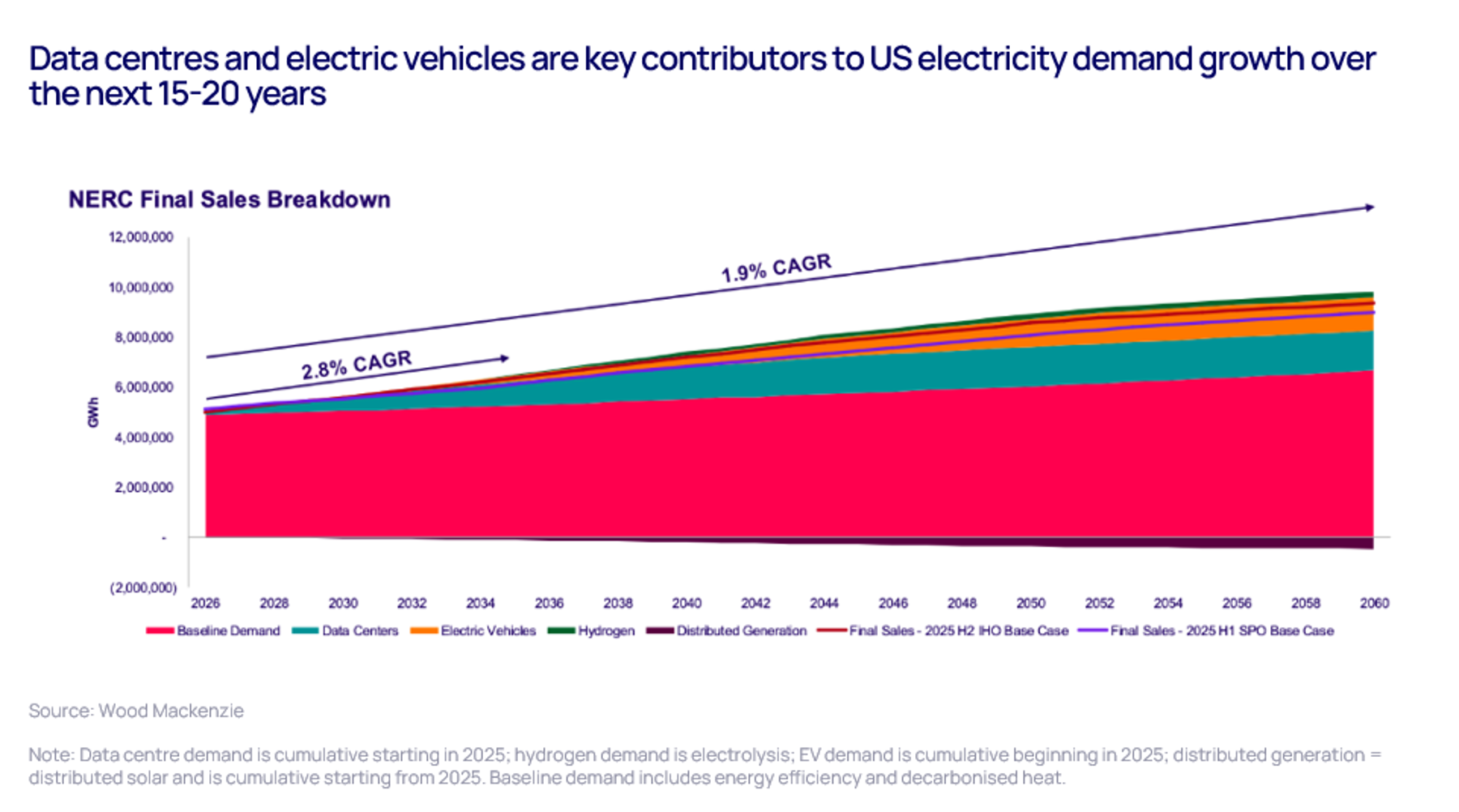
Wood Mackenzie estimates North American electricity demand to grow at a compound annual growth rate (CAGR) of 2.8% over the next decade. This increase will be driven by rapid data centre buildout to deliver processing power required to drive forward the commercialisation of artificial intelligence (AI). From the mid-2030s, electric vehicles (EVs) will make a significant contribution to demand growth; by 2060, datacentres will account for 17% of the region’s overall electricity demand, while EVs will account for 14% (see chart below).

Large-scale investment in new electricity generation will be essential to meet this surge in demand — we expect US$1.45 trillion in 2025 real dollars to be invested across generation technologies through 2035 in North America, of which the United States accounts for $1.36 trillion.
Committed demand is significant, as is the gap in capacity
Announcements of large load power demand amount to over 500GW. However, once we look under the hood, we see that commitments with a construction agreement, financial commitment, and/or a long-term service agreement amount to 183 gigawatts (GW) of additional demand. Though, significantly less than announcements, it is still equivalent to more than 20% of US peak demand in 2025.
The ability for supply to match demand is dependent on several factors, including location. More than 70% of these commitments are in ERCOT and PJM, two competitive markets where utilities are not responsible for ensuring adequate capacity in advance of signing an agreement. And as PJM has proven, supply will not flock to the market if the price point is not adequate. We estimate more than double committed load in PJM as there is risked accredited capacity in its interconnection queue. Will there be a reliability backstop auction that meaningfully narrows the gap? And at what cost?
New capacity needs to cover more than growth
Rapidly rising demand, coupled with the current administration’s pivot towards fossil fuels, has increased focus on thermal generation. We forecast about a quarter of total power and renewables generation investment in new projects through 2035 will be directed towards gas-fired capacity.
However, thermal power plant retirements, coupled with gas turbine shortages, mean that new gas builds and ramp up of existing thermal generation will meet a little over a third of overall US demand growth to 2030.
Given the need to meet increasing demand and substitute retiring assets, renewable and storage capacity additions will continue to support the US market. While there will be a relative lull as tax credits are withdrawn, cost and demand factors will enable growth across technologies.
Supply chains are ramping up but there is a lag in meeting “speed-to-power”
Supply chains are one of the greatest challenges to meeting demand at the speed initiated by the technology sector. For example, there is a 30% shortage of power transformers, critical technology for bulk transmission and grid interconnection. According to Wood Mackenzie’s proprietary real-time data, power and distribution transformer have average lead times of about three years, significantly above 2023 timelines.
In addition to domestic manufacturing announcements, other markets are ramping up to meet US demand, including South Korea and Brazil, which more than doubled imports of transformers over the last year.
We see a wide range of countries stepping up to produce generation technologies as well. Gas turbine imports increased 166% year-over- year, while renewable suppliers have shifted locations to meet changes in US policy. As a result, shifts in tariffs, impact build out plans and price points.
As the US becomes one of the most expensive markets to build power infrastructure, the cost of economic growth becomes a pressure point
Thanks to a perfect storm of surging demand, import tariffs and a severely strained supply chain, building new power infrastructure in the US has become more expensive than in any other major market.
Owing to the spike in demand for gas turbines, combined cycle plants have reached an average cost of $2500/kw. Manufacturing is ramping up, but costs are also impacted by the price of subcomponents, such as steel, copper, and specialty alloys. Meanwhile, commercial-scale solar systems cost nearly 50% more than in Europe on average - and almost three times that of China.
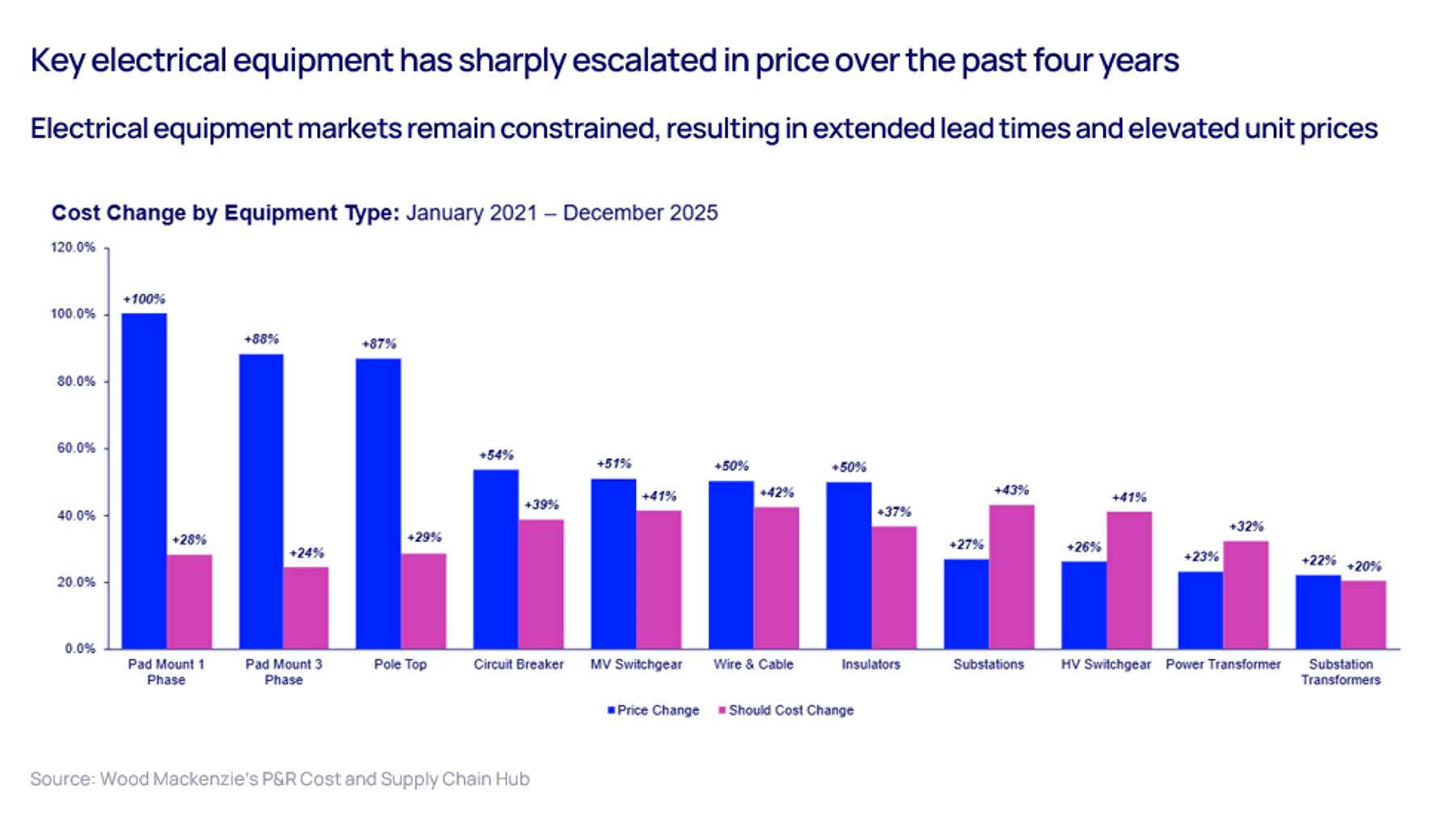
Electrical equipment, such as switchgears, circuit breakers, transformers, and wires and cables are not fairing any better, with increases ranging from 20-100% over the last year.
The soft costs of operating in the United States are increasing. Geopolitical shifts, including tariffs add volatility and premiums across technologies in the value chain.
This raises the question of how the cost of new infrastructure will be absorbed. Electricity prices increased 6.9% last year, far outpacing inflation and more than 200 gas and electric utilities have increased or proposed increasing rates.

More efficient equipment will bring costs down over time
Despite current uncertainties and increases in soft costs, innovation continues to drive efficiency improvements, which puts downward pressure on hard costs. Large amounts of revenue are being reinvested into research and development, and each 10% increase in deployment brings levelised costs for solar, wind, battery storage and nuclear power down by as much as 3%, depending on the technology.
The sweet-spot is maintaining deployment levels that support these declines, while reducing non-infrastructure costs, so the build out allows for affordable prices that drive economic growth across sectors.
Learn more
Don’t forget to fill out the form at the top of the page to access the presentation, which contains a wide range of charts and data. These include breakdowns of expected capex and capacity additions by technology, capacity shortfalls, equipment costs and lead times, and more.
Plus, join us in signing up to the upcoming ACORE Finance Forum on May 13th-14th this year in New York, where we'll continue to explore these themes and more with some of the greatest minds in the energy and investment industries.