


Find out how our Consulting team can help you and your organisation
Reassessing Canadian Export Infrastructure
What has changed in the last 7 months, and what challenges lie ahead for Canada?
2 minute read

Kian Akhavan
Consultant, EMEA

Kian Akhavan
Consultant, EMEA
Kian is a specialist in public policy, with a focus on public-private partnerships.
Latest articles by Kian
-
The Edge
Is there still life in decarbonising hard-to-abate sectors?
-
Opinion
Reassessing Canadian Export Infrastructure
-
Opinion
Evaluating infrastructure and optionality in Canadian hydrocarbon exports
-
Opinion
How public-private partnerships can accelerate the energy transition
Seven months after the federal election, Prime Minister Mark Carney has gone all-in on developing Canadian export infrastructure.
Key "nation building projects" – for many of which Wood Mackenzie serves as an adviser – have gained renewed attention as the country looks to expand its footprint in the global commodities trade and diversify its trading partners away from the United States. This Insight builds on previous analysis and evaluates the changes and challenges facing Canadian natural resources exports.
Carney's infrastructure push gain momentum
Build, baby, build!
Since his election in April, Canadian Prime Minister Mark Carney has made "nation-building projects" a central part of his policy agenda. This includes heavy investment in export infrastructure to diversify consumers of Canadian goods, including natural resources.
To that end, the government has passed the Building Canada Act and established the Major Projects Office (MPO) to fast-track regulatory approval of major infrastructure projects deemed to be in the national interest.
While these projects have yet to be commissioned and face many political, economic and logistical hurdles, the outlook appears promising. The government has identified strategically significant projects that have the potential to transform Canada's standing as a major global commodities exporter.
Critical minerals strtegy targets global supply chains
Canada’s new Critical Minerals Strategy seeks to position the country as a major and reliable supplier of critical minerals, focusing on the entire value chain – from exploration and extraction to manufacturing and recycling end-of-life products.
The MPO is evaluating several projects to increase Canada’s mining output. Of note, the Red Chris mine expansion in British Columbia will increase national copper output by over 15%, while the McIlvenna Bay mine in Saskatchewan will produce large quantities of both copper and zinc, positioning Canada as a key supplier of raw materials vital to the production and transmission of renewable energy.
In Eastern Canada, Ontario’s Crawford Project is slated to produce ultra-low carbon nickel, cobalt, chromium and platinum-group metals, all of which are crucial components of batteries. Furthermore, the Matawinie graphite mine in Quebec will be integrated with a facility to refine products for use in batteries and broader industrial applications. The opening of the Sisson Mine in New Brunswick will restart tungsten and molybdenum production in Canada since the country’s last mine was shut down in 2015. These minerals have both civilian and military uses, including in steel and military munitions – vital when countries are rearming rapidly.
Northern ports unock remote mining potential
A key issue in the mining sector is often not building a mine or extracting minerals but rather getting products to market by connecting remote mines to export infrastructure. To that end, the MPO is evaluating the Port of Churchill Plus project, which seeks to upgrade the Port of Churchill, improve the existing rail line feeding into it and build a new all-weather road to allow year-round access to key trade corridors between central Canada and global markets through the Arctic and Hudson Bay.
Separately, the Canadian Infrastructure Bank has announced its support of the Grays Bay Road and Port project, which will see the construction of a deep-water port in Nunavut. This would connect remote gold and base metals mines in the far north to global markets via the increasingly navigable Northwest Passage. Although still at a very early stage, these projects can potentially transform the Canadian North by making it a major exporting region with convenient access to both Asian and European markets.
Canada is also investing large sums in expanding existing ports, recently announcing a $6 billion fund for developing trade and transportation infrastructure with the aim of exporting an additional $300 billion of products. This stands to benefit the economy as a whole but will be particularly valuable for exposing existing industries like steel and aluminium, which have suffered as a result of the ongoing trade war with the United States, to new markets.
LNG expansion faces supply glut concerns
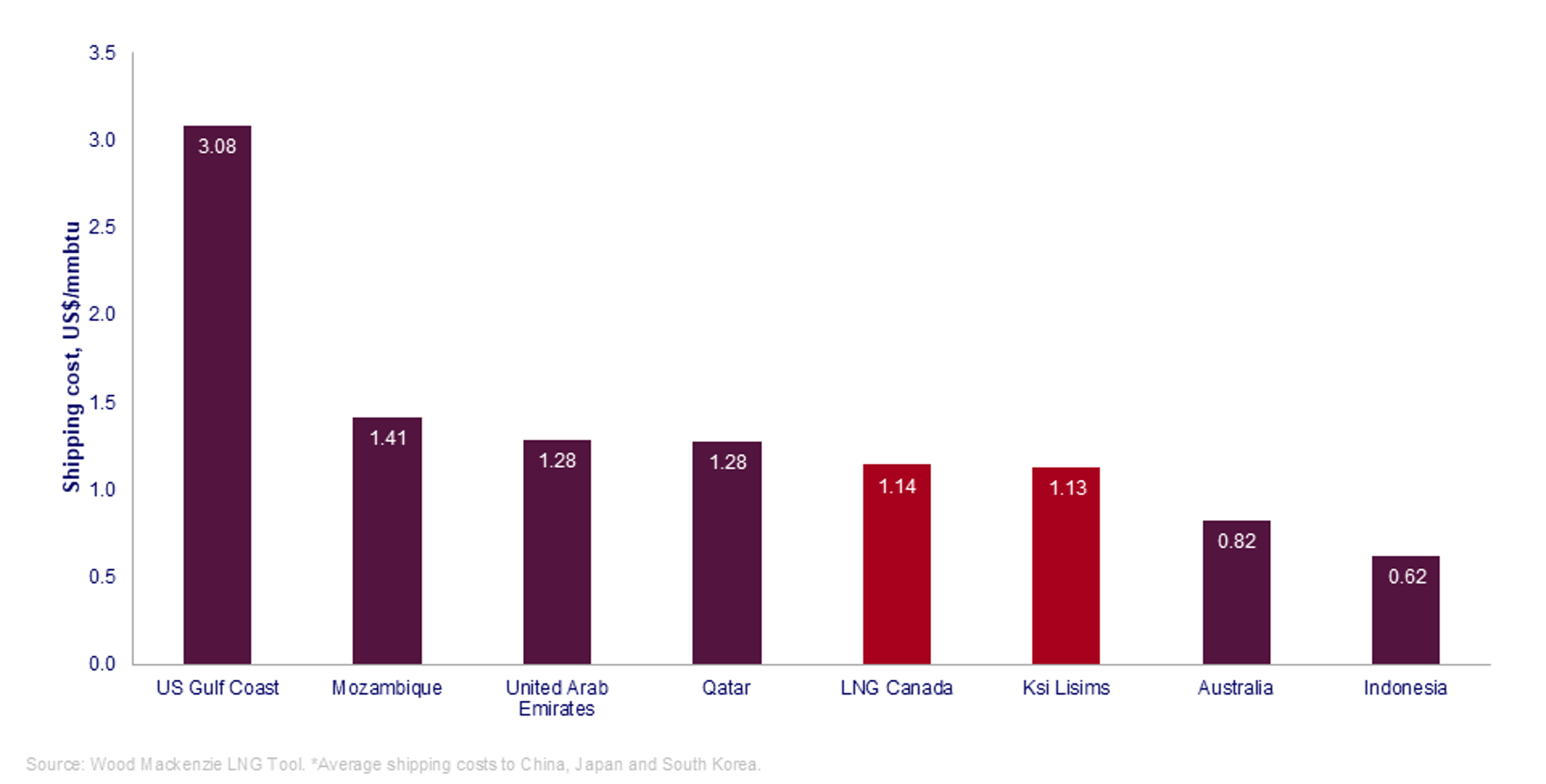
Since Canada's historic first LNG shipment from Kitimat, British Columbia, in June, the federal government has referred Phase II of LNG Canada and Ksi Lisims LNG to the MPO. Ksi Lisims, to be located near Gringolx, at the top of Canada's Pacific coast, promises to serve East Asian markets via the shortest marine route from North America.
The economics of new LNG export terminals have changed significantly in recent months, as enormous volumes of new capacity have been approved to be brought online before the end of the decade. This has raised fears of a supply glut putting downward pressure on prices, challenging the potential profitability of many terminals. Liquefaction facilities seeking to reach FID must navigate this commercial uncertainty quickly and deftly to secure offtake contracts before prices drop further, ensuring that their projects are economically sound.
At the same time, there is demand uncertainty in many key markets. China, for example, has signed deals to receive up to 100 billion cubic metres of piped gas from Russia at the same time as it is increasing its domestic production. LNG demand will continue, though, and Ksi Lisims is likely to be a strong candidate to supply Chinese demand. However, it will have to compete with American, Australian and Middle Eastern facilities, many of which can offer lower-cost cargoes. However, while cargoes from most regions must pass through major chokepoints like the Panama Canal, Malacca Strait and Strait of Hormuz, the route from Ksi Lisims is open ocean.

Oil pipeline proposal faces political headwinds
The November 27th memorandum of understanding between the federal government and the government of Alberta includes a provision to build a privately financed oil pipeline from Alberta to the north coast of British Columbia. A formal proposal is scheduled to be submitted to the MPO by July 1st, 2026.
Any new oil pipeline in western Canada faces significant hurdles beyond the challenges of building infrastructure through over one thousand kilometres of dense forest and mountains; there are few issues in Canadian politics as polarising as an oil pipeline.
Any piece of infrastructure that crosses multiple jurisdictions – no less one as politically fraught as an oil pipeline – requires the full buy-in of all stakeholders, not just as hosts but also as economic partners. This reduces risk and accelerates both regulatory approval and project execution. A key challenge for this new prospective pipeline will be to win the support of the government of British Columbia and of Indigenous nations, both of whom have expressed strong opposition to this project.
A new oil pipeline faces significant economic challenges as well. No private company has yet to publicly express interest in building a new pipeline, likely because few companies have the risk tolerance to spend $20-30 billion in an oil market on the brink of oversupply, where prices are forecast to hit a floor below $56/bbl in 2026. While prices will most likely be higher by the end of the decade, Wood Mackenzie predicts that global demand for oil products will peak by 2032, possibly within a matter of months of any new pipeline being commissioned. Markets in the Pacific basin are expected to make up an estimated average of 40% of total annual demand through 2050, but refiners may not want to import large volumes of heavy, sour Canadian crude.
A new era?
The global appetite for natural resources is insatiable. Even if demand and pricing outlooks appear uncertain, Canada's infrastructure development priorities position it well to supply massive enduring demand for metals, minerals, oil and gas in key markets.
As the Prime Minister himself said, "Canada has what the world wants". Since April, the country has taken significant strides to develop its natural resources export infrastructure.
While significant political, economic and logistical challenges remain, the overall outlook appears positive. If stakeholders can navigate this uncertainty shrewdly and execute projects efficiently, Canada can cement its role as a global energy superpower.
Fill in the form above to find out how our Consulting team can help you and your organisation.