




Discuss your challenges with our solutions experts
Rising retail rates are accelerating commercial solar payback periods
Escalating electricity prices create a new landscape for post-ITC commercial solar development
1 minute read

Amanda Colombo
Research Analyst, US Solar

Amanda Colombo
Research Analyst, US Solar
Amanda’s areas of focus include commercial solar policy and public company financial landscape analyses.
Latest articles by Amanda
-
Opinion
Rising retail rates are accelerating commercial solar payback periods
-
Opinion
US distributed solar companies navigate economic headwinds
The US commercial solar sector is entering a pivotal transition. As the ITC phases out under the One Big Beautiful Bill Act (OBBBA), developers must adjust to a future less reliant on federal incentives. Yet even as the sector prepares for this shift, rising retail electricity rates are emerging as a powerful driver of project economics.
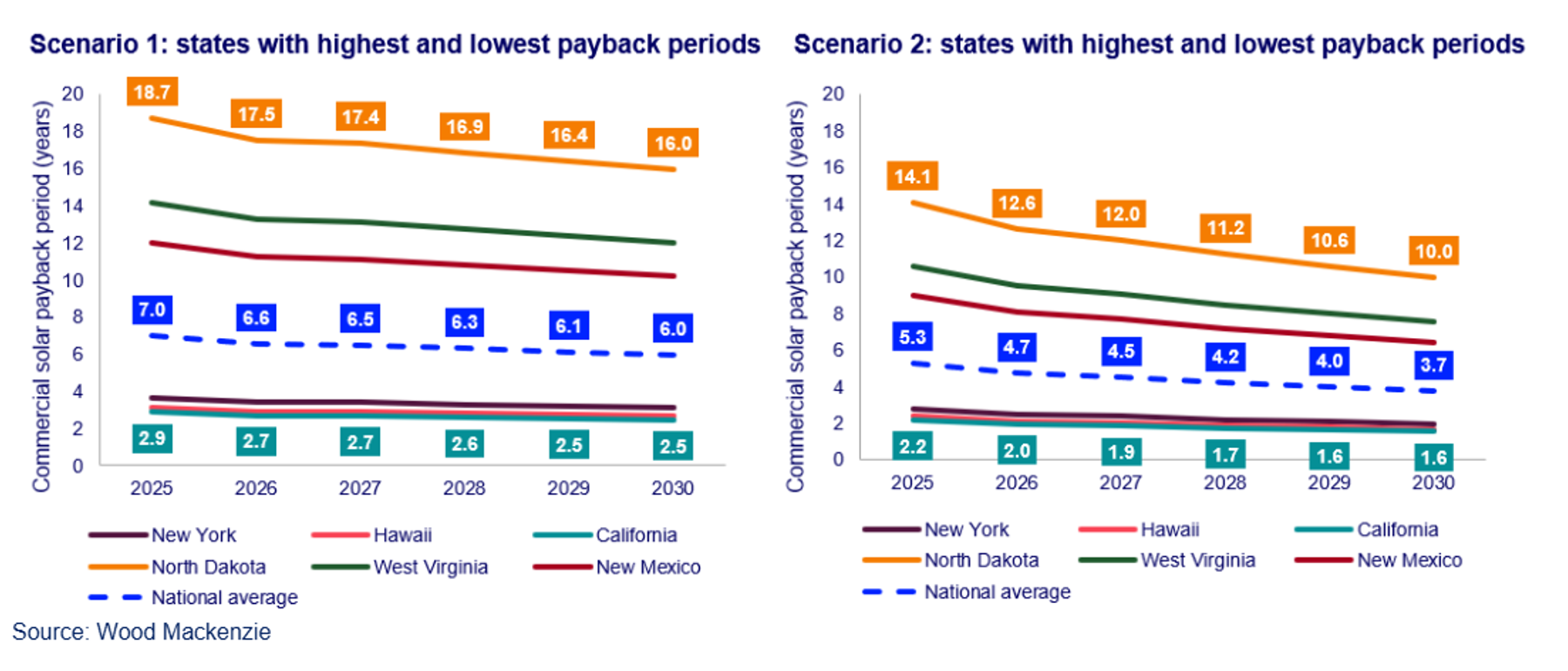
In our new insight, How retail rates shape commercial solar payback periods, we examine how escalating retail rates - driven by data centre and overall demand growth, electrification and mounting grid constraints - are reshaping commercial solar returns across the nation. The insight models two retail rate escalation scenarios for a standard 2 MWdc commercial solar system. Increasing average annual retail rate growth from 2% to 6% between 2026 and 2050 reduces the national average payback period for a commercial solar project from 6.3 years to 4.2 years - a 33% decrease driven solely by higher electricity prices.
This shift underscores a fundamental reality of the post-ITC era: as grid power becomes more expensive, the value of offsetting energy costs grows dramatically. Even without federal tax support, commercial solar becomes increasingly attractive in markets where retail rates are rising more rapidly.
State level variability remains wide, with a 12 year spread between most and least favourable markets
Despite applying the same retail rate growth percentages across all states, the analysis finds significant differences in payback periods due to underlying retail rates:
- California consistently shows the shortest payback periods, reflecting its high commercial electricity prices and strong solar market maturity.
- North Dakota has the longest payback periods, driven by comparatively low retail rates.
- The gap between the highest and lowest states is roughly 12 years in both modeled scenarios.
States like Hawaii, California, New York, Massachusetts, and Connecticut - where commercial electricity prices are already elevated - naturally see the strongest economics. These states also rank among the top markets for cumulative commercial solar installations through 2025, which is unlikely a coincidence.

Retail rates matter - but local incentives still play a critical role
While retail rate escalation is a powerful driver of project economics, local policy environments also remain essential in a post-ITC world. State rebates, utility-level incentives and regulatory structures can meaningfully improve payback periods, especially in markets where retail rates alone are insufficient to make project economics attractive.
Developers report that client needs are becoming more individualised, increasing the importance of tailored project strategies, trusted local developer-client relationships, as well as consistent communication and risk management. As federal incentives decline, market continuity will depend on project economics, but also strong local policies.
The next phase of commercial solar growth will be shaped by a combination of rising retail rates, local policy dynamics, and increasingly customised development approaches. Developers must adapt to a landscape where retail rate trajectories drive payback periods more than ever, state and utility incentives fill the gaps left by the ITC, and client priorities vary widely, from risk mitigation to rapid deployment.
In this environment, the ability to deliver tailored solutions - and to build trustbased relationships - will be a defining competitive advantage. As electricity demand surges and retail rates climb, commercial solar is poised to become an even more valuable tool for businesses seeking cost savings and long-term energy resilience.
Moreover, the path forward will require navigating a more complex, localised and incentive-sensitive market. In a post-ITC world, rising retail rates are a catalyst accelerating commercial solar payback periods nationwide.