


The South Atlantic’s next exploration chapter
Analysis of two very different basins points to where the next round of oil and gas capex in the South Atlantic should go.
2 minute read

Fiona Piggott
Research Analyst, CCUS Subsurface

Fiona Piggott
Research Analyst, CCUS Subsurface
Fiona works on insights and analysis for CCUS subsurface in the US Gulf of Mexico, US Gulf Coast and Latin America.
Latest articles by Fiona
View Fiona Piggott's full profile
Jessica Ciosek
Senior Manager, Subsurface Research

Jessica Ciosek
Senior Manager, Subsurface Research
Jessica Ciosek, VP of Exploration & Subsurface Research focuses on deepwater, industry trends, and market adaptation.
Latest articles by Jessica
-
Opinion
The South Atlantic’s next exploration chapter
-
Opinion
Wells to watch 2026
-
Featured
Subsurface 2026 outlook
-
Opinion
Daenerys: the Gulf of America/Mexico’s biggest discovery since 2017

Alexander Connelly
Senior Research Manager, Subsurface

Alexander Connelly
Senior Research Manager, Subsurface
Latest articles by Alexander
View Alexander Connelly's full profileThe South Atlantic is the defining frontier of conventional deepwater exploration, and two of its anchors look nothing alike: one approaching 50 years of drilling, the other barely tested. Yet on the Upper Cretaceous play they share, the frontier Southwest African Coastal Basin is analogous to what a re-imaged ultra-deepwater campaign in Brazil’s mature Santos Basin could deliver.
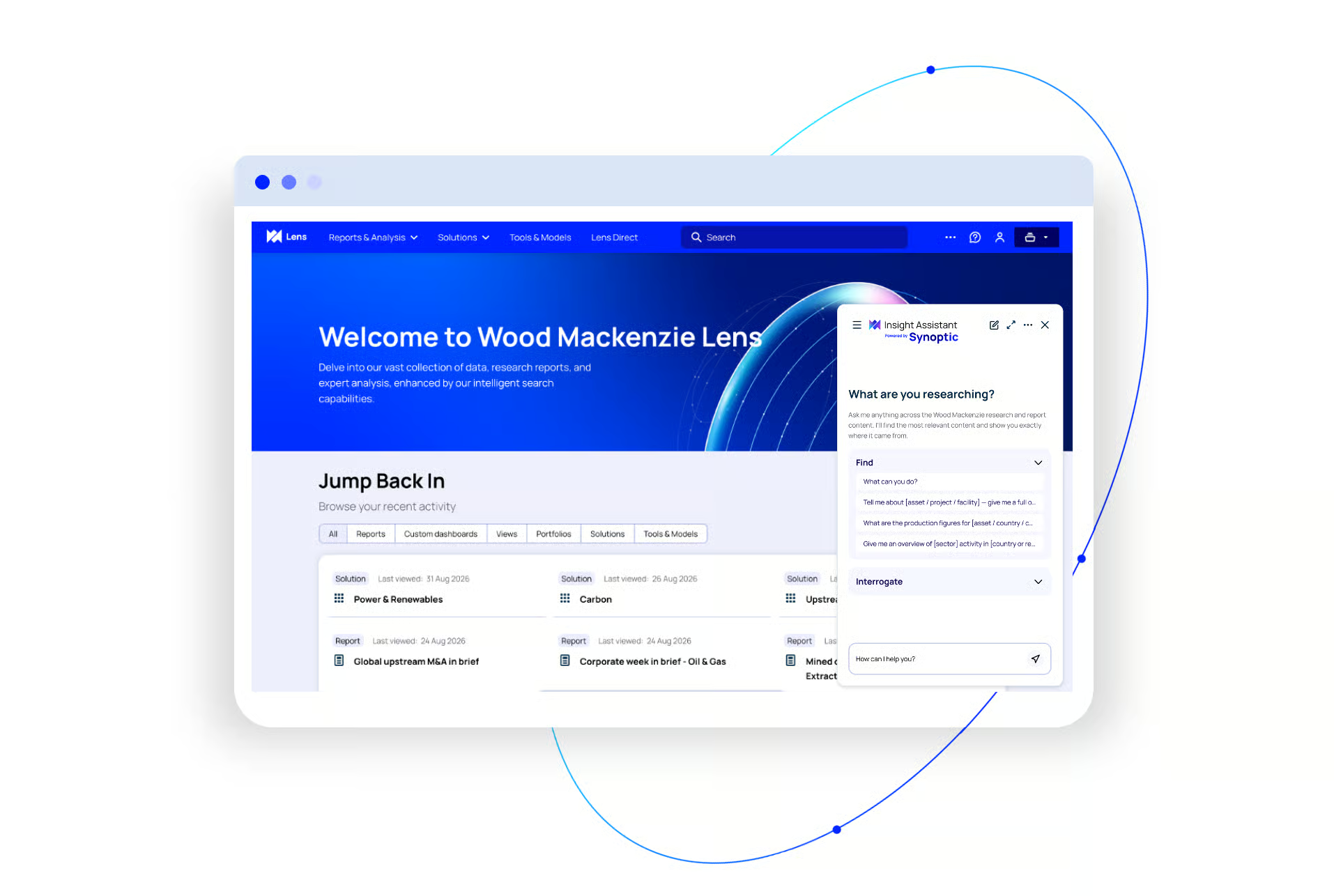
In a new long-form report, Wood Mackenzie’s expert analysts used the Conventional Plays dataset in our Lens Subsurface modelling tool to move from high-level benchmarking of the region’s five key basins to play-level comparison of the two analogues. We have created a concise insight from the full report for upstream exploration, subsurface and new ventures professionals looking to identify the next South Atlantic opportunity.
In this report:
- Benchmarking the South Atlantic play: a clear hierarchy across five basins
- Where five-basin exploration capex is currently focused
- Why discovered ultra-deepwater reserves in the Santos Basin understate its true potential
- Where the economics of the two margins diverge, and why
- Where the next South Atlantic opportunity lies
The South Atlantic oil and gas play’s five key basins: shared geology but different maturities
While separated geographically, the five most prolific offshore basins in the South Atlantic share the same geology. Campos, Santos, Guyana, Côte d'Ivoire and SW African Coastal basins were all formed when the African and South American tectonic plates ripped apart in the Early Cretaceous period.
Over 1,400 exploration wells have been drilled across the five basins, with a quarter making a discovery, 57% of those discoveries in Upper Cretaceous Sandstone plays. But the five basins sit at very different stages of maturity. Santos and Campos are mature and Guyana is mid-cycle with strong momentum. Côte d'Ivoire has yet to deliver a step-change, while the Southwest African Coastal Basin has barely been tested against its mapped prospective area.
Now fill out the form at the top of the page to download your free copy of the report.