




Discuss your challenges with our solutions experts
US residential solar customer acquisition costs set to spike 40% in 2026 before gradual decline
Installers are transitioning to customer lifetime value models as the market adapts to a post-25D investment tax credit landscape
1 minute read

Max Issokson
Research Analyst, US Distributed Solar

Max Issokson
Research Analyst, US Distributed Solar
Max supports research and data collection for our US Distributed Solar practice.
Latest articles by Max
-
Opinion
US distributed solar installers, developers and equipment suppliers navigate unprecedented change in 2025
-
Opinion
Tracking distributed solar and storage competitive landscapes
-
Opinion
RE+ 2024: Our 7 biggest takeaways
-
Opinion
RE+ 2024: Our 7 biggest takeaways
-
Opinion
The state of US distributed solar-plus-storage
-
Opinion
US distributed solar and storage competitive landscapes shift in 2023
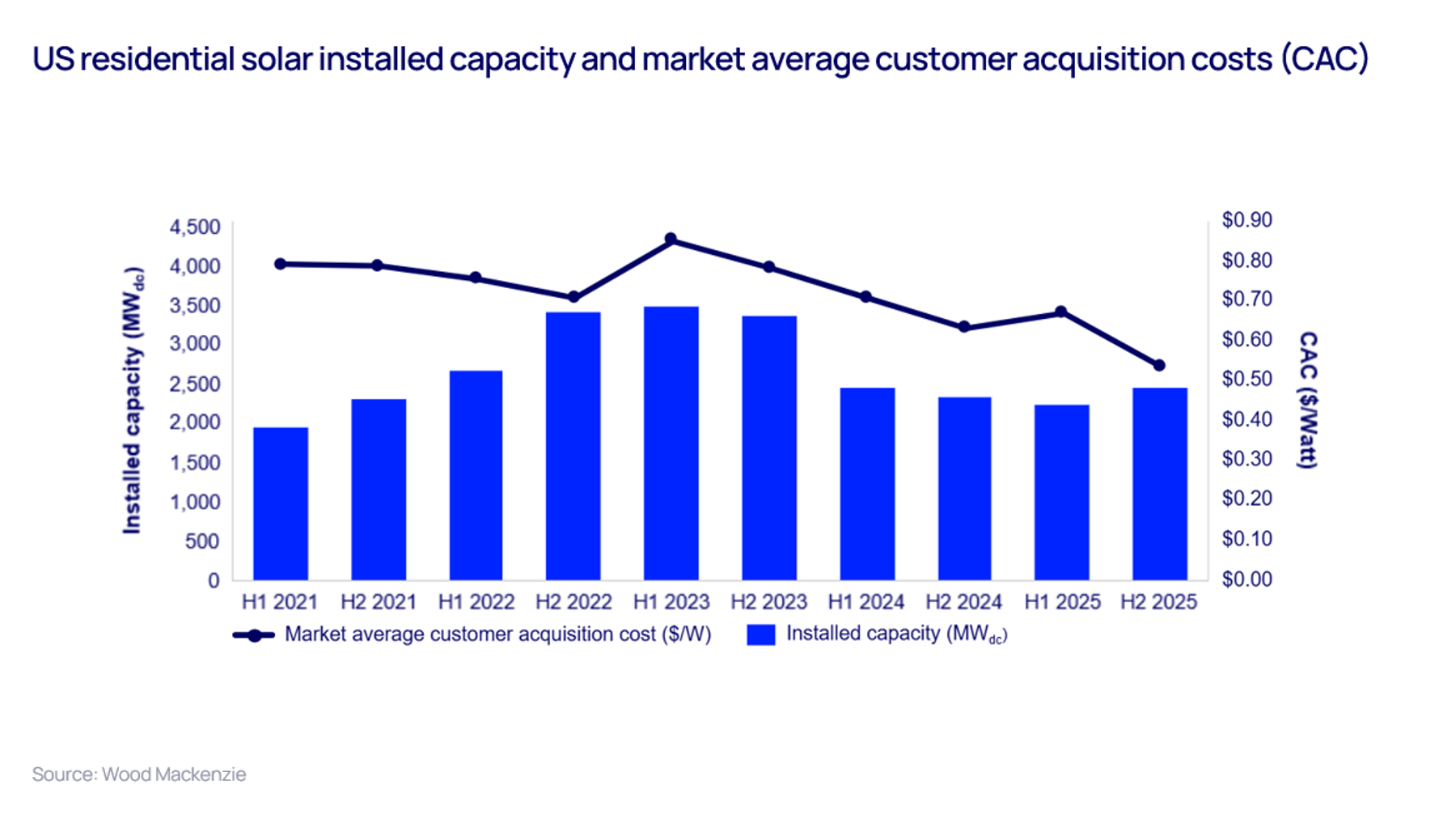
After reaching a five-year low of $0.60/W in 2025, residential solar customer acquisition costs (CAC) are poised to surge 40% to $0.84/W in 2026, according to Wood Mackenzie's latest US distributed solar customer acquisition cost outlook 2026. The increase reflects the ripple effects of the Section 25D investment tax credit expiration and a contracting market that is forcing installers to compete more aggressively for fewer customers.
The 2025 lull before the 2026 storm
Last year's CAC decline was something of an anomaly. The impending expiration of the Section 25D investment tax credit (ITC) at the end of 2025 created a demand rush as homeowners raced to lock in the 30% federal tax credit before year-end. This pull-forward effect allowed installers to temporarily reduce sales and marketing budgets while still filling their pipelines. Combined with operational efficiencies from AI-enabled sales tools and digital platforms, CAC fell 10% from 2024 levels.
But 2026 tells a different story. With the residential solar market set to contract by 19% following the ITC sunset, installers face heightened competition for a shrinking customer base. Marketing budgets are climbing again, and companies are investing in operational shifts - transitioning sales teams from loan-focused models to third-party ownership products and prepaid leases, and diversifying their product offerings to include batteries, EV chargers, roofing, and other adjacent services.

The shift to customer lifetime value models drives near-term costs higher
In the post-25D environment, forward-thinking installers are abandoning the traditional one-time, solar-only sales model in favor of customer lifetime value (CLV) approaches. Instead of viewing revenue as ending at installation, these companies are building multi-product ecosystems designed to generate referrals, storage upsells, and repeat purchases at significantly lower acquisition costs than cold lead generation. These strategic investments - deploying customer engagement platforms, building referral engines, and diversifying product lines - add to near-term acquisition costs but position companies to extract value from customers over many years. The payoff comes post-2027, when these systems mature and begin generating lower-cost follow-on sales.
As the industry shifts to adopt CLV approaches, more installers will also move away from fully outsourced third-party sales models toward vertically integrated customer acquisition. Without the 30% ITC buffer, some installers can no longer afford to pass on the costs of high dealer fees, expensive lead purchases, and commission-heavy sales models while remaining competitive on price. This margin squeeze is forcing a strategic reckoning across the industry that favors vertically integrated installers with in-house sales teams. These companies don't depend on increasingly expensive purchased leads, they own the customer experience and data, and they can more easily amortize acquisition costs across multiple products and services.
Community solar: a brighter CAC outlook
While residential installers brace for a challenging 2026, the community solar segment is moving in the opposite direction. Subscriber acquisition costs fell 12% in 2025 to an average of $69/kW, as developers refined their customer acquisition strategies and benefited from increased market maturity. Wood Mackenzie expects this downward trajectory to continue, with subscriber acquisition costs declining an additional 18% through 2030.
However, challenges remain, particularly around low-to-moderate income (LMI) subscribers. Acquiring LMI customers costs 34% more than non-LMI residential subscribers, driven by the additional resources required for targeted outreach in a limited addressable market, income verification, and higher attrition rates. As state-level LMI requirements push the share of capacity serving LMI subscribers higher, managing these elevated acquisition costs will become increasingly critical for project economics.
Market consolidation, digital marketing strategies, and policy interventions are the primary drivers of expected cost reductions. States that have implemented consolidated billing, where community solar credits appear directly on utility bills, report improved customer satisfaction and reduced churn compared to dual-billing structures. Meanwhile, standardized income verification processes and "opt-out" enrollment programs show promise for streamlining LMI subscriber acquisition and reducing administrative burdens.