






Discuss your challenges with our solutions experts
Valero Port Arthur refinery: a month after the explosion
Recovery advances as repairs continue at Valero's Port Arthur refinery
5 minute read

Jake Eubank
Senior Research Manager, Downstream Assets

Jake Eubank
Senior Research Manager, Downstream Assets
Latest articles by Jake
-
Opinion
Valero Port Arthur refinery: a month after the explosion
-
Opinion
Port Arthur refinery explosion removes 415k bpd from market
-
Opinion
Big in Japan? The impact of Typhoon Shanshan on oil
More than a month has passed since an explosion and fire damaged one of the diesel hydrotreaters (DHT 243) at Valero's 415,000 b/d Port Arthur, Texas, refinery. The facility has since entered a phased recovery, with select units returning to service while repair work continues in the areas most affected by the March 23 incident.
Wood Mackenzie has tracked the refinery's progress through continuous aerial surveillance and ground-based monitoring since the explosion occurred. Our imagery reveals ongoing reconstruction efforts at the damaged sections, while our field-based infrared cameras have documented the sequential restart of multiple processing units following the plant-wide shutdown.
The most recent milestone came on 26 April, when the refinery's fluid catalytic cracker (FCC) resumed operations. That same morning, operators began ramping up the facility's largest crude unit, though activity levels remain below normal operating capacity. While the affected diesel hydrotreater falls outside our real-time infrared monitoring coverage, Wood Mackenzie's multi-source surveillance has provided a comprehensive view of the recovery timeline.
Monitored unit status as of morning, 30 April:
|
Unit |
Capacity |
Back online? |
Restart date |
|
CDU |
265,000 |
Ramping up |
- |
|
VDU |
172,000 |
Ramping up |
- |
|
Sulfur Recovery Unit (SRU) |
- |
No |
- |
|
Diesel hydrotreater (DHT-243) (not monitored/based on aerial imagery) |
47,000 |
No |
- |
|
CDU |
150,000 |
Yes |
Apr-02 |
|
VDU |
48,000 |
Yes |
Apr-02 |
|
Hydrocracker |
57,000 |
Yes |
Apr-03 |
|
ULSD Hydrotreater |
55,000 |
Yes |
Apr-03 |
|
Coker |
55,000 |
Yes |
Apr-03 |
|
Catalytic Reformer |
53,000 |
Yes |
Apr-06 |
|
Hydrocracker |
45,000 |
Yes |
Apr-15 |
|
Coker |
100,000 |
Yes |
Apr-22 |
|
FCC |
80,000 |
Yes |
Apr-26 |
Collateral impact and recovery
The incident's effects extended beyond Valero's fence line. Diamond Green's adjacent renewable diesel facility, which relies on steam and utilities from the Valero refinery, was forced offline immediately following the explosion. Wood Mackenzie's biofuels monitoring confirmed the plant returned to service in late March, demonstrating a relatively swift recovery for the dependent facility.

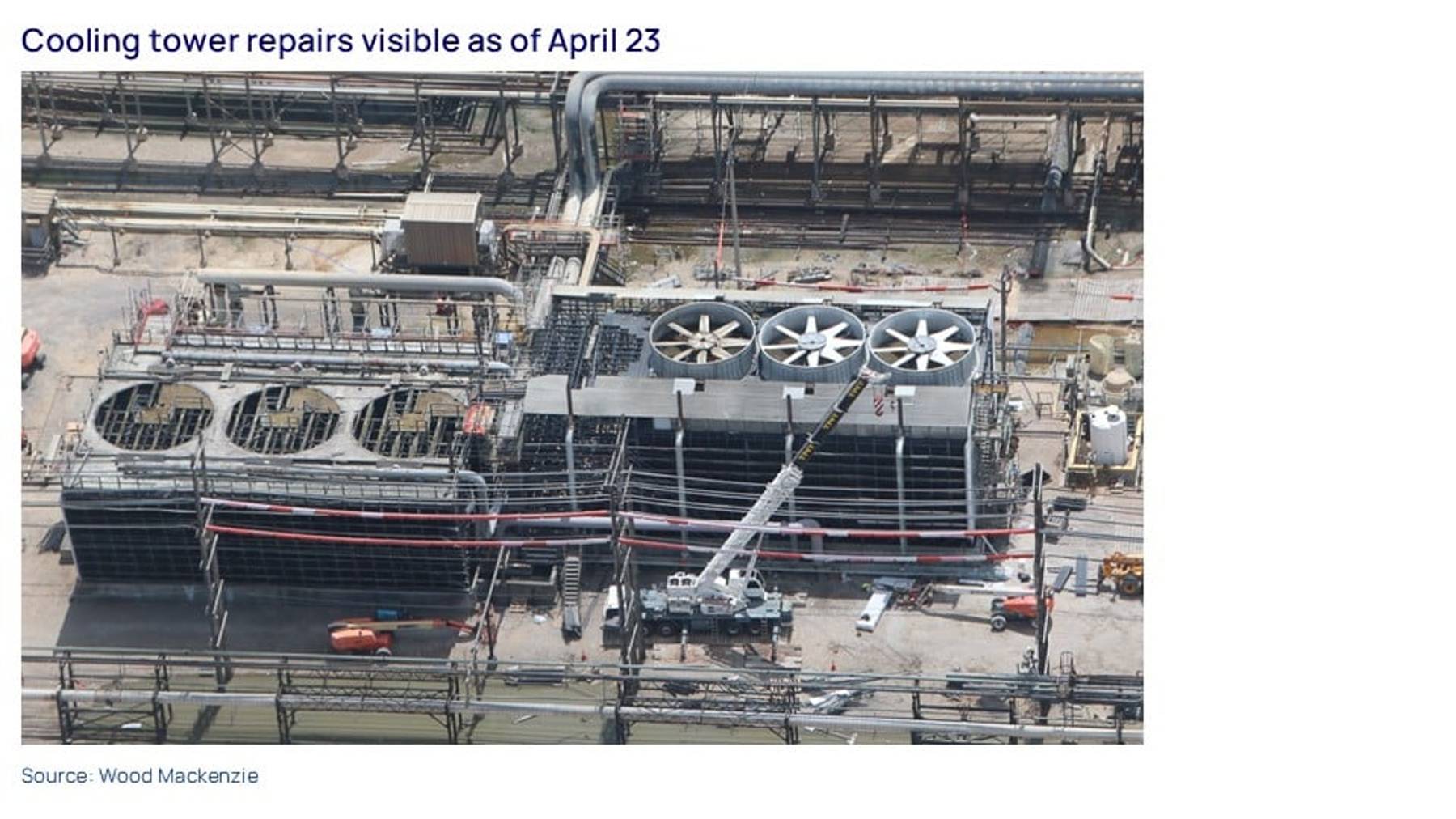
Damage assessment and repair progress
Aerial imagery captured in the immediate aftermath revealed the explosion's epicentre: DHT 243 sustained the most severe structural damage, with collapsed and heavily warped piping throughout the unit. Adjacent infrastructure also bore the brunt of the incident—a neighbouring processing unit showed minor damage, while two cooling towers and a control room in the blast radius sustained more significant impacts.
In the weeks since, repair activity has concentrated on the damaged cooling towers, which have seen the most intensive reconstruction efforts. Scaffolding and crane operations have been a near-constant presence at these structures, and recent imagery shows contractors have begun dismantling components, including cooling fan blades, as part of the restoration work.
Analysis: extended outage adds pressure to tight markets
More than a month on, Valero's Port Arthur refinery remains in partial recovery mode. While the recent restart of the FCC and the initial ramp-up of the primary crude unit signal progress, multiple processing units were still offline as of 27 April—including full operation of the facility's largest crude distillation capacity.
The extended outage comes at a particularly challenging moment for regional refined product balances. Ongoing geopolitical tensions in the Middle East have already introduced volatility into crude and product markets, raising concerns about supply adequacy. The prolonged absence of 415,000 b/d of refining capacity on the US Gulf Coast only compounds these pressures.
Wood Mackenzie's real-time monitoring infrastructure—combining field-based infrared cameras with regular aerial surveillance—continues to track the facility's unit-by-unit recovery, providing clients with independent, data-driven insights into outage duration and restart timelines.
How We're Tracking This
During periods of market volatility following a disruption, timely, data-driven insight is essential. Wood Mackenzie subscribers received unit-by-unit restart analysis within 24 hours of each milestone event, including the FCC return on 26 April and crude unit ramp-up—intelligence that informed real-time trading and operational decisions while recovery was still unfolding.
We provide both historical context and real-time intelligence on Valero's Port Arthur refinery through the following core services:
|
Product |
Monitoring Since |
What We Cover |
|
2010 |
Real-time monitoring of most major US and Canadian refineries, with detailed status tracking on a unit-by-unit basis. This includes 92% of US PADD 3 refining capacity and 12 different units at Valero’s Port Arthur refinery. |
|
|
2014 |
Weekly monitoring of crude stocks and inventory levels across Houston, Corpus Christi, and Beaumont-Nederland – including the Port Arthur refineries |
|
|
2023 |
Real-time monitoring of biodiesel and renewable diesel production plants in North America. |
Fill in the form if you would like to learn how our real-time monitoring can support your market decisions.