




Discuss your challenges with our solutions experts
Will the polysilicon Section 232 drive upstream solar manufacturing to the US?
Unpacking the new tariff's uneven impact on US solar pricing and manufacturing
4 minute read

Elissa Pierce
Research Analyst, Solar Module Technology and Markets

Elissa Pierce
Research Analyst, Solar Module Technology and Markets
Elissa's research includes solar module markets, technologies and supply chains across the globe.
Latest articles by Elissa
-
Opinion
Will the polysilicon Section 232 drive upstream solar manufacturing to the US?
-
Opinion
The state of safe harboring: a strategic outlook for US utility-scale solar development
-
Opinion
RE+ 2024: Our 7 biggest takeaways
-
Opinion
RE+ 2024: Our 7 biggest takeaways
-
Opinion
Turn of the tide? What the entry of Chinese polysilicon to the US means for the American solar supply chain
On 6th August, 2026, President Trump signed a proclamation establishing Section 232 trade measures on polysilicon and its derivatives, capping a 13-month Department of Commerce investigation. Unlike the targeted AD/CVD cases that have shaped US solar trade policy in recent years, Section 232 applies globally - closing off suppliers' ability to dodge duties by shifting production between countries.
The measures, which set minimum import prices (MIPs) at every stage of the module value chain and a 15% tariff on derivatives of polysilicon, take effect on December 4th, 2026. Commerce has also created an onshoring incentive program offering temporary relief to manufacturers investing in US polysilicon, ingot, wafer, or cell production - but module-only investments don't qualify, and many implementation details remain unresolved.
In Will the polysilicon Section 232 drive upstream solar manufacturing to the US?, available via Wood Mackenzie's Lens Power & Renewables solution, we assess how the new minimum import prices and tariffs will move through the module supply chain, what they mean for US module and system pricing, and whether they will finally catalyse the upstream solar manufacturing capacity the US has lacked for over a decade. Here's a preview of what we found:
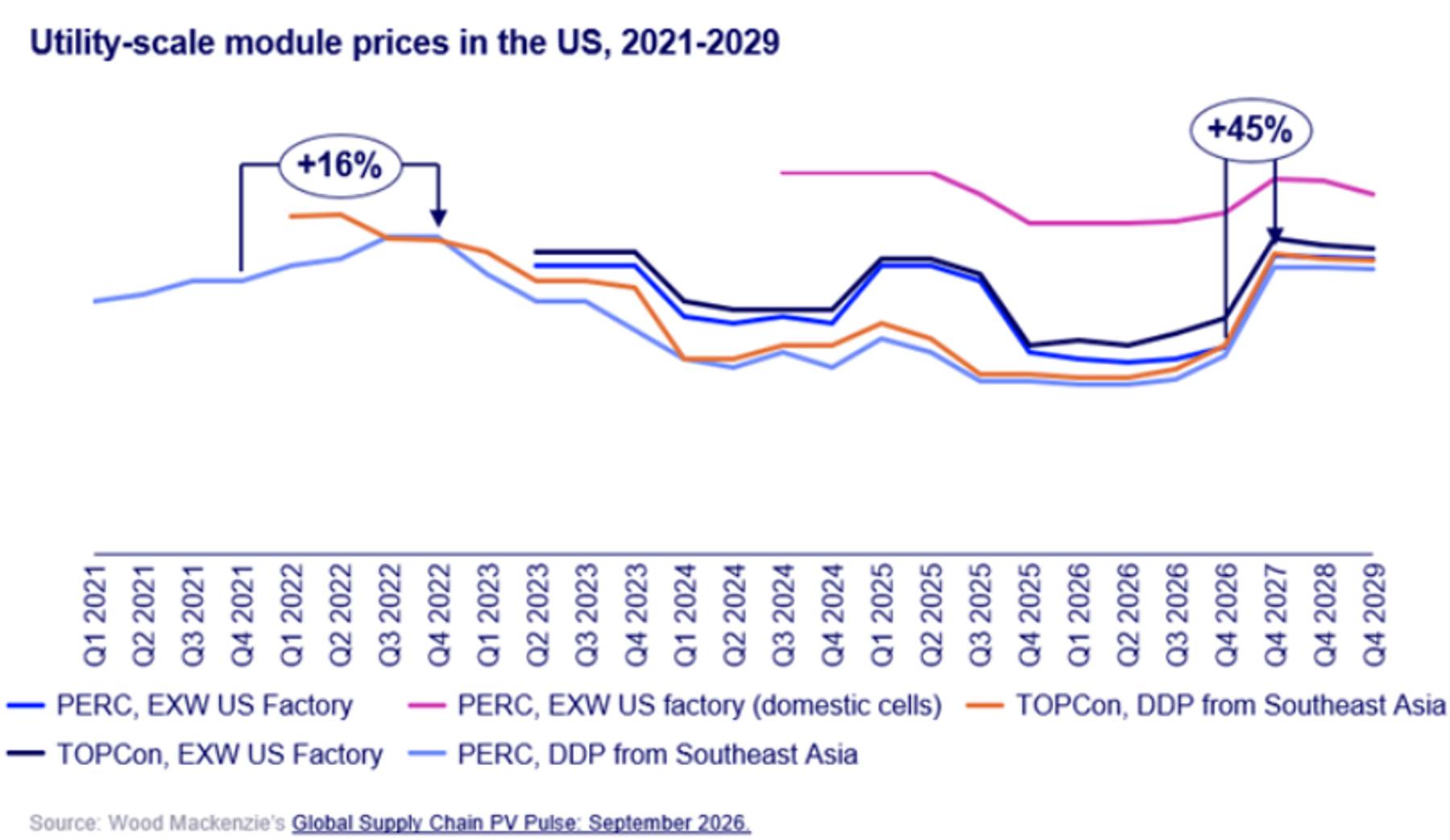
Module prices are headed toward 2022 highs
We expect the tariffs to push utility-scale module prices above $0.40/W, back near their 2022 peak. While suppliers began raising prices by $0.01-0.02/W immediately after the proclamation was announced, the full impact will be delayed into 2027 as suppliers work through existing US inventory, which currently represents more than a year's worth of installations.
These higher module prices raise modeled commercial and industrial (C&I) system costs by 11% and utility-scale system costs by 20%. Developers will likely try to pass much of this through to offtakers via higher power purchase agreement (PPA) prices, but the scale of the increase may still force some projects to be delayed, renegotiated, or cancelled.

Upstream manufacturing gets a boost - but not enough to spur new investment
Section 232 meaningfully improves the economics of partially integrated manufacturing. Producers integrated from wafer-to-module will be able to achieve the lowest costs while the 45X manufacturing credits remain in place, and even those integrated only from cell-to-module can land comfortably below the $0.38/W module MIP. But our analysis finds the new minimum import price for polysilicon and wafers still isn't enough to offset the cost of building new domestic capacity for these components, given long investment timelines, high capital costs, and ongoing policy uncertainty.
That means the tariff's biggest winners are likely to be the cell and module manufacturers who were already developing factories, not the upstream capacity gap the policy was arguably designed to close. Module-only assemblers, who don't qualify for onshoring relief and face rising input costs for imported cells, will struggle to compete in the new environment. But only 6.4 GW of integrated cell-and-module capacity is currently operational in the US, and no domestic manufacturer yet has enough cell capacity to meet its own module demand — meaning even integrated players will need to keep importing components to some degree and bear the brunt of rising import costs in the near future.
The bottom line
Section 232 will materially raise the cost of solar in the US, and it strengthens the case for manufacturers that are already integrated from cell through module. But it does little to change the calculus for the upstream segments - polysilicon and wafers - that have proven hardest to reshore. Long investment timelines, an MIP that still sits below US production costs, and the eventual phase-down of the 45X manufacturing tax credits all work against new greenfield investment in those segments. The policy's biggest winners, at least in the near term, look to be partially integrated producers who were already positioned to benefit — not the upstream capacity gap that Section 232 was arguably designed to close.
Read the full analysis
Our full report digs into the specific price and cost breakdowns across every stage of the supply chain - polysilicon, wafer, cell, and module - the production cost advantage of different integration strategies, and our updated manufacturing capacity forecasts through 2028. It's available now to Wood Mackenzie Lens Power & Renewables subscribers.