




Winter Storm Fern shuts in 18.3 bcfd of US gas production at its peak
Cumulative freeze-offs projected to exceed 120 bcf, ranking among the most impactful winter events in recent memory
3 minute read

Daniel Myers
Senior Research Analyst, North America Gas

Daniel Myers
Senior Research Analyst, North America Gas
Daniel delivers short-term fundamental modelling and regional market analysis.
Latest articles by Daniel
-
Opinion
The Blackcomb question: can the pipeline reach its full 2.5 bcfd capacity at startup?
-
Opinion
Gulf Coast Express expansion begins commissioning
-
Opinion
US gas prices slide as storage expectations tighten: what it means for summer 2026
-
Opinion
Natural gas futures shrug off winter storm impact despite storage drawdown
-
Opinion
Winter Storm Fern shuts in 18.3 bcfd of US gas production at its peak
-
Opinion
US L48 gas: injection season ends
Winter Storm Fern just served up a sobering reminder that despite years of promises and investments, America's natural gas infrastructure remains frustratingly vulnerable to Mother Nature's worst tantrums.
The numbers don't lie
When the storm reached its peak fury on 26 January, it knocked out a staggering 18.3 bcfd of production, that's almost 17% of total U.S. gas supply vanishing almost overnight. Even now, more than two weeks beyond the main event, nearly 3 bcfd of production remains offline, a testament to just how thoroughly this storm and ensuing bouts of cold disrupted operations.
The scale of disruption becomes clear when you see the production data compared to other winter events of recent years:

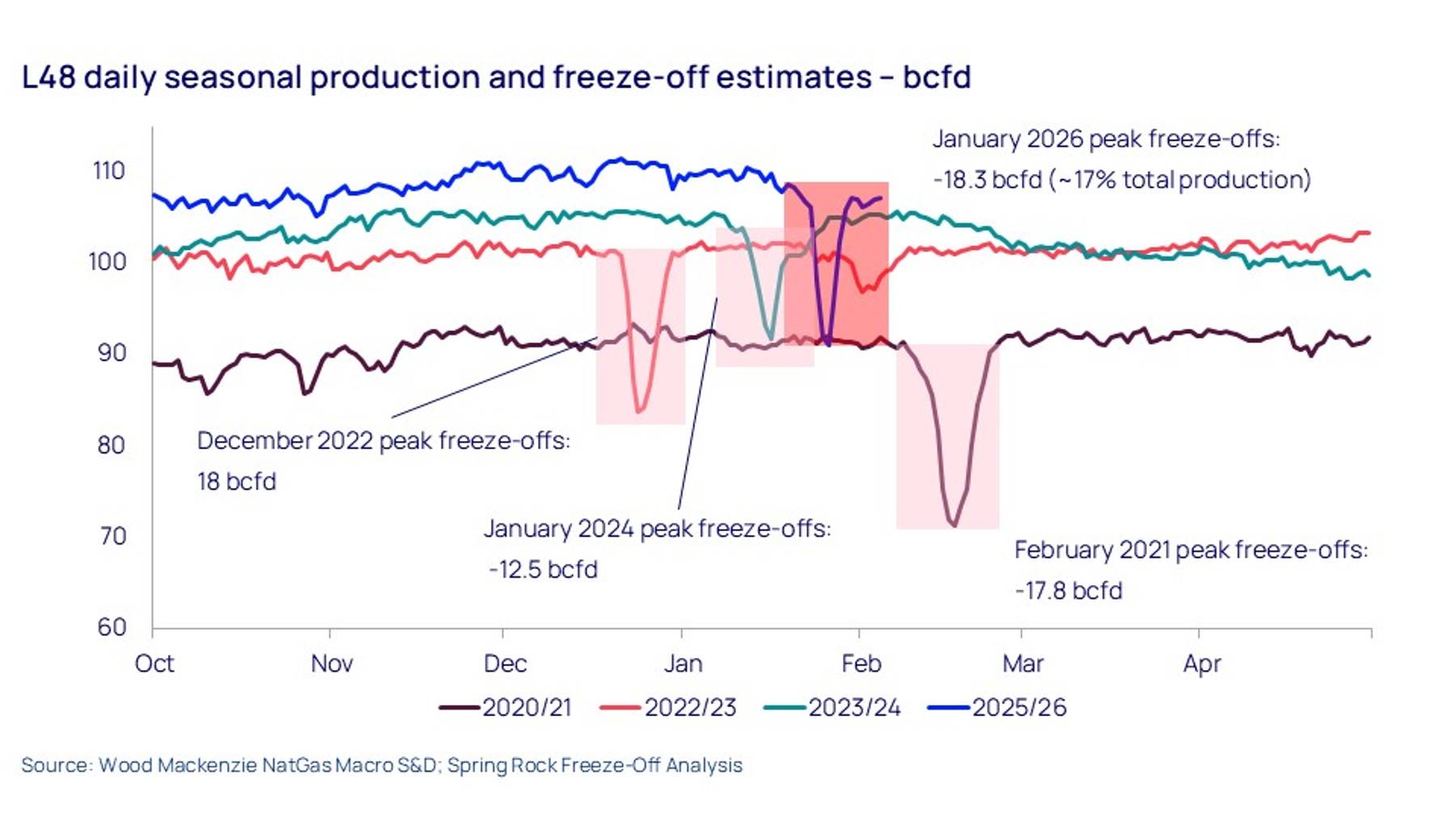
The geographic spread tells its own story of widespread vulnerability. The Permian Basin saw nearly half of all freeze-offs with 8.8 bcfd shut in. But perhaps more telling was the record-breaking 5.1 bcfd of losses in Northern Louisiana and East Texas, about 28% of production in the region, which outperformed estimates due to freezing rain and icy conditions.
From “winter is over” to “one to remember” in three weeks
Here's an inconvenient fact: we're looking at more than 120 bcf of cumulative production losses through early February, catapulting this winter into the top three worst freeze-off seasons of the past decade. This comes after freeze-offs were basically non-existent through the first half of the season into early January.
The Uri paradox: better, but not good enough
Yes, let's give credit where it's due. The industry didn't completely collapse like it did during Winter Storm Uri in February 2021. Winterisation efforts, better preparation, and the absence of major power outages all helped prevent an even more catastrophic scenario.
But here's the thing – avoiding total disaster shouldn't be our benchmark for success. When you're still losing over 18 bcfd at peak impact, "it could have been worse" feels like cold comfort to consumers facing volatile energy prices and supply concerns.
The inconvenient questions
Three years after Uri exposed the fragility of our energy infrastructure, Winter Storm Fern forces us to confront some uncomfortable realities:
- How much winterisation is enough? Clearly, current efforts aren't yet sufficient if we're still seeing record freeze-offs in regions like East Texas.
- Are we preparing for the right scenarios? Climate change is delivering more frequent and intense weather events. Are our resilience plans keeping pace?
- What's the real cost of "cheap" energy? Every bcf of lost production represents not just immediate supply disruption, but also the hidden costs of inadequate infrastructure investment. With the highest futures prices since 2022 and all-time record Henry Hub prices during the peak of Winter Storm Fern, these costs eventually filter their way to consumers.
The path forward
The energy industry loves to tout its technological prowess and operational excellence. Winter Storm Fern suggests there's still plenty of work to do. As we dig out from this latest weather-related supply shock, the focus shouldn't just be on getting production back online – it should be on ensuring we're not having this same conversation after the next major storm.
The question isn't whether another severe weather event will test the system again, but whether the industry will be ready when it does.
Fill in the form above to receive future updates and market insights directly in your inbox.