




Get in touch
-
Mark Thomtonmark.thomton@woodmac.com
+1 630 881 6885 -
Hla Myat Monhla.myatmon@woodmac.com
+65 8533 8860 -
Chris Bobachris.boba@woodmac.com
+44 7408 841129 -
Angélica Juárezangelica.juarez@woodmac.com
+5256 4171 1980
Wood Mackenzie: Global CO2 transport industry set to reach USD 211 billion by 2060
4 minute read
- Asia Pacific drives almost 60% of global CO2 transport investment, with cross-border networks a critical enabler
- Over 80% of global transport investment is directed to pipelines, connecting emitters to storage sites
- Policy and bilateral agreements will determine whether cross-border CCUS networks are realised
Wood Mackenzie’s latest global report on CO2 transport infrastructure reveals that the industry could be worth USD 211 billion by 2060, with transport increasingly determining the viability of carbon capture, utilisation, and storage (CCUS) projects worldwide. This investment could enable three gigatonnes per annum (Gtpa) of CO2 to be transported globally, with 200 million tonnes per annum (Mtpa) crossing international borders.
According to Wood Mackenzie, Asia Pacific accounts for about 60% of total investment due to its long transport distances and large projected CO2 volumes, followed by North America and Europe. Pipelines drive the largest share of investment, connecting emitters which are primarily located onshore to both onshore and offshore geological storage sites. However, the mismatch between CO2 volumes and domestic storage availability is driving the emergence of cross-border CO2 trade and liquefied CO2 (LCO2) shipping solutions, particularly in Europe and Asia Pacific.
“Geography sets the transport challenge, while economics determines whether CO₂ moves by pipe, ship or both,” said Stephanie Chiang, senior research analyst, CCUS at Wood Mackenzie. “Pipeline and shipping costs are comparable for distances up to 1,000 km, but the economics depend on other factors, such as existing infrastructure availability.”
Repurposing existing gas pipelines could reduce capital expenditure by over 60% and halve total CO₂ transport costs. This substantially improves pipeline economics relative to shipping.
That said, not all infrastructure can be repurposed, and rigorous assessment will be needed.
Global cost fundamentals:
Pipelines and ships have distinct cost structures and risk profiles. Pipelines are capital-intensive, with high fixed costs for steel and construction, and requires high utilisation rates to recover the initial investment. Meanwhile, shipping is more governed by operational costs, with fuel and electricity accounting for over 50% of levelized costs. Shipping thus provides greater capital and operational flexibility, particularly for early-stage projects.
"Pipelines and ships have different trade-offs; pipelines become more economic as volumes scale but shipping gives early-stage projects the flexibility needed to manage risk. The right answer isn’t always the cheapest one.” said Bo Frohlich, research analyst CCUS at Wood Mackenzie.
For cross-border shipping, the choice of pressure configuration matters. Low-pressure vessels carry denser cargo in fewer, larger ships and can cut costs by up to 34% over long distances compared to medium-pressure alternatives. This difference is marginal on shorter European routes but decisive over the distance typical of Asia Pacific cross-border shipping.
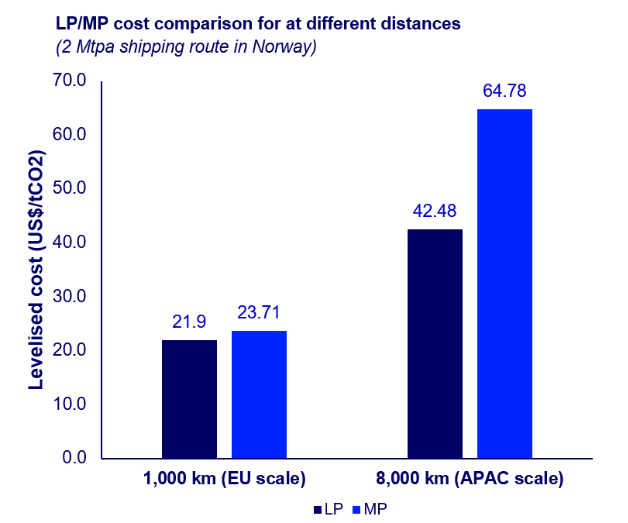
Source: Wood Mackenzie Lens Carbon
Asia Pacific:
Asia Pacific presents a compelling cross-border CO2 transport challenge and opportunity. By 2060, demand for cross-border CO2 transport from Japan, South Korea, Singapore, and Taiwan is projected at 164 Mtpa, against 187 Mtpa of storage capacity across Australia and Southeast Asia. Australia, Indonesia, and Malaysia are projected to be the region’s storage hotspots, competing to serve demand from the north.
Japan illustrates the scale of the cross-border CCS challenge clearly. To achieve carbon neutrality, the country targets storing 120 to 240 Mtpa of CO2 by 2050, but domestic storage potential is limited. Wood Mackenzie estimates Japan may need to ship nearly 50 Mtpa of CO2 across borders, close to Japan’s domestic LNG import volumes of around 65 Mtpa. Cross-border CO2 shipping alone could add USD 40/tCO2, contributing almost 30% of Japan’s total levelised CCS cost. Offshore pipeline and shipping economics in Japan reveal clear capacity thresholds. At 5 Mtpa, shipping becomes more cost-effective beyond 400 kilometres.
Policy: the critical swing factor
Wood Mackenzie noted that permitting delays, land acquisition challenges, and regulatory uncertainty can raise pipeline costs. Ongoing gaps in cross-border bilateral agreements, liability frameworks, and economic incentives continue to limit cross-border CCS networks. These issues are especially significant in Asia, where improved policy coordination could influence regional transport routes and project viability.
Editor note:
- Stephanie Chiang, Senior Research Analyst, CCUS at Wood Mackenzie, will speak at the 2026 Japan CCUS Summit on the panel “Building CO₂ Networks for Japan: Integrating Transport, Storage and Cross-Border Infrastructure.”
- Wood Mackenzie’s research covers CO2 transport economics and investment across global markets, with detailed modelling of pipeline and shipping cost structures, breakeven distances, utilisation risk, and the impact of infrastructure repurposing.