


Sign up today to get the best of our expert insight in your inbox.
Is Nigeria’s deepwater roaring back?
Reforms, incentives and corporate alignment
4 minute read

Simon Flowers
Chairman, Chief Analyst

Simon Flowers
Chairman, Chief Analyst
Simon is our Chief Analyst; he provides thought leadership on the trends and innovations shaping the energy industry.
Latest articles by Simon
-
The Edge
What’s on upstream leaders’ minds?
-
The Edge
Are we at an inflection point for a new wave of EV growth?
-
The Edge
Unleashing the Caspian’s potential in oil, gas and critical minerals
-
The Edge
EU methane regulation risks worsening the energy crisis
-
The Edge
‘Here be giants’ – unlocking Africa’s deepwater exploration puzzle
-
The Edge
War is reshaping LNG beyond winter

Ian Thom
Research Director, Upstream

Ian Thom
Research Director, Upstream
Ian brings 18 years of experience to his role as head of regional analysis for Europe, Russian, Caspian and Africa
Latest articles by Ian
-
Opinion
Equatorial Guinea turns stranded gas into a regional hub strategy
-
Opinion
Mozambique's LNG reset: from force majeure to major force
-
Opinion
The four markets redefining Africa upstream
-
Opinion
Is Nigeria’s deepwater roaring back?
-
Opinion
The unstoppable rise of Africa’s upstream independents
-
Featured
Upstream-oil-gas-2026-outlook

Gavin Thompson
Senior Vice President, Research

Gavin Thompson
Senior Vice President, Research
Gavin oversees our Europe, Middle East and Africa research.
Latest articles by Gavin
-
The Edge
Are we at an inflection point for a new wave of EV growth?
-
The Edge
‘Here be giants’ – unlocking Africa’s deepwater exploration puzzle
-
The Edge
War is reshaping LNG beyond winter
-
The Edge
UAE’s oil potential boosted by promising shale discovery
-
The Edge
Oil and gas markets’ perilous dilemma
-
The Edge
Is Europe’s gas market inching towards a winter crisis?
Deepwater remains the key conventional growth play globally as Big Oil look for large scale resource to strengthen portfolios for the next decade. Nigeria, still Africa’s largest liquids producer by a distance, offers huge potential. It’s highly prized deepwater sector, however, has been in the doldrums, going more than a decade without major new investment before Bonga North reached final investment decision (FID) in late 2024. Deepwater liquids output fell from a 2016 peak of around 800 kb/d to below 500 kb/d a decade later.
Things are now changing. The Wood Mackenzie team participated in last week’s Nigeria Oil and Gas conference in Abuja and talked to me about why the country’s deepwater sector could be on the cusp of a new era.
What’s driving a return to growth? How is the corporate landscape evolving? What does this mean for Nigeria’s oil and gas production?
What’s behind Nigeria’s deepwater resurgence?
After years of stagnation, Nigeria’s investment landscape is on the up. The government of President Bola Ahmed Tinubu, motivated by its ambitious production targets of 3 million b/d and 12 bcfd of gas by 2030, is seeking to reverse decline through policy and regulatory reform and fiscal incentives.
In deepwater, six legacy contracts between state-owned NNPCL and international oil companies (IOCs) were extended in 2022. The 2024 incentives further upped the game, with the most attractive tax credits available for fields that reach FID before 2029. These incentives have renewed IOC focus on large-scale offshore projects that could deliver material post-2030 growth.
Operators are responding, advancing deepwater development planning across numerous opportunities. Four major greenfield projects combined could commercialise more than 2 billion boe of resources.
Who are the key players?
Deepwater Nigeria is Big Oil territory, presenting exactly the type of opportunities that align with the Majors’ post-2030 portfolio priorities. Shell, ExxonMobil, Eni and TotalEnergies have high graded their Nigerian portfolios to focus on developing deepwater resources that have proved economically unattractive under earlier fiscal terms.
The turning point for Nigerian deepwater development was Shell’s 2024 FID on Bonga North (twenty years after discovery). This was followed just last week by ExxonMobil’s approval of the US$1 billion Usan Infill Project as part of a pledge to invest US$10 billion to develop its Nigerian deepwater assets.
Acquisitions have also ticked up as the Majors seek greater control and alignment over their Nigerian development strategies and timelines. TotalEnergies recently agreed to acquire ConOil’s 50% stake in the Egina South discovery, while Shell acquired 10% of TotalEnergies’ stake in OML 118 to help accelerate its Bonga Southwest-Aparo project.
What are the key developments?
Several opportunities operated by Shell, Eni, ExxonMobil and TotalEnergies are moving towards FID. If sanctioned, these projects would help boost Nigeria’s production and revenue trajectory.
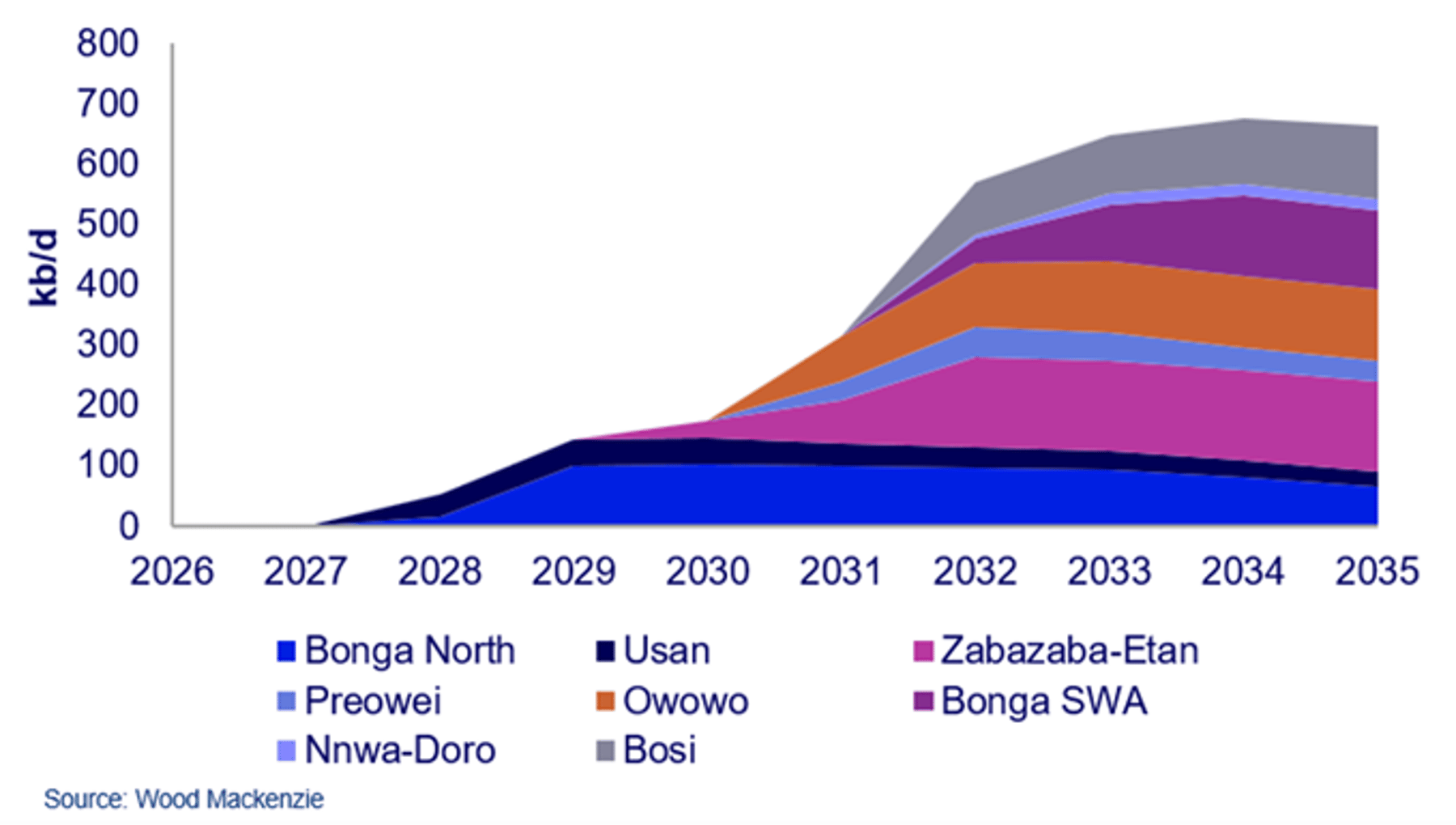
The keys to delivering further growth are Bonga Southwest-Aparo (Shell-operated), Owowo (ExxonMobil-operated) and Zabazaba and Etan (Eni-operated). ExxonMobil has indicated an FID on its Bosi field will require progress on Owowo, while the gas-dominated Nnwa-Doro field (Shell and Chappal Energies-operated) must overcome high costs and a complex ownership.
A transformed operating environment gives Nigeria a real shot at reversing the decline in deepwater production seen over the past decade. If developed, Bonga Southwest-Aparo, Owowo, Zabazaba, Etan, Preowei, Nnwa-Doro and Bosi – together with Bonga North and Usan – could add 700 kb/d of liquids and 950 mmcfd of gas at peak. Given Nigeria’s ambitious production growth targets, every barrel will count.
What are the risks to future success?
Project execution remains the key risk. In addition, partner alignment, capital competition, unitisation, regulatory approvals, gas sales agreements and offshore supply-chain constraints could also slow progress. Spare capacity on existing FPSOs offers a lower-cost, lower-risk tieback opportunity, but creaky infrastructure will test this. Projects that require new-build FPSOs will face higher costs, longer timelines and greater execution risk.
Right now, all eyes will be on whether Bonga Southwest-Aparo, Zabazaba and Preowei move towards FID within the next 18 months. If these projects get over the line, Nigeria’s deepwater resurgence will prove it has real bite.