






Adapt or die: Why oil refineries must evolve to survive

November 2026


November 2026




Author(s):

Chris Barry
Vice President, Downstream Consulting
Chris's consulting expertise spans the refining, chemicals and storage sectors where he has advised clients worldwide.
Latest articles by Chris
View Chris Barry's full profile
Alan Gelder
SVP Refining, Chemicals & Oil Markets
Alan is responsible for formulating our research outlook and cross-sector perspectives on the global downstream sector.
Latest articles by Alan
-
Opinion
5 things you need to know about the future of Asian refining
-
Opinion
Oil, Gas & Power in H2 2026: a trader’s guide
-
The Edge
Oil and gas markets’ perilous dilemma
-
Opinion
The Hormuz shock: what the data reveals about global oil markets in 2026
-
The Edge
Has the oil price bubble burst?
-
Opinion
Horizons Live: Strait talking | Webinar replay

Savankumar Aghara
Senior Analyst, Oil and Chemicals
Savan focuses on the commodities market and downstream industry for the Asia Pacific region.
View Savankumar Aghara's full profile
Kian Akhavan
Consultant, EMEA
Kian is a specialist in public policy, with a focus on public-private partnerships.
Latest articles by Kian
-
The Edge
Is there still life in decarbonising hard-to-abate sectors?
-
Opinion
Reassessing Canadian Export Infrastructure
-
Opinion
Evaluating infrastructure and optionality in Canadian hydrocarbon exports
-
Opinion
How public-private partnerships can accelerate the energy transition
For the oil-refining industry, the energy transition is an existential challenge. While refineries are critical to national energy security, as the Middle East conflict and the Russia-Ukraine war have shown, declining global oil demand in future means that closures are inevitable.
Each of the world’s 700-plus refineries is unique in its capacity, crude slate, configuration, product yield and market access. All operate in a landscape shaped by macroeconomic, geopolitical and energy transition pressures, however, and that landscape is evolving.
Slowing population growth, electrification and improving fuel efficiency lead Wood Mackenzie to expect that global oil demand will peak in the early 2030s and decline gradually after that. All refiners face this market-driven destiny, although the exact pressures will vary by region.
There is no universal remedy that can bestow long-term resilience, but many refineries will be able to strengthen their position if they make the right choices. This edition of Horizons examines the options available and explains which type of refinery will be best placed to adapt to survive and even thrive in this changing environment.
All eyes on refining
The refining sector has its own distinct and complex fundamental drivers. Oil refining is, at its core, a conversion business. This means refining margins are mostly independent of oil prices, driven instead by the difference in price between oil products and crude oil, known as ‘crack spreads’. For refiners operating between these large commodity markets, where persistent investment drives competition, typical benchmark margins are relatively thin. However, the most competitive refiners, or those with structural advantages, outperform significantly.
The spotlight has been on refiners since the start of the Middle East conflict. Disruption to Middle Eastern oil supply has pushed benchmark refining margins to record highs, as constrained crude and oil product supply struggles to meet global demand. This strain has been exacerbated by damage to Russian refineries. The resulting energy shock has forced many countries to ban oil product exports, implement commercial curfews, close businesses or release strategic oil reserves.
Yet, the sector also faces major long-term structural and strategic challenges. To navigate these, refiners must adapt to evolving patterns of crude oil supply, product demand, increasing competition, and tighter environmental and sustainability targets.
The highly competitive nature of the sector means that long-run average refining margins are slim, and currently elevated margins will return to more modest levels when the Middle East conflict ends. Refining generates lower returns on capital than upstream, increasing the challenge that downstream companies face in accessing the capital needed to make critical investments for the future.
Figure 1: Crude price and refining margins are loosely connected
Brent price vs global composite gross refining margin (US$/bbl, real)
Source: Wood Mackenzie Product Markets Service
A history of adaptation, resilience and innovation
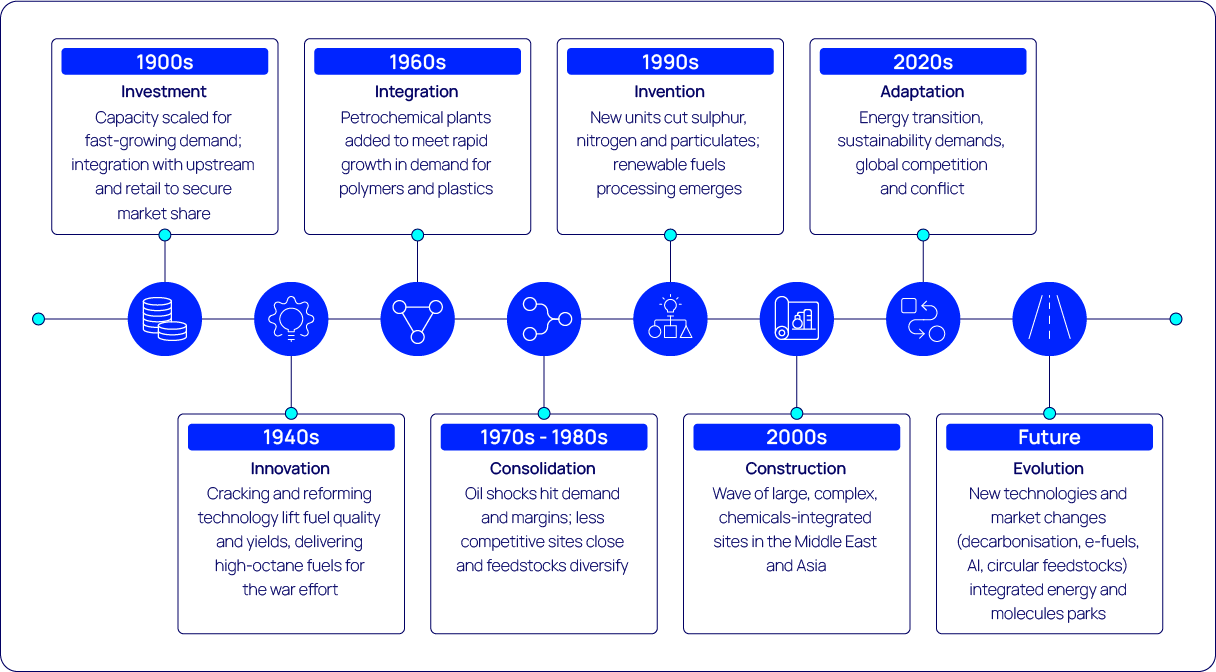
The refining sector has always adapted to ever-changing market dynamics. Refineries were originally established by oil majors as a critical part of a vertically integrated supply chain that spanned well to wheels. The emergence of global commodity markets in the 1980s relegated refining to a low-margin sector suffering from over-capacity, as the oil shocks of the 1970s disrupted the trajectory of oil demand growth. Petrochemical integration was a source of value, with the supply of clean fuels becoming a ‘stay-in-business’ requirement. The construction wave of new refining capacity across the Middle East and Asia in the 2000s delivered national benefits broader than earning a commercial rate of return, namely, domestic energy resilience, a platform for further industrialisation and value capture along the supply chain.
The refining sector has had to constantly evolve with the needs of the market and policymakers. Those that have been bold and able to adapt to these ever-changing dynamics have grown into the successful oil majors, refining specialists and major national oil companies (NOCs) we know today.
Figure 2: The refining sector has evolved to meet market and policy needs
Competitive position is a key attribute for all refineries, measured by their net cash margin (NCM), the cash from refining operations after payment of feedstock, fixed and variable costs on a per-barrel-of-throughput basis. The following figure shows the global refining NCM profile for 2024 and 2025. New refineries target a first-quartile position to generate high cash flow, with major refinery upgrades aiming to move sites up the curve. These investments push other sites down the curve towards lower margins – refiners who do nothing are effectively on a downward escalator.
Figure 3: Refinery earnings vary widely, with few loss-making sites in 2024 and 2025
Global NCM profile against cumulative refining capacity (kb/d)
Source: Wood Mackenzie Refinery Evaluation Model
Competitive advantage is secured through combinations of:
- obtaining access to lower-cost crude oil (either through location or crude quality)
- investing to build a complex configuration that can convert and upgrade lower-value crudes into higher-value transport fuels, petrochemicals and speciality products
- locking in advantaged access to demand centres, where alternative sources of product supply involve costly import logistics
- integrating with upstream or downstream operations, ranging from crude production to retail fuel sales, petrochemical supply and trading operations
- ensuring low costs of energy, labour and emissions.
Many of these factors are location/country dependent and cannot be readily replicated by refineries in other regions. Scale is not included here, as it is established at the point of construction. Although it is a key driver of investment economics, its impact on NCM is limited to lowering fixed costs on a per-barrel basis.
The energy transition threatens the commercial viability of the refining sector in its current form. Declining demand for refined products means more sites will become loss-making, leading to closure unless they adapt. There is no adaptation silver bullet, however, due to the uneven pace of regional energy transition and the heterogeneity of the refining sector.
Regional and industrial characteristics
Each refinery is unique and most assets have been developed over time to meet the specific scale, needs and product focus of their relevant markets, available feedstocks and access to technology. Some refineries can trace their origins back more than a century. Most new-build assets over the past decade feature economies of scale, high complexity, petrochemical integration and high-efficiency, low-emission technologies. Differences in such features are the primary determinants of which assets will remain competitive as the energy transition applies pressure unevenly across products and geographies.
Refining archetypes
While all refineries are unique, they can be divided into five main archetypes, which serve as a useful lens for considering potential future adaptation strategies:
- Large scale, high complexity. These are among the most competitive assets, benefitting from economies of scale and an ability to process a wide range of lower-quality crudes into the highest-value oil products, enabling them to push products successfully into export markets.
Examples include major refineries on the US Gulf Coast, modern export-oriented refineries in the Middle East and the new Dangote refinery in Nigeria. - Complex chemical-integrated. Refineries that also have major petrochemical production facilities (such as stream cracking, aromatics or polymers) can shift output away from declining transport fuel markets and increase their margin.
Examples include several medium-scale integrated refiners in Europe and Asia, and an increasing number of new, highly integrated mega-sites in China. - Coastal cracking. The most common refining type. They have some ability to upgrade crude to transport fuels, but lack full-complexity conversion of heavier products. Their coastal location gives them access to imported crudes and product distribution, but exposes them to international competition.
Most refineries in OECD countries are configured in this way. - Small-scale speciality. Smaller-scale assets with production focused on high-value, niche products such as lubricants, bitumen, waxes and solvents. Their lack of scale and complexity is both a strength and a weakness; they do not compete in commodity markets and have less exposure to declining transport fuel demand.
A small number of this type of asset already exists around the world. - Small scale, low complexity. Small assets with only the simplest refinery upgrading processes, typically only producing transport fuels. Their edge is often that they are the only supply source for a given product in a particular location, making them resilient to global shifts, but vulnerable to local disruption. Most of the refineries of this type have either already been upgraded to more complex types or closed due to lack of profitability.
Examples include NOC-owned and operated assets in developing countries, which are often protected, so continue to operate despite incurring losses.
Refineries are most commonly described in terms of their crude distillation unit (CDU) capacity, a basic crude processing scale; complexity (on a scale of 1 to 25), which measures how much a refinery has invested in plant and equipment to upgrade crude into higher-value products, with a higher score reflecting more flexibility on crude quality and product yield; and NCM.
Archetypal refining characteristics
|
Archetype |
CDU capacity (kb/d) |
Complexity |
NCM (US$/bbl) |
|
Large scale, high complexity |
300-600 |
12-15 |
>10 |
|
Complex chemical-integrated |
200-400 |
8-12 |
5-10 |
|
Coastal cracking |
150-250 |
6-10 |
2-5 |
|
Small-scale speciality |
20-30 |
1-4 |
0-4 |
|
Small scale, low complexity |
20-50 |
1-4 |
<0 |
Note: Based on typical average values (2015-25)
Refineries with a higher complexity are generally capable of achieving greater NCM, but other crude and location-specific factors also have a significant impact.
Figure 4: Refinery complexity is an important driver of NCM
Note: The chart excludes refineries with capacity lower than 150 kb/d.
Source: Wood Mackenzie Refinery Evaluation Model
Changes driving adaptation
Refined product demand is expected to peak at 108 mb/d in 2032 (from 105 mb/d in 2025) before declining. The pace of the energy transition will not be uniform, but rather driven by economics and policy, leading to regional differences. Generally, robust growth in electric vehicle uptake will hit gasoline demand hardest, while diesel/gasoil and jet/kerosene will remain comparatively resilient as heavy road transport and aviation lack a clear route to decarbonisation. Liquified petroleum gas (LPG) and naphtha will be supported by growing demand for petrochemical feedstocks. Demand for speciality products (such as lubricants, waxes, bitumen and sulphur) will remain largely independent of the energy transition, as bio-based alternatives do not yet exist at scale.
The energy transition requires decarbonisation of both a refinery’s operations and its product outputs. European refineries are more likely to invest in operational decarbonisation than Asian or Middle Eastern competitors due to national and European Union (EU)-level emissions policy. As carbon capture and green hydrogen adoption has yet to scale, reducing indirect end-use emissions may prove the more viable route: some sustainable aviation fuels already cut emissions by up to 80% compared with conventional jet fuel.
Against a backdrop of declining demand, diverging costs and uneven pressure from policymakers to decarbonise, new investments in capacity expansion are increasingly difficult to justify. The exception is where demand growth and security-of-supply concerns are still strong enough to override the economics; India alone is expected to host 40% of global capacity additions to 2030 as part of a broader push for self-reliance.
This, though, is capacity added locally into a global market in decline. The defining global feature of the next decade and beyond will be refinery rationalisation, with an estimated 20% of existing global capacity – those on the ‘down escalator’ (with falling or negative NCM) ‒ increasingly at risk of closure. Exposure to that risk varies sharply by archetype, reflecting how unevenly competitive advantages hold up under pressure. Refiners will, therefore, need to understand their relative market, policy and competitive exposure, and consider what strategies they may need to deploy.
Adapt or die
There is a range of adaptation strategies that can be deployed. Not all options may be viable for each refinery, and the high capital cost and future market uncertainty make some of these investments challenging. Refiners will need to make strategic decisions on the way forward in an uncertain world.
Figure 5: Potential refinery pathways and outcomes
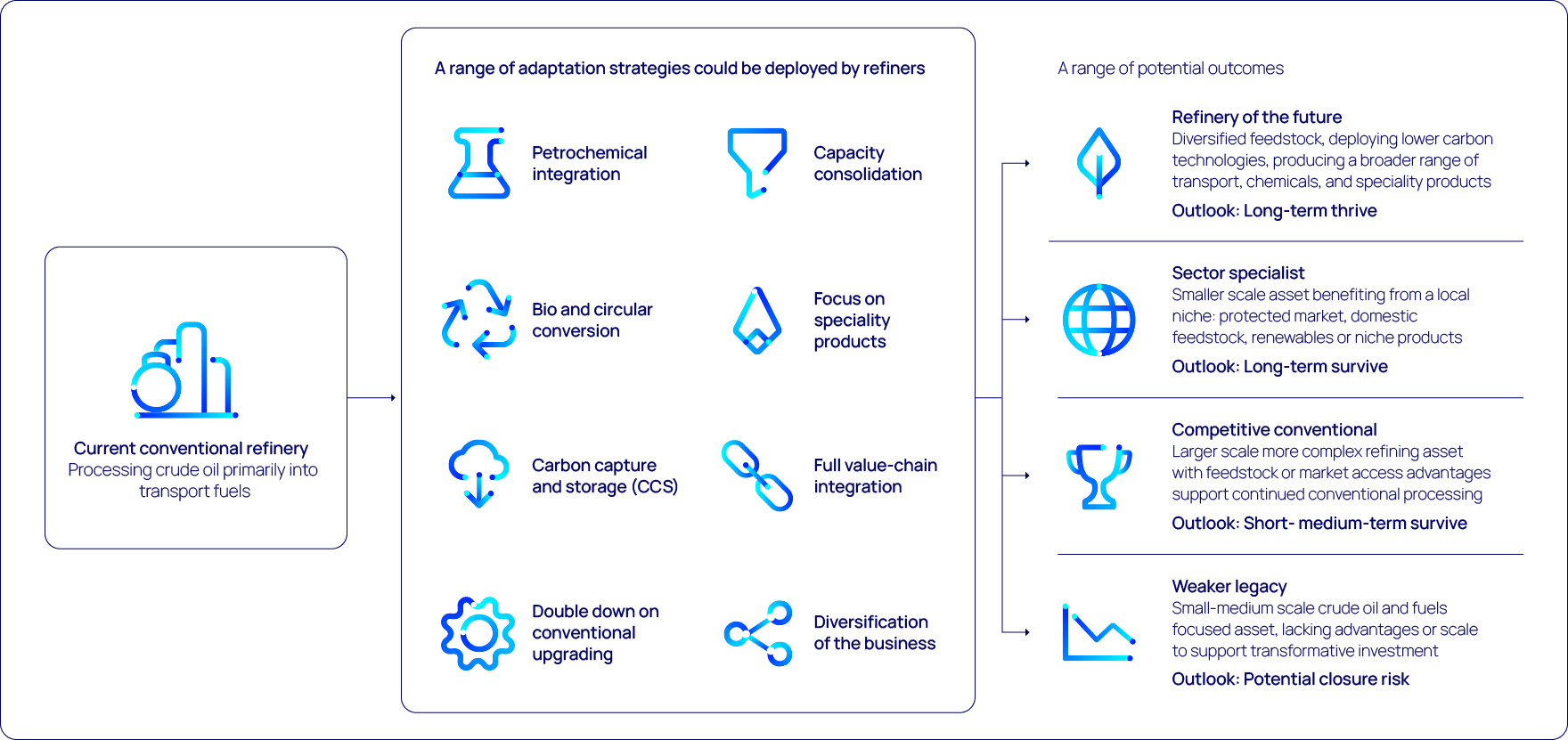


 Petrochemical integration
This is the primary means of offsetting declining road-fuel demand by shifting LPG and naphtha molecules into the production of olefins, aromatics and polymers. Petrochemical investments are more likely to be attractive at world scale while there is persistent demand growth, as the petrochemical market navigates its own cyclical nature and large-scale, competing investments. Asian and Middle Eastern exporters lead with large, heavily integrated facilities built with state backing.
Smaller-scale simple and cracking configurations (for example, EU and US assets) are likely to lack the scale to be competitive here. Larger complex sites and new greenfield assets in advantaged locations (for example, in the Middle East and Asia) are the most likely candidates for major future chemicals integration.
 Bio and circular conversion
This involves substituting crude oil with sustainable feedstocks (such as used cooking oil, pyrolysis or recycled plastic feedstocks, and second-generation ethanol) to produce higher-value/policy-mandated sustainable products, such as renewable diesel or sustainable aviation fuel. The technology is now well developed, and lower-level co-processing of these feedstocks has been incorporated into conventional refineries. There are also options to develop dedicated processing units or convert older/closed refinery processing units, but competition for limited volumes of quality renewable feedstocks will pose a challenge.
This will largely apply to those refiners with greatest access to these premium markets (namely, EU coastal refineries). However, production could be developed by assets outside key consumer markets if they have access to renewable feedstocks and export finished products.
 Carbon capture and storage (CCS)
CCS is essential to mitigating direct plant CO2 emissions, reducing emissions costs and maintaining a social licence to operate (in regions with relevant policy or societal pressure). It could become an existential retrofit for regions with high emission costs. Major investments have so far remained challenging, as the capital and operating costs of such facilities are high, the technology is relatively nascent, and the commercial case typically relies on government support. The cost-efficient deployment of capture technology and access to sequestration sites will remain a challenge.
This option is most likely in Europe and the wider OECD region, whereas many Asian, Middle Eastern or developing-country facilities face no immediate pressure to deploy it.
 Double down on conventional upgrading
Leaning into scale and complexity is the most intuitive way for refineries to improve their yield slate and product value, processing lower-cost feedstocks and benefitting from economies of scale. This will require significant capital investment in conventional refining processing to increase the crude processing and product upgrading capacity of the plant, increasing margins and economies of scale, but exposing the asset further to competitive export markets.
This option is most feasible for Middle Eastern/Asian refiners with access to capital, space to expand and access to export markets. A smaller number of well-positioned assets in other regions may also be able to achieve this, but all will need to be able to out-muscle competitors in key product export markets.
 Capacity consolidation
This involves reducing crude processing capacity to fit product output into the local advantaged hinterland markets where they may have stronger pricing power and limited competitive pressure. This approach increases effective site complexity, as consolidated sites can selectively rationalise crude capacity and optimise their upgrading capabilities.
This approach may be favoured by inland refiners in declining markets with costly logistics that make exports to coastal/international markets prohibitive (for example, refineries in OECD countries with declining domestic demand).
 Focus on speciality products
Refineries can focus on low-volume, high-value non-transport products (such as lubricants, waxes, bitumen or niche petrochemicals) that will remain in demand and be largely insulated from the energy transition. This shift away from commodity fuel markets is often more of an art than a science, with success requiring highly advanced capabilities, including trading, marketing and distribution. Limited demand for these products will make this option challenging for many players.
Such an approach may be favoured by smaller assets with limited scale and few alternatives. Owners with existing integration or experience in these speciality markets may be best placed.
 Full value-chain integration
Integrated assets span upstream production, midstream infrastructure, retail distribution networks and trading capabilities. This approach has the potential to capture additional margin and secure offtake of production and renewable feedstocks, or place product into secure sales channels. This has been a common approach for many of the oil majors in the past, but divestments across the business have led to a more fractured and merchant system.
This approach may become more relevant again in a post-peak-oil-demand world and is an increasingly common operating model for trading companies and major NOCs.
 Diversification of the business
Refineries can move into adjacent sectors. This may be driven by a desire to manage longer-term exposure to pure refining-sector margins via investment in adjacent sectors, such as power supply, renewables, energy and product storage, gas/liquefied natural gas, ammonia, chemicals/derivatives, retail fuels and electric vehicle charging.
This approach may be more applicable to independent refiners in declining markets that lack the scale or position to make larger or structural investments in their small or medium scale refineries.
A refinery’s afterlife
Fewer options exist for the weakest refining assets driven to closure by poor commercial performance or failure to adapt.
- Terminal conversion. This is a pragmatic exit strategy when complex retrofits are not economically viable. Location is key to success: by leveraging market access, infrastructure and deep-water logistics, operators can preserve a vital foothold in the regional supply chain by repurposing existing oil and product storage tanks and marine facilities.
- Conversion to other industrial use. Examples of this strategy include power generation as an energy park or the production of alternative fuels.
- Closure and site remediation. If a refinery is unable to adapt or overcome the challenges of a rapidly tightening market, its inevitable outcome is site closure with land remediation, potentially at a significant cost.

Join our Horizons Live webinar on Monday 16 November. This month's report authors will discuss the key findings and tackle your questions in a Q&A session
Explore our latest thinking in Horizons
Loading...
For details on how your data is used and stored, see our Privacy Notice.
Why sign-up?
By submitting your details you’ll gain access to the latest Horizons report, part of a thought-leadership series exploring the themes shaping the energy natural resources landscape. You’ll also receive the Inside Track, our weekly newsletter, so you won’t miss out on future editions.