



Get in touch
-
Mark Thomtonmark.thomton@woodmac.com
+1 630 881 6885 -
Hla Myat Monhla.myatmon@woodmac.com
+65 8533 8860 -
Chris Bobachris.boba@woodmac.com
+44 7408 841129 -
Angélica Juárezangelica.juarez@woodmac.com
+5256 4171 1980
Power Electronics, Kehua, and Sineng rank atop Wood Mackenzie’s inaugural utility-scale storage PCS inverter market share rankings
4 minute read
- Utility-scale projects represented 81% of total global PCS shipments in 2025
- Chinese-headquartered vendors captured 62% of global utility-scale PCS shipments, but just 11% in the US and Canada
Wood Mackenzie released its inaugural Global Energy Storage System PCS Market Share 2026 report today, ranking the top vendors by 2025 shipment totals. The rankings include PCS capacity embedded in complete battery energy storage systems, not just standalone inverters. This includes converters inside utility-scale products, as well as all-in-one residential battery and inverter systems.
DC-coupled hybrid inverters are also included, even when sold ahead of battery installation. Market share is measured in AC inverter capacity (MWac), not battery energy capacity (MWh). The global and regional rankings are categorised between utility-scale and distributed inverter demand segments, leveraging direct data from vendor shipment surveys.
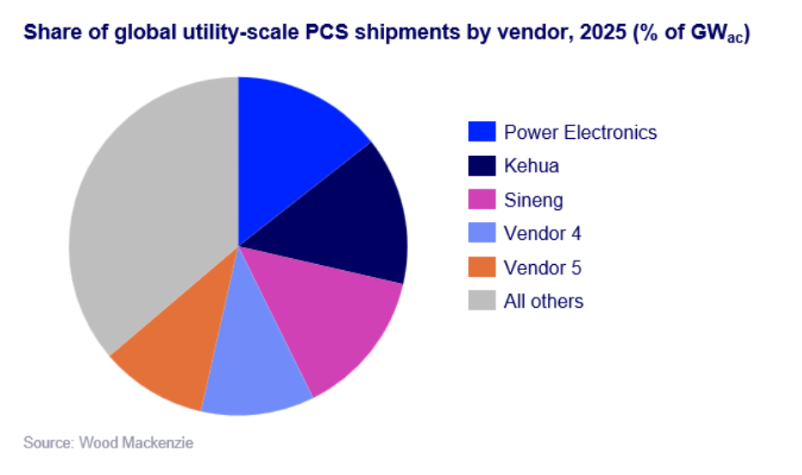
Power Electronics ranked first globally in utility-scale battery energy storage power conversion system (PCS) shipments in 2025, marginally ahead of Kehua and Sineng, according to Wood Mackenzie’s Global Energy Storage System PCS Market Share 2026 report. The three suppliers together accounted for approximately 43% of worldwide utility-scale PCS shipments.
Utility-scale projects accounted for 81% of global PCS shipments in 2025, underscoring the importance of grid-scale battery deployments to supplier rankings.
Regional market dynamics drive contrasting PCS supplier rankings
Power Electronics led utility-scale PCS shipments in the US and Canada, including more than 10 GWac delivered to the US in 2025. Tesla ranked second in the region, followed by GE Vernova. In China, large domestic storage tenders supported Kehua and Sineng, lifting both suppliers into the global top three.
Chinese-headquartered vendors accounted for 62% of global utility-scale PCS shipments but just 11% in the US and Canada. Europe was more evenly split, with Chinese-headquartered suppliers capturing 52% of shipments. Regional trade rules, procurement practices and technical requirements continue to influence market access.
“Regional procurement dynamics are not fully reflected in global PCS rankings,” said Timothy Shen, senior analyst at Wood Mackenzie. “Bankability and grid-code compliance remain central to supplier selection, particularly for utility-scale projects. Europe remains a highly competitive market, with Chinese and Western suppliers closely matched. Evolving cybersecurity requirements and advances in grid-forming technology could shift this balance in the coming years.”
Central architecture remains the utility-scale standard
Central PCS accounted for approximately 75% of utility-scale shipments in 2025, reflecting its lower per-megawatt equipment cost in large battery plants. Power Electronics, Kehua and Sineng mainly supply central systems, while string PCS is more closely associated with integrated battery products and systems supplied by Huawei. Wood Mackenzie expects the string PCS architecture to gain share gradually, although central PCS should remain the majority choice through 2027.
Hybrid inverters lead the distributed market
Wood Mackenzie released separate rankings of the leaders in the distributed PCS market, including both residential and commercial storage inverters. Deye ranked first in global distributed PCS shipments in 2025, followed by Huawei and Growatt. DC-coupled hybrid inverters, which combine solar PV and battery conversion functions, accounted for 91% of the distributed PCS segment. Manufacturers with established rooftop solar distribution networks benefited from this product mix, alongside suppliers selling all-in-one battery and inverter systems.
“The distributed storage market is being shaped by suppliers with deep solar PV distribution channels,” said Shen. “As hybrid inverter adoption grows across residential and commercial segments, the line between solar and storage suppliers will continue to blur. Suppliers that can leverage existing installer relationships while expanding battery-compatible product lines are best positioned to capture share as the market matures.”
The global PCS market is entering a period of intensifying competition, with regional trade dynamics, cybersecurity regulation and evolving grid-code requirements all set to influence supplier rankings in the years ahead.