



Get Ed Crooks' Energy Pulse in your inbox every week
Supply chain constraints limit the growth of gas-fired generation in the US
Renewables and storage, and slower retirements of coal plants, are needed to meet rising demand
1 minute read

Ed Crooks
Vice Chair Americas and host of Energy Gang podcast

Ed Crooks
Vice Chair Americas and host of Energy Gang podcast
Ed examines the forces shaping the energy industry globally.
Latest articles by Ed
-
Opinion
The mother of all disruptions
-
Opinion
Higher energy prices raise stagflation fears
-
Opinion
A power producer’s view of keeping the lights on. What does rising electricity demand from data centers mean for the US grid?
-
Opinion
Oil prices rise despite IEA reserves release
-
Opinion
The war with Iran: what does the disruption in the Strait of Hormuz mean for global energy?
-
Opinion
Iran conflict a test of US energy supply response
As the capabilities of the latest AI tools have continued to develop, making rapid progress even just in the past few months, predictions about their significance have become increasingly ambitious.
Elon Musk said at the World Economic Forum last month: “The rate at which AI is progressing, I think we might have AI that is smarter than any human by the end of this year. And I would say no later than next year.”
Five years from now, he added, AI would probably be smarter than all of humanity collectively.
Even if you see those claims as overstated or simplistic, the evidence that AI will have a transformational impact is becoming increasingly difficult to reject.
But beneath the high-flying ambitions and predictions of the AI industry are the earth-bound realities of what the industry needs to grow. In particular, that means energy, and everything in the energy supply chain.
Kevin O’Leary, the celebrity entrepreneur and investor who is one of the stars of the TV show Shark Tank, said recently that for the next three years he would focus on supplying “picks and shovels” for the AI gold rush.
“Where does the big dough go now? I think the new play is energy,” he said on Fox Business. “That means I buy land with natural gas, invest in turbine manufacturing. Anything that has to do with the grid, I’m on board for. Engineering firms that do this stuff. Copper as a commodity. I mean, that’s worked.”
Companies in the energy supply chain have agreed with that judgment. Equipment suppliers were initially cautious about expanding capacity in what has always been a cyclical industry. But over the past year or so, there has been a steady flow of announcements from manufacturers planning to increase production for critical equipment.
The large-frame gas turbines used in combined-cycle gas power plants are a case in point. Data centres’ demand for 24/7 power means that in the US, gas-fired generation is an important part of the mix for additional electricity supply. The availability of turbines is a critical constraint on future supply.
The three big manufacturers of those turbines – GE Vernova, Siemens Energy and Mitsubishi Heavy Industries – have all announced significant capacity expansions since the start of last year.
Siemens Energy announced earlier this month that it planned to invest US$1 billion and add 1,500 jobs in the US to step up production of gas turbines and grid equipment. It will be restarting production of gas turbines at its Charlotte factory after a six-year hiatus.
The announcement followed a statement last year from Mitsubishi that it plans to double its gas turbine manufacturing capacity over the next two years.
GE Vernova last year announced a plan to invest nearly US$600 million and add 1500 jobs to increase capacity in the US. It plans to deliver up to 80 heavy-duty turbines per year, up from an average of about 51 per year in the five years from 2021 to 2025.
The question for the US AI industry is how much difference all this additional capacity is going to make to electricity supply over the next five years, a period that is seen as critical for the future of the technology.
The Wood Mackenzie view
In the five-year period to 2030 that will supposedly be critical for the development of advanced AI, gas-fired plants will make a significant contribution to meeting increased US power demand, Wood Mackenzie analysts project. But the availability of equipment, particularly heavy-duty gas turbines, is likely to remain a constraint on electricity supply growth, despite the new capacity being added by manufacturers.
As of last year, the average lead time for delivery of a gas turbine was almost five years after receipt of order, Wood Mackenzie’s Supply Chain team found. Lead times may have edged up slightly since then. In 2021, the average was only about two years.
We are forecasting that those lead times should start to drop by 2027, as the additional manufacturing capacity ramps up. But that is not expected to have much impact on generation capacity additions until 2030 and beyond.
Wood Mackenzie’s most recent base case forecast is that the US will add about 63 GW of gas-fired generation capacity, including combined-cycle plants, peaking plants and coal plant conversions, by 2030. That is more than double the net increase in gas-fired capacity over the past five years, which was just 26 GW.
Our analysts are currently working on a scenario looking at the consequences if demand were to grow faster than in our base case. The full details will be available soon. But Patrick Huang, a senior research analyst on our North America power team, said he did not expect the projected output from gas-fired plants between now and 2030 to be substantially different in that accelerated demand growth case.
“Manufacturers are unlikely to be able to deliver the turbines much faster in this timeframe, even with the recent announcements of capacity expansions,” he said.
Instead, increased electricity supply will have to be added in other ways. Renewables and storage can meet some of the new demand, as can smaller engines that burn gas or diesel.
Another important factor is likely to be the slower retirements of coal-fired plants. As of last year, about 57 GW of coal-fired generation was set to shut down between 2026 and 2030. We project that 22 GW, about 40% of that capacity, could be kept running.
Those deferred retirements will be driven in part by government action. The Department of Energy has been issuing orders to utilities to keep coal-fired plants running. This week, for example, it extended an order compelling a 1.4 GW coal plant in Michigan to remain online, on the grounds of concerns about resource adequacy on the MISO grid. Several other similar orders have been issued.
The administration is also moving to ease regulatory requirements that could force coal plants to close. The New York Times reported this week that the Environmental Protection Agency plans to ease restrictions on mercury pollution from coal-fired generation.
Coal plants will also often benefit from rising power prices, improving the economics of keeping them online.
All these sources can play a role in helping to meet accelerated demand growth. But it still seems clear that many data centre developers will not be able to secure the power supply they want on the timetable they want.
The latest Wood Mackenzie data show that US utilities already have at least 178 GW of new large loads either committed or already under construction, with more than 450 GW more known but currently uncommitted.
If the breakthrough to the sort of super-intelligent AI talked about by Elon Musk is to happen, it will have to be achieved within the boundaries set by the US electricity system.
In brief
The US military build-up in and around the Gulf region has accelerated, fuelling speculation that an attack on Iran could come soon, perhaps as early as this weekend. The US now has its largest concentration of warplanes in the region since the invasion of Iraq in 2003. The White House said President Donald Trump was seeking an agreement with Iran over its nuclear programme, and negotiations were under way, but the two countries were still “very far apart on some issues”. Ayatollah Ali Khamenei, Iran’s Supreme Leader, threatened to sink US warships if his country was attacked.
Oil prices have risen sharply during the week, and Brent crude was trading at about US$72 a barrel on Friday morning.
The ministerial meeting of the International Energy Agency this week was riven by disagreements over the organisation’s position on carbon emissions. Chris Wright, the US energy secretary, said the IEA did not need to present a net zero emissions scenario as a possible future, saying it was “ridiculous” and “never going to happen”. He also said the Trump administration would “use all the pressure we have” to push the IEA to drop its analysis of emissions and focus on energy security. He also reiterated previous warnings that the US could withdraw from the organisation if it did not change direction.
Fatih Birol, the IEA’s executive director, said the organisation was data-driven and non-political, but supported secure, affordable and sustainable energy. He added that it was “determined to lead the global energy journey towards the betterment of humanity”.
Earlier, Secretary Wright criticised European energy policy, saying it had taken a wrong direction since around 2010. Speaking at the French Institute of International Relations, he said that between 2010 and 2025, the US share of global energy consumption had risen from about 25% to about 28%. Over the same period, the share accounted for by the then-members of the EU had dropped from about 25% to about 17%.
“I lament that,” Wright said. “These are awesome countries, awesome businesses, awesome humans, awesome educational systems. But making energy more expensive and unreliable, it’s led to a deindustrialisation, a lack of investment, and [it is] harder to make ends meet.”
Secretary Wright also rejected suggestions that Europe could not rely on the US as a source of LNG, describing his country as a “rock-solid supplier of energy”. Dan Jørgensen, the EU Energy Commissioner, said last month that Europe was actively seeking alternatives to US LNG and planning closer ties with other gas suppliers, including Canada, Qatar and Algeria.
Toby Rice, chief executive of EQT, is launching a new non-profit group called Energy Corps, which will work to increase access to modern energy in developing countries. The new group will support a wide range of solutions, from fossil fuels to solar power to nuclear plants, the Wall Street Journal reported.
Other views
How jet engines are powering data centers – Jinjoo Lee
Why linking grid regions is the way to reliable, affordable American energy – Patrick Whitty
The water vapor problem: the weak point in EPA greenhouse gas regulation – Roger Pielke Jr
Quote of the week
“Somebody’s going to develop the oil in Venezuela — it’s too valuable… Do I want Chevron and Exxon and US companies, even if there’s no EPA, that have a responsibility to their shareholders? Or do I want Iran and China developing that resource?”
Governor Kelly Armstrong of North Dakota defended the Trump administration’s push to increase oil production in Venezuela, even though it could hurt the revenues of the industry in his state.
Josu Jon Imaz, CEO of Repsol, told investors on a call on Thursday that the company hoped to increase its production in Venezuela by 50% in the next 12 months, and triple it over the next three years.
Chart of the week
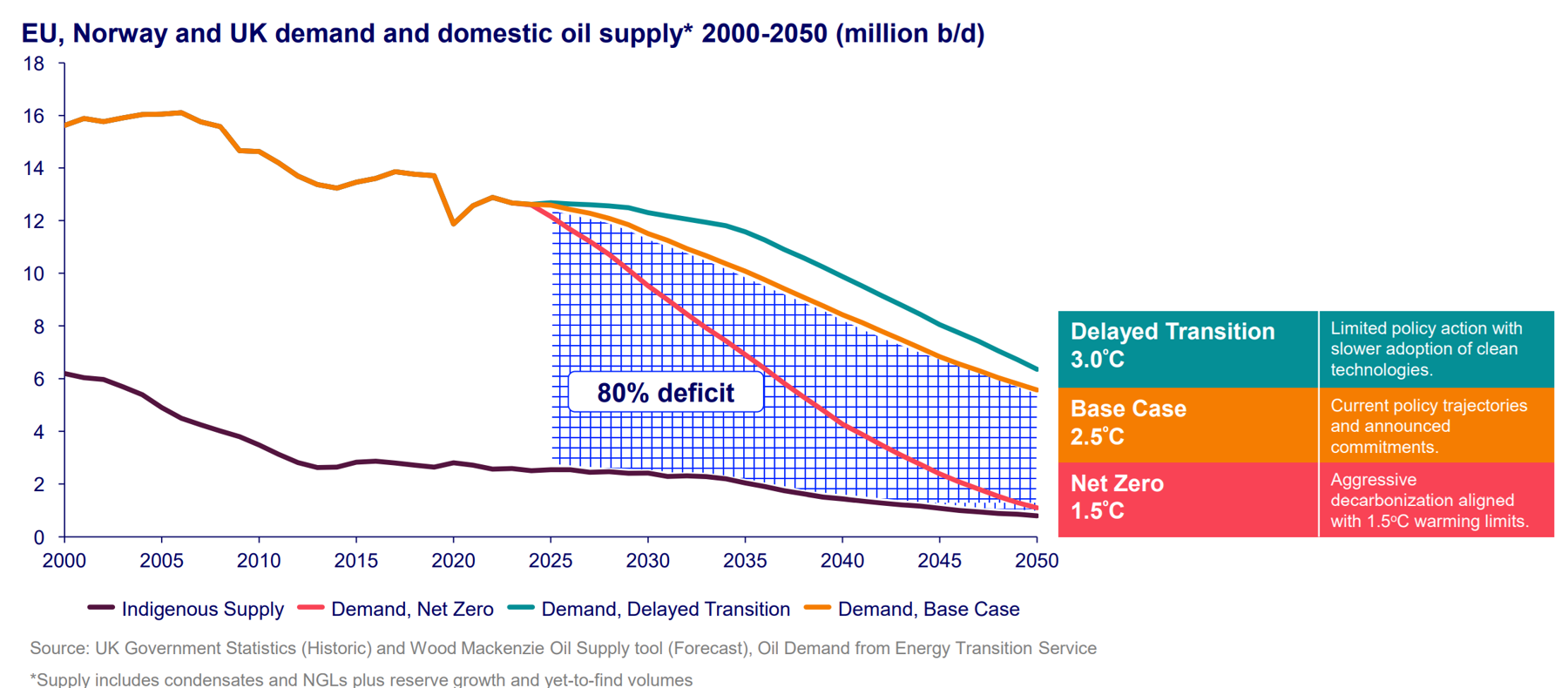
This is from a report that was published last year but is still highly relevant, particularly with concern growing over possible disruption to global oil supplies following a US attack on Iran.
It shows the balance of supply and demand for oil in the EU, UK and Norway, with historical data back to 2000 and Wood Mackenzie forecasts out to 2050. You can see that Europe has been reliant on oil imports for decades, and will remain so for decades to come, unless it moves towards achieving net zero emissions by 2050. As things stand, that looks highly unlikely.
Download the full report, ‘The UK's critical role in Europe's integrated oil system’, for more details.

Get The Inside Track
Ed Crooks’ Energy Pulse is featured in our weekly newsletter, the Inside Track, alongside more news and views from our global energy and natural resources experts. Sign up today via the form at the top of the page to ensure you don’t miss a thing.