




Get Ed Crooks' Energy Pulse in your inbox every week
The US oil industry is consolidating as growth slows
The US$58 billion Devon-Coterra merger reflects investors’ demands for scale and stable cash flows
1 minute read

Ed Crooks
Vice Chair Americas and host of Energy Gang podcast

Ed Crooks
Vice Chair Americas and host of Energy Gang podcast
Ed examines the forces shaping the energy industry globally.
Latest articles by Ed
-
Opinion
A power producer’s view of keeping the lights on. What does rising electricity demand from data centers mean for the US grid?
-
Opinion
Oil prices rise despite IEA reserves release
-
Opinion
The war with Iran: what does the disruption in the Strait of Hormuz mean for global energy?
-
Opinion
Iran conflict a test of US energy supply response
-
Opinion
Are VPPs really a viable solution for easing strain on the grid?
-
Opinion
Data centers are adding an extra 220 gigawatts of electricity demand in the US. How can the grid cope?
Oklahoma City has taken a couple of blows from the oil and gas industry this month. Two of the largest US E&P companies, Expand Energy and Devon Energy, have announced they are moving their headquarters out of the city and relocating to Houston.
The moves have different motivations, but are both symptomatic of a shared theme: the changes the US unconventional oil and gas industry is going through as it matures. It is consolidating on Houston as companies seek to cut costs and look for new opportunities.
Expand, the largest natural gas producer in the US, said this week it was moving its executive leadership team in order to “capitalise on Houston’s leading role as a gateway to the global natural gas market.” The huge increase in US LNG export capacity now under way is creating new opportunities for gas producers.
Expand’s announcement followed the news from Devon last week that, following its US$58 billion merger with Coterra Energy, the headquarters of the combined company would be in Houston, where Coterra is currently based.
Another sign of maturity in the industry is that growth in US oil production has just about come to a halt. On Wood Mackenzie’s numbers, oil production from the US Lower 48 states in December 2025 was about 11.19 million barrels per day, up only about 70,000 b/d from its level of 11.12 million b/d in December 2024.
That flat profile is a result of market conditions. West Texas Intermediate crude averaged about US$65 a barrel in 2025, and the active rig count dropped from 560 in December 2024 to 513 a year later. Higher prices would revive activity and could get production growing again.
But this period of stagnation could be a foretaste of a more fundamental shift. Wood Mackenzie projects an approaching plateau in US oil production, starting from around the mid-2030s.
The outlook for gas is different. Wood Mackenzie is forecasting that US gas production will grow 36% between 2025 and 2035. But for many US E&Ps, especially if they are oil-focused, the question of how to deliver earnings growth will become increasingly pressing.
The new Devon Energy will be the largest independent producer in the Lower 48 states with about 1.6 million barrels of oil equivalent per day production, passing ConocoPhillips and trailing only the US Majors. Its planning for strategy and capital allocation is a valuable indicator of the ways that the industry is evolving to respond to shareholders’ demands in this changing environment.
The Wood Mackenzie view
In the first decade of the US tight oil industry, the 2010s, investors valued growth and focus on a specific basin. That was what earned E&P companies’ shares a premium multiple.
Since the later years of that decade, investors have shifted their priorities to favour capital discipline and distributions to shareholders. E&Ps do not have to be focused to achieve superior ratings.
In fact, being larger and having a more diverse spread of operations is generally better, because it can reduce volatility in cash flows, helping to support stable dividend payments.
Among US oil-focused companies, there is a clear correlation between size and valuation multiple. The Majors, ExxonMobil and Chevron, get the highest ratings, followed by the “elite E&Ps” such as ConocoPhillips, Diamondback Energy and EOG Resources, followed by the large-cap independents and then the smaller and mid-cap ones.
As Ryan Duman, a director in Wood Mackenzie’s US Upstream research team, puts it: “Scale plays an incredibly important role these days.”
Devon is delivering an immediate demonstration of the benefits of scale, with a significant increase in dividend payments. A planned quarterly dividend has been set at US$0.31 per share, up 31% from Devon’s current US$0.24 per share, with a goal of consistent dividend growth through the cycle.
Before the deal, Devon was paying out about 10% of its operating cash flow as a base dividend, which was at the lower end of the range for large-cap oil-focused E&Ps. The post-deal payout will be about 15% of cash flow, which is higher than for Diamondback, and catching up with EOG and ConocoPhillips.
Devon also plans a new share buyback programme worth more than US$5 billion.
The company’s leadership team still needs to demonstrate that it can make the deal work. “They need to execute flawlessly, prove cash flow stability, and streamline enough to improve capital allocation clarity, which argues for selective divestitures,” says Wood Mackenzie’s Duman. “But Devon and Coterra have made the right first move.”
There are remaining questions over which assets the company could sell off. Duman suggests there could be a “sweet spot” in the balance between focus and diversification, with Devon selling assets to go down from operating in five main basins to concentrate on two or three. That could make it focused enough for operational excellence, but diversified enough for cash flow stability.
However those asset sales play out, the message from the merger will be the same. Investors in US tight oil generally want scale, stability, efficiency, capital discipline and shareholder distributions. That position seems unlikely to change for the foreseeable future, and the industry will continue to evolve to reflect those demands.
The US overturns fundamental climate rule
The Trump administration has overturned the endangerment finding, a ruling by the Environmental Protection Agency under the Obama administration in 2009 that greenhouse gas emissions “threaten the public health and welfare of current and future generations.” The finding had been the basis for a series of climate regulations, particularly related to vehicle emissions.
The EPA said the Obama administration’s finding had “exceeded the agency’s authority to combat ‘air pollution’ that harms public health and welfare”. It added that a policy decision of that magnitude, with sweeping consequences, could only be taken by Congress.
Environmental groups said they would challenge the move in court. The Environmental Defense Fund said the decision “rejects the overwhelming evidence that climate pollution threatens everyone’s health and safety.”
Although the endangerment finding has symbolic significance as a signal of the administration’s position on climate policy, its practical impact on US energy has been limited. Attempts by the Obama and Biden administrations to use the finding to regulate emissions from power generation never went into effect.
The most significant regulations based on the finding put limits on greenhouse gas emissions from vehicles, and all of those rules are now being scrapped. The Trump administration is also moving to ease the related but separate Corporate Average Fuel Economy (CAFE) standards for vehicles.
However, Wood Mackenzie analysts say even the vehicle rules have a relatively modest impact. In anticipation of these policy changes, we built a slower rate of efficiency gains into our fuel demand models last year.
We projected that the impact would be to increase US gasoline consumption by up to 2.5% over the 25 years to 2050.
In brief
Chris Wright, the US energy secretary, has visited Venezuela to assess at first hand the condition of the country’s oil industry. Wright met Venezuela’s acting President Delcy Rodríguez, and joined her for a tour of oil facilities in the Orinoco Belt region. He said he thought Chevron could double production at its Petropiar project, a joint venture with state oil company PDVSA, within 12 to 18 months, and quintuple it within five years.
Wright also said he expected Venezuela’s oil production to rise by 30%-40% this year, and to continue its growth “at a pretty good clip” after that.
Venezuela’s National Assembly has passed reforms of its hydrocarbons law, with the aim of encouraging international investment. Graham Kellas, Wood Mackenzie’s Senior Vice President for Global Fiscal Research said last month that although the reform was an important first step, “there is a long way to go before we will see the large-scale private company investment that is desired."
China has said it will “do what it can” to help Cuba, which is facing growing hardship as a result of the US cutting off its oil imports. Lin Jian, a spokesman for China’s foreign ministry, denounced the US for “inhumane actions that deprive the Cuban people of their right to survival and development.” Sergei Lavrov, Russia’s foreign minister, separately said Moscow stood in solidarity with Cuba. He said Russia was “ready to provide our friends with all necessary support,” without specifying what form that support could take.
The US is sending another aircraft carrier to the Gulf region, as tensions with Iran remain high. President Donald Trump said he hoped for a result from US negotiations with the Iranian government “over the next month”. But he warned that if the two countries failed to strike a deal, the consequences would be “very traumatic” for Iran.
Brent crude, which has been under upward pressure in anticipation of potential disruption to supplies from the Gulf region, fell on Thursday. On Friday morning it was trading at about US$67.50 a barrel.
Transocean has agreed to buy Valaris for US$5.8 billion, consolidating Transocean’s position as the world’s largest offshore driller. Wood Mackenzie analysts said the deal moved the deepwater drilling market towards an effective duopoly, with Transocean and Noble between them in control of 60% of the globally marketed fleet.
Anthropic, the pioneering AI company, has pledged to cover any electricity price increases that consumers face as a result of its data centres. The move follows similar commitments from Microsoft and OpenAI. Concerns about the impact of soaring demand for power on household electricity bills have been rising up the political agenda in the US, and legislation to block data centre development has been proposed in six states.
Other views
Is there still life in decarbonising hard-to-abate sectors? – Simon Flowers
What’s shaping European power markets in 2026? – Peter Osbaldstone and Mark Pyman
China’s coal-fired power generation declines for the first time since 2015
BP is not getting enough credit for its turnaround – FT Lex
Something big is happening – Matt Shumer
Large Language Model reasoning failures – Peiyang Song, Pengrui Han and Noah Goodman
(Two contrasting views on the progress and potential of the latest developments in AI, with huge implications for the future of energy)
Quote of the week
“China builds the world’s largest solar farms within a few months. In the EU, it takes years just for the project to get approved. Therefore, I propose to implement a fundamental principle in most permitting processes. Any project that is not treated within a few weeks or months will be regarded [as] approved automatically.”
Friedrich Merz, Chancellor of Germany, urged the EU to push ahead with regulatory reforms to strengthen its economy.
Chart of the week
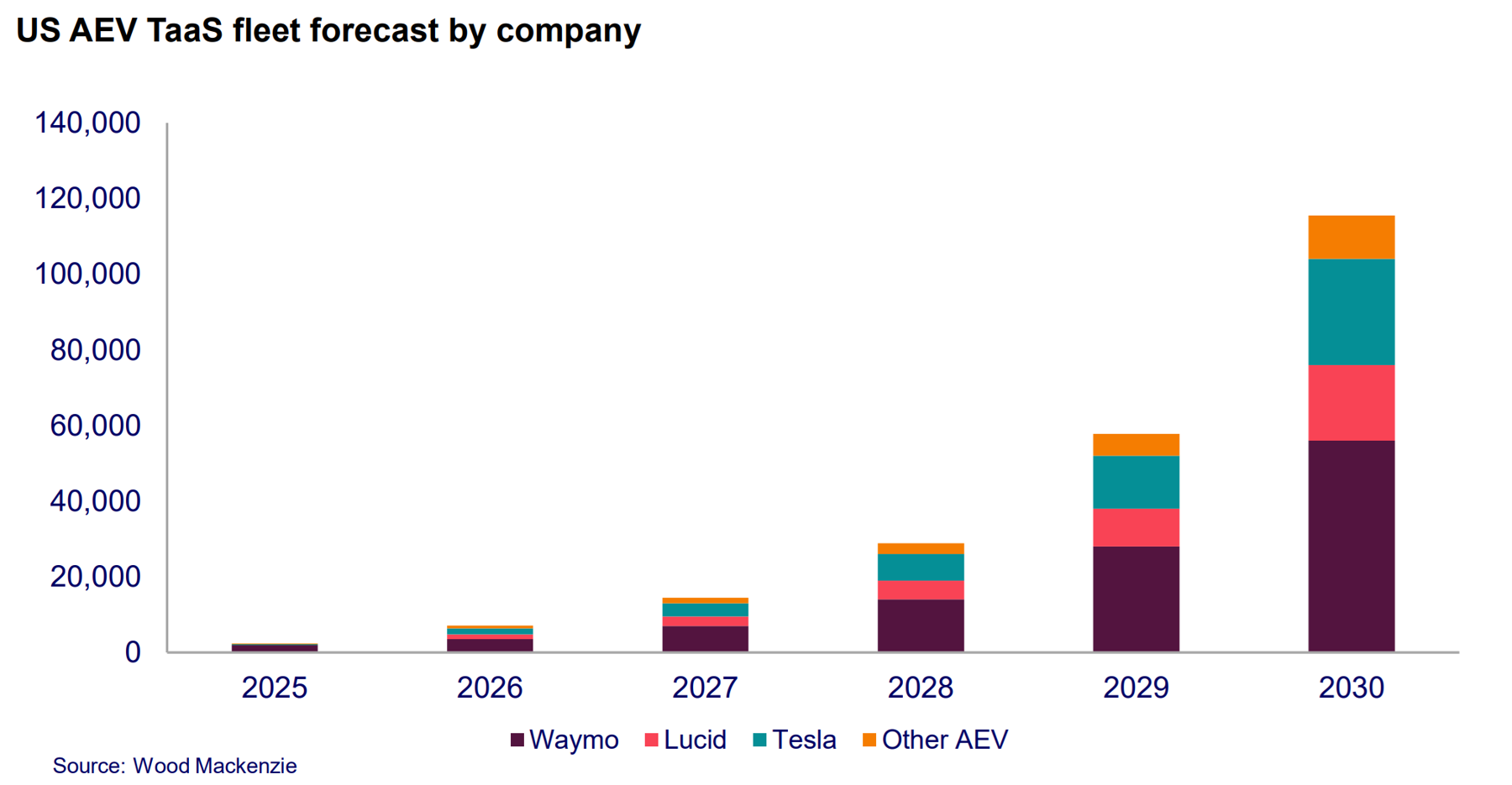
This comes from Wood Mackenzie’s recent report on autonomous electric vehicles (AEVs). The successful deployment of AEV taxis in Phoenix and San Francisco is leading to a wider roll-out of commercial services in other US cities, as well as pilots in the UK and Japan that are scheduled to begin this year. Waymo expects to be delivering a million rides a week worldwide by the end of 2026, up from a million a month at the end of 2025. By 2030, we expect about 120,000 AEV taxis to be on the roads in the US. That would still be a tiny fraction of the total US passenger vehicle fleet of about 280 million. But it looks like the beginnings of a revolution.

Get The Inside Track
Ed Crooks’ Energy Pulse is featured in our weekly newsletter, the Inside Track, alongside more news and views from our global energy and natural resources experts. Sign up today via the form at the top of the page to ensure you don’t miss a thing.