




Sign up today to get the best of our expert insight in your inbox.
Can natural hydrogen deliver its potential?
Technology, capital and regulation required
1 minute read

Simon Flowers
Chairman, Chief Analyst

Simon Flowers
Chairman, Chief Analyst
Simon is our Chief Analyst; he provides thought leadership on the trends and innovations shaping the energy industry.
View Simon Flowers's full profile
Kate Adie
Research Analyst, Subsurface

Kate Adie
Research Analyst, Subsurface
Kate is a key contributor to our global research on established and developing geoenergy technologies.
Latest articles by Kate
-
The Edge
Can natural hydrogen deliver its potential?
-
Opinion
Hot rocks: geothermal momentum continues to build
-
Opinion
Rock solid: geothermal’s upward trajectory
-
The Edge
The coming geothermal age
-
Opinion
Heating up: 2024 showcased the promise of geothermal energy
-
Featured
Subsurface 2025 outlook
The low-carbon hydrogen sector had a tough 2025. Final investment decisions fell by 30% in capacity terms compared to 2024, while cancellations roughly tripled. The key challenge facing the industry isn’t a lack of demand, but a struggle to reduce costs.
Despite stalling progress, companies and governments continue to explore different options for hydrogen supply. Unlike green or blue hydrogen, both of which require inefficient conversion processes, natural hydrogen comes oven-ready and – potentially – at a much lower cost.
Could natural hydrogen reshape the sector’s long-term supply outlook? Kate Adie from our Subsurface team lays out the opportunities and challenges.
What is natural hydrogen?
Pretty much what is says on the tin. These are naturally occurring hydrogen molecules that are generated by continuous geochemical reactions in hard rock. They follow similar migration and accumulation patterns to oil and gas in the subsurface. Unlike hydrocarbons, however, natural hydrogen – also referred to as white hydrogen – molecules are small and light, with much lower volumetric energy density than natural gas. Hence, far larger proven volumes are needed to match the energy value of a typical gas discovery.
Where is the industry today?
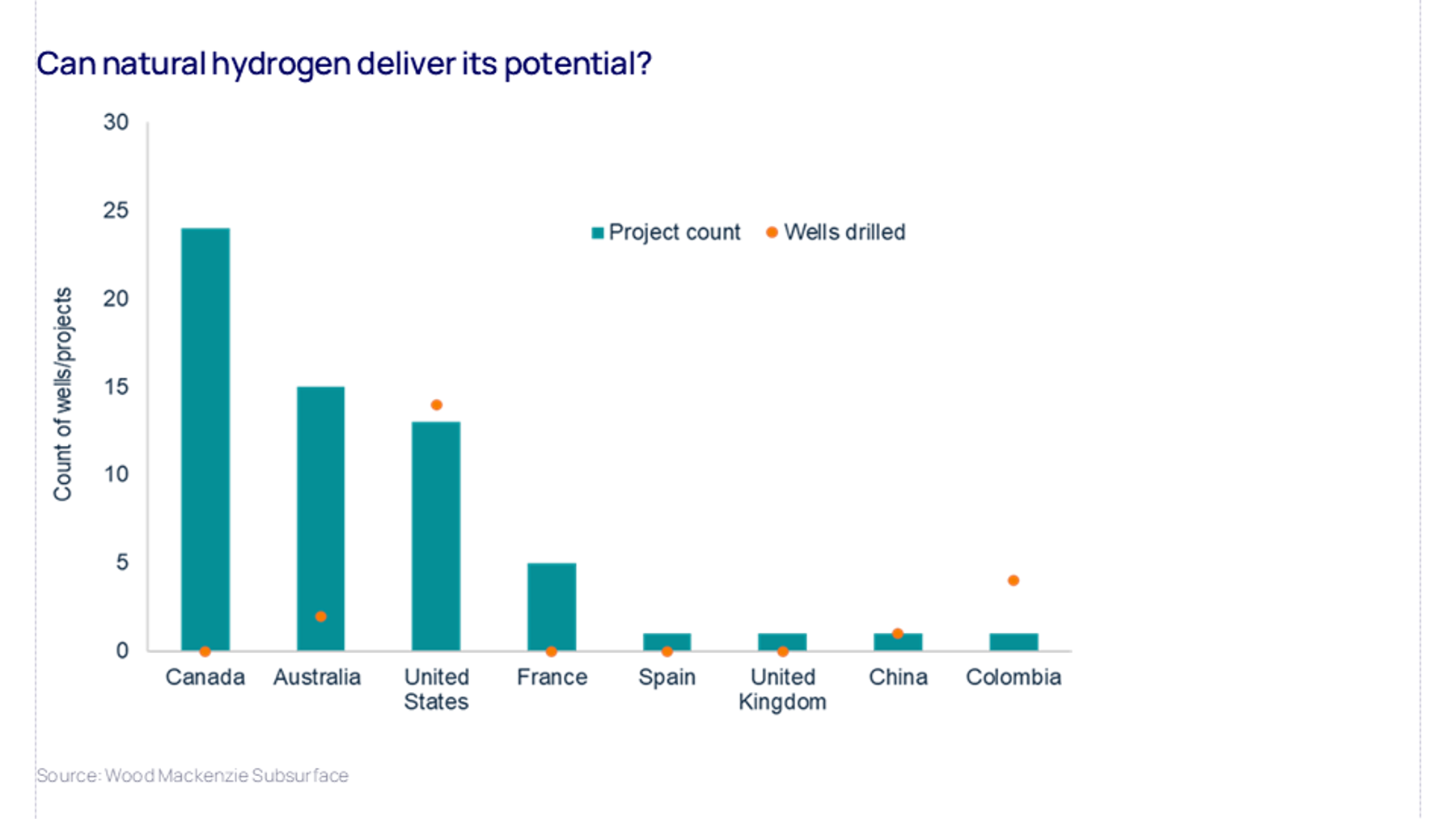
It’s still very early days, but natural hydrogen exploration is shifting gears. After years of desk studies, drill bits are finally breaking ground. The US is leading the pack on drilling activity, with Australia not far behind. Canada and France are following suit with active campaigns now underway. These initial wells are pivotal to demonstrating that dedicated exploration programmes can gain traction, though the sector still needs many more wells to understand the resource potential.
While these drilling campaigns are forging ahead, broader exploration interest is building. Wood Mackenzie is tracking a total of 60 announced projects, though nearly all remain at desk study or surface data collection stages. If early drilling delivers results, more prospects are likely to advance.
Who are the sector’s leading players?
Unsurprisingly for a nascent sector, the natural hydrogen exploration landscape is dominated by a combination of startups, small-cap operators and small mining companies. Colorado-based Koloma is leading the field, having secured 85% of the US$400 million of startup capital raised by the sector to date.
Larger mining and oil and gas companies have yet to jump in, but some are keeping a watching brief on emerging technologies and frontier resource plays. Major players including Fortescue, Rio Tinto and BP Ventures have taken strategic positions through investments, following the well-trod path of waiting for proof of concept before committing significant capital.
Does natural hydrogen align with the core skills of the petroleum industry?
Natural hydrogen draws on the same geoscience and subsurface exploration skills that define the oil and gas company playbook.
Oil and gas companies also have the capital to drive forward nascent sectors such as natural hydrogen but look unlikely to be allocating this anytime soon. With Big Oil’s strategic goal now clearly shifting towards strengthening upstream portfolios for the next decade, any significant capital allocation towards low-carbon molecules, including natural hydrogen, looks unlikely.
Are policy and regulation keeping pace?
As with oil and gas, robust regulatory frameworks are essential to support natural hydrogen investment. Inevitably, jurisdictions with the most advanced regulation are seeing the most activity – streamlined mineral rights access in the US and progressive legislation in Australia have created exploration hotspots. In Europe, it’s a mixed bag – France has been quick to recognise hydrogen as a regulated energy molecule, while Spain's restrictive drilling regulations have stalled progress.
Much more is needed to unlock the full potential. Policies and regulations dedicated to natural hydrogen remain a rarity. In many markets, it remains unclear whether natural hydrogen can tap into the same supportive mechanisms as green and blue hydrogen. Attracting investment requires a clear line of sight to subsurface rights and ownership.
The Middle East is a case in point: promising geology and strong hydrogen demand but no regulatory framework. Given that natural hydrogen resources are found across a variety of terrains and geographies, governments could move faster to introduce the clarity and incentives needed to kick-start the sector.
How big is the natural hydrogen opportunity?
Realistically, natural hydrogen is likely to remain a niche sector. Wood Mackenzie's long-term hydrogen outlook doesn't currently include natural hydrogen in our base case supply forecast. That said, if exploration proves successful, the technical production potential from announced prospective resources could reach 20 Mtpa by 2050 – equivalent to around 12% of all low-carbon hydrogen supply by this time.
This is despite natural hydrogen offering a potentially cheaper alternative resource. Without the need for inefficient energy conversion or manufacturing processes, wellhead costs should easily beat green and blue hydrogen. But the critical question is whether it can reach markets economically, or whether offtake will need to be built at source. Proving this commercial model, alongside securing supportive regulations and capital, will be the challenge ahead.

Make sure you get The Edge
Every week in The Edge, Simon Flowers curates unique insight into the hottest topics in the energy and natural resources world.
Sign up today using the form at the top of the page.