



How is energy transition investment evolving in 2026?
What investors and stakeholders need to know about the rapidly evolving investment landscape for clean energy
1 minute read

Jom Madan
Principal Analyst, Scenarios & Technologies

Jom Madan
Principal Analyst, Scenarios & Technologies
Jom works on scenario modelling for country and global-level energy mixes across all major energy commodities
Latest articles by Jom
-
Opinion
How is energy transition investment evolving in 2026?
-
The Edge
How the Iran war could change energy markets
-
Opinion
Energy transition outlook: Asia Pacific
-
Opinion
Energy transition outlook: Middle East
-
Opinion
Energy evolution: navigating the path to a sustainable future
-
The Edge
The coming low carbon energy system disruptors

Lindsey Entwistle
Senior Research Analyst, Energy Transition

Lindsey Entwistle
Senior Research Analyst, Energy Transition
Lindsey provides analysis and insights into global policy, regulations and disruptive technologies.
Latest articles by Lindsey
-
Opinion
How is energy transition investment evolving in 2026?
-
The Edge
How the Iran war could change energy markets
-
Opinion
Energy transition outlook: UK
-
Opinion
Energy evolution: navigating the path to a sustainable future
-
Opinion
What are the energy transition technologies to watch in 2025?
-
Opinion
Energy transition outlook: UK

Roshna N
Research Analyst, Energy Transition

Roshna N
Research Analyst, Energy Transition
Roshna N specialises in integrated energy and emission models for Asia-Pacific and African markets.
Latest articles by Roshna
-
Opinion
How is energy transition investment evolving in 2026?
-
Opinion
Energy transition outlook: Asia Pacific
-
Opinion
Energy transition outlook: Africa
-
Opinion
What are the energy transition technologies to watch in 2025?
-
Opinion
Energy transition outlook: Africa
-
The Edge
How the world gets onto a 1.5 °C pathway

Prakash Sharma
Vice President, Head of Scenarios and Technologies

Prakash Sharma
Vice President, Head of Scenarios and Technologies
Prakash leads a team of analysts designing research for the energy transition.
Latest articles by Prakash
-
Opinion
How is energy transition investment evolving in 2026?
-
The Edge
How the Iran war could change energy markets
-
Opinion
Energy transition outlook: Asia Pacific
-
Opinion
Energy transition outlook: Africa
-
Opinion
Energy transition outlook: Middle East
-
Opinion
Energy transition outlook: UK
The energy transition presents US$3 trillion to US$6 trillion annual investment opportunity , but it also raises important questions that must be answered to ensure capital deployment generates returns to stakeholders. What role should equity play in driving the transition? What are the biggest market and technological shifts? And how could investment requirements change under different transition trajectories?
Wood Mackenzie’s Lens Energy Transition Scenarios solution leverages our proprietary scenario modelling results and cost-of-supply intelligence across the energy and resources value chain - providing an in-depth toolkit to help investors navigate the rapidly evolving energy investment landscape. Fill out the form at the top of the page to download an extract from the full report, or read on for a brief overview of key themes.
Global energy and infrastructure investment is rising despite geopolitical uncertainty
Our detailed energy transition modelling is based on four potential scenarios, outlining four different energy transition pathways to 2060:
- Base case (‘energy evolution’): Renewables surge but meet only incremental demand, resulting in an average global temperature rise of 2.6 °C
- Delayed transition (‘energy dominance’): security fears slow clean energy momentum, with fossil fuels filling the gap; temperatures rise 3.1 °C
- Country pledges (‘energy resilience’): A coordinated, pragmatic and decisive shift to clean energy results in a temperature rise of 2 °C
- Net zero (‘energy innovation’): A wholesale rewiring of the energy system keeps average global temperature rises to 1.5 °C
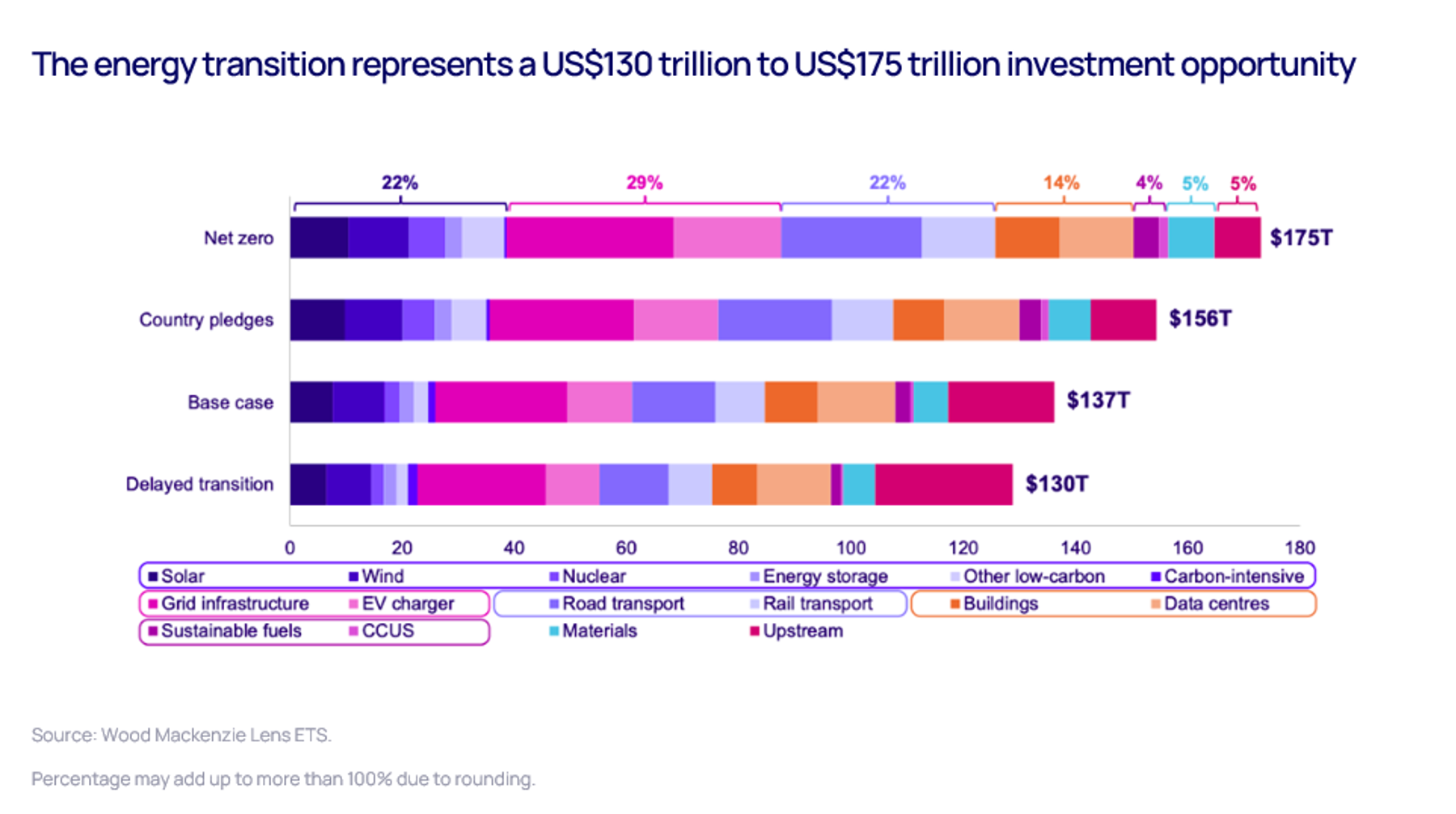
Based on our analysis of these possible pathways, the energy transition presents an immense US$130 trillion to US$175 trillion investment opportunity globally between now and 2060. Under the net zero pathway, half of total capex would need to go to electrification and infrastructure (see chart below). Mature technologies will dominate overall spend, as policy makers prioritise cost efficiency and supply security.

Despite significant geopolitical uncertainty, energy sector investment is rising. Capex spending reached US$3.3 trillion in 2025, and is on track to exceed US$3.8 trillion by 2030. Power supply and grid infrastructure still dominate spending; however, transition momentum has slowed, with EV spending downgraded from previous expectations and oil and gas investment rising to meet near-term demand.
Spending is increasingly concentrated in major economies, with China clearly in the lead
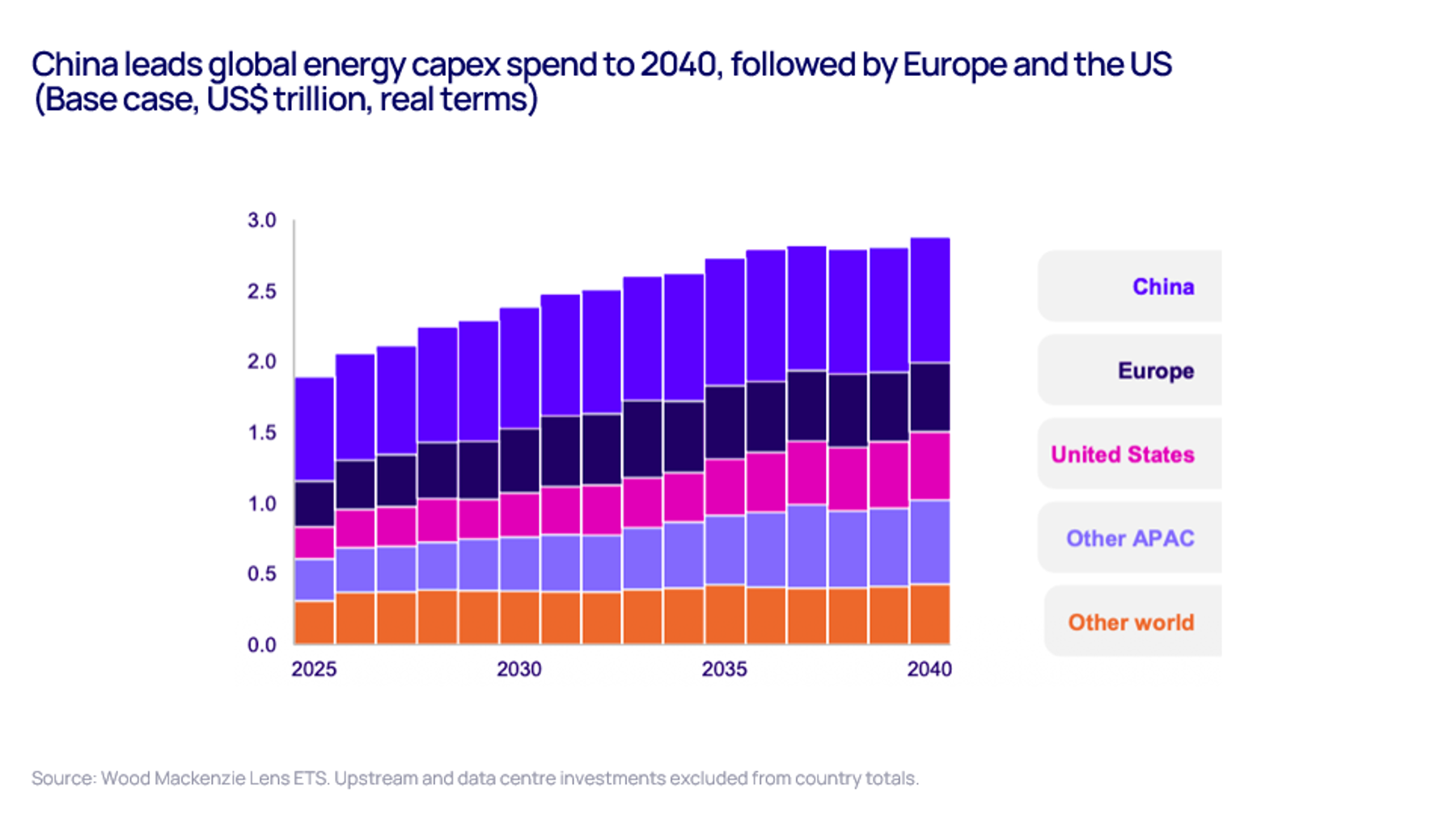
Under our base case, China, Europe and the US account for 70% of global capex to 2040 between them (see chart below). China alone will invest 30% of total global capex, focusing on power expansion, electrification and efficiency to target lower costs and ensure supply security.
In developed markets, subsidies, carbon taxes and higher energy prices have already achieved easy wins by pushing heavy emitters to adopt commercial lower-carbon and abatement technologies. Remaining last-mile emissions will typically need to be addressed through more costly investment in the development of early-stage technologies. In Europe, modest demand growth will spread spend across technologies; by comparison, the US will see greater demand growth but will benefit from abundant gas and renewable resources.

Financing gaps remain acute in developing economies due to high borrowing costs and risk
Developing nations tend to have much larger spending gaps; to meet climate goals, they will need to spend a greater share of their income on investing in the energy transition. The gap is larger for countries that must both expand energy supply and decarbonise their economies simultaneously. We expect Africa to drive just 1% of global spend, with limited finance, high capital costs and development priorities making decarbonisation challenging. In contrast, India’s spending will grow nearly six times by 2060 - a necessary increase to meet an expected quadrupling of power demand.
The next decade is critical to deploy capital and scale new low-carbon technologies
The upfront costs of transition could create near-term economic headwinds; however, preventing extreme warming will likely generate positive returns over the next three decades by avoiding the most severe impacts of climate change. Our most recent analysis projects annual global GDP to be 32% higher than our base case under a net zero scenario, and 21% higher under country pledges.
Under our base case, spending is set to be lower than needed over the next decade, however. Deploying additional capital in this window will be critical to scale new low-carbon technologies and drive the transition forward. With renewables already maturing, the largest spending gap is in enabling infrastructure, including electricity grids and electric vehicle charging networks, rather than in power generation. Meanwhile, heavy industry will depend on rapid investment in emerging solutions including green hydrogen and carbon capture. To bridge the financing gap, we calculate that global investment must surge from 2.4% to 4% of global GDP.
Find out more
Don’t forget to fill in the form on this page to access the report extract, which covers these themes in detail and includes a wide range of charts and supporting data.
You may also want to explore how our Lens Energy Transition Scenarios solution can help you dive deeper - including querying investment data by market, technology, scenario and debt-equity split.