



US Rockies gas: right place, right time, right economics
What do E&P firms need to know as announces 2025 bid round winners and sets out offerings for 2026?
1 minute read
Jennifer McNally
Senior Research Analyst, Upstream Lower 48
Jennifer McNally
Senior Research Analyst, Upstream Lower 48
Jenifer leads the key play service which delivers core content on plays across North America.
View Jennifer McNally's full profileHigh costs have stifled the growth of gas production in the US Rockies over the past two decades. But with demand rising, expectations of sustained gas prices above US$4 per thousand cubic feet (mcf) change everything, especially as improved extraction techniques maximise well economics. Add to that established pipelines with expansion capacity to export additional production and the scene is set for a Rockies gas renaissance.
Why the Rockies went dormant as a gas producer
The cost of extracting much of the gas in the Rockies region meant producers were unable to compete at historic gas prices around the US$2.50/mcf mark. Higher costs stem from several factors:
- Geology: The need for deeper, more technically complex wells results in higher drilling and completion costs
- Infrastructure: Limited takeaway capacity creates higher basis differentials and transportation costs to key demand centres and LNG terminals
- Scale: Lower development density makes it difficult to achieve economies of scale, driving up unit costs
- Regulatory environment: Stricter permitting and environmental compliance in Colorado and Utah adds time and cost to project development
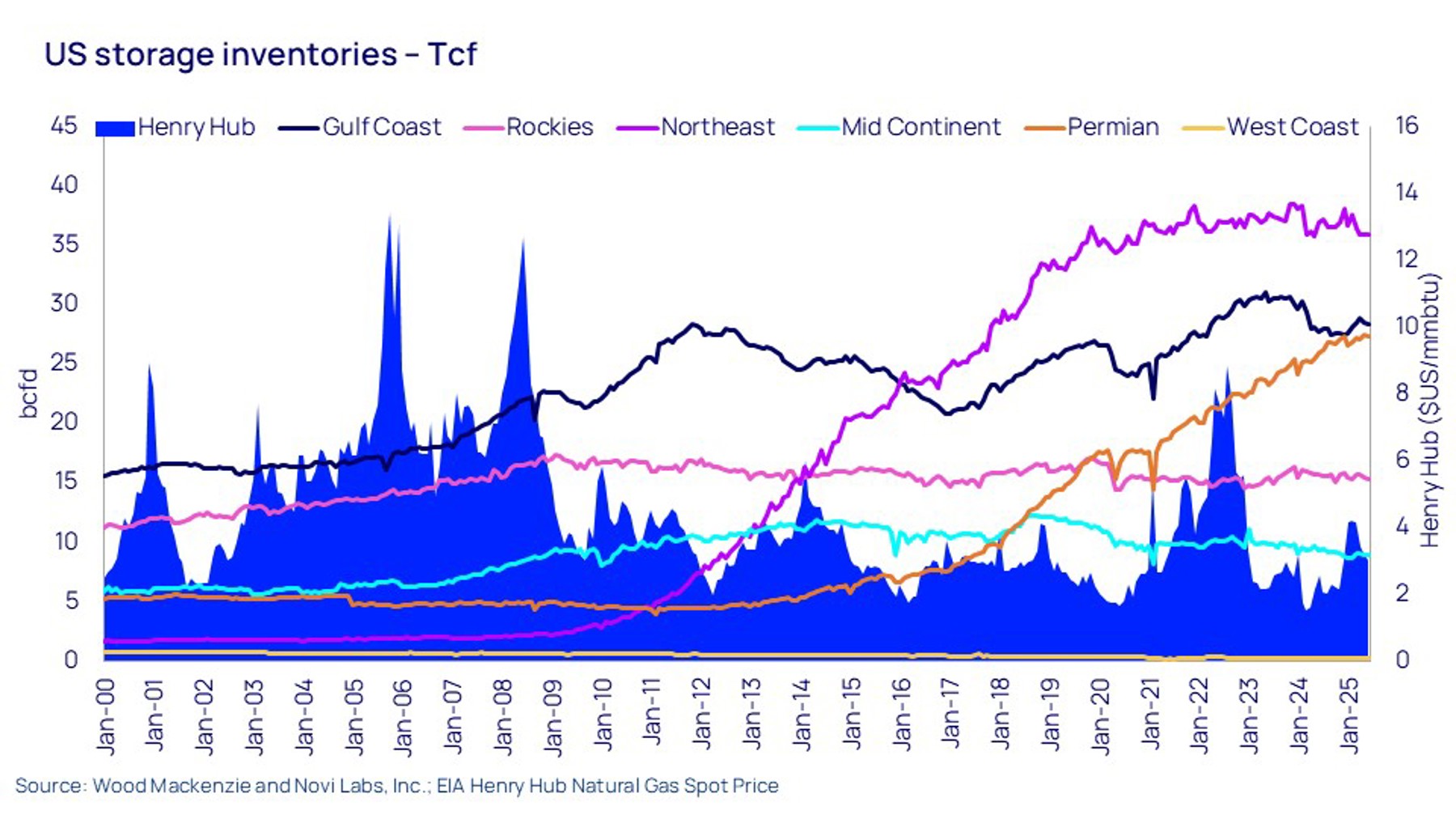
As a result, lower prices over the past 15 years have seen Rockies production struggle even as Gulf Coast production has risen and Northeast production has soared (see chart below).

However, thanks to surging demand, stronger prices, new technology and the potential to exploit existing infrastructure, the region is poised for a significant comeback. From being ‘too hard, too expensive’, suddenly it looks like a case of ‘right place, right time, right economics’ for Rockies gas.
A supply gap that traditional sources can’t bridge
We forecast US gas demand to grow by 40 billion cubic feet per day (bcfd) by 2035, creating significant supply opportunity that traditional sources alone will be unable to meet. Even without taking into account LNG exports, the West South Central region (Arkansas, Louisiana, Oklahoma and Texas) will account for 30% of that demand, redirecting Permian gas away from the West Coast and creating a competitive opportunity for Rockies gas supply to step in.
Local demand in the Rockies region, comprising Colorado, Montana, North Dakota, South Dakota, Utah and Wyoming, will rise by 26%, from 3.7 bcfd in 2025 to 4.6 bcfd in 2035. The power sector, driven largely by data centre demand, will account for 70% of total net growth, adding 0.7 bcfd, while local distribution companies, transport and blue hydrogen are each expected to add 0.2 bcfd.
Get more insight
With various elements falling into place, the Rockies are ready to re-emerge as a strategic gas supply region. Fill out the form at the top of the page to download the rest of this article, which explores the economics and logistics of the new Rockies gas opportunity in detail