


Sign up today to get the best of our expert insight in your inbox
The Iran war and the energy transition
What happens when the world is focused on supply security, not emissions

Ed Crooks
Vice Chair Americas and host of Energy Gang podcast
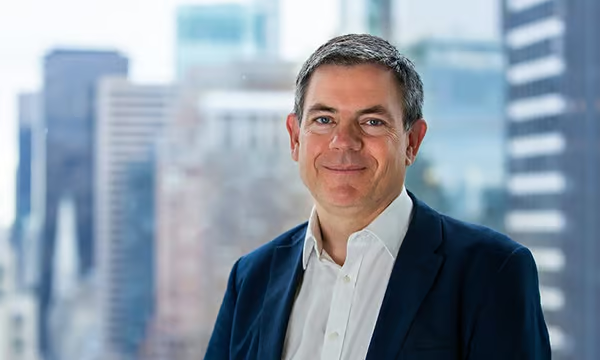
Ed Crooks
Vice Chair Americas and host of Energy Gang podcast
Ed examines the forces shaping the energy industry globally.
Latest articles by Ed
-
Opinion
US permitting reform plan could transform energy investment
-
Podcast
Energy in a more dangerous world
-
Opinion
US considers diesel export restrictions
-
Podcast
Power under pressure | Climate Week NYC special
-
Opinion
The US Federal Reserve responds to the rise in oil prices
-
Podcast
Climate finance without Washington
The conflict in the Middle East has created severe disruption to shipping traffic through the Strait of Hormuz, taking roughly 20% of global supplies of liquefied natural gas (LNG) off the market. It has been a reminder that hundreds of millions of people rely on the international gas trade to heat our homes, fuel our industries and keep our lights on. And that trade is highly vulnerable to sudden shocks. In this special episode, recorded at Wood Mackenzie's Gas, LNG and the Future of Energy Conference in London, host Ed Crooks speaks with industry leaders and experts about the forces that are changing the gas business. Security of supply and affordability are now the top priorities for policymakers and business leaders around the world. But climate change has not gone away, and greenhouse gas emissions are going to be an increasingly significant issue in the future. Balancing those three imperatives is the trilemma that the energy industry has to solve.
First, Ed talks to Anita Odedra, of the LNG platform MidOcean Energy, to discuss the critical role of geography. When energy supplies from the Middle East are disrupted, assets elsewhere in the world take on a greater importance.
Joining Anita is Valentina Kretzschmar, of Wood Mackenzie, who puts the shock from the Iran war into the context of a decelerating energy transition in the West. She walks through the EU Methane Emissions Regulation and why it is so hard to work out exactly how much escaped methane is associated with a cargo of imported LNG. And she talks about how the real threat to fossil fuels is cheap Chinese clean energy technology.
Arturo Gallego, of Centrica Energy, is another industry leader who is attempting to balance consumers’ immediate demands for reliable, affordable energy with long-term climate goals. He warns that if the Strait of Hormuz stays closed, Europe will struggle to find the gas it needs next winter, and high prices may be necessary to destroy demand. He makes the case for LNG as a transition fuel and for tackling greenhouse gas emissions step by step.
TJ Conway, of the think-tank RMI, closes on a practical note. His work has focused on the technical solutions that make the EU methane regulation workable. He argues that his proposed framework could allow the EU to continue importing US gas, while still sending a signal that methane performance matters.
Energy Gang is now available as a video podcast on YouTube. Follow the link below to watch this week's episode, recorded live from the Gas, LNG and Future of Energy Conference 2026. You can also explore the archive.

Energy Gang is a bi-weekly podcast. Join Ed Crooks and the gang for their take on the biggest energy stories shaping the world, with sharp analysis from top experts in climate, policy and the energy industry.