


Get in touch
-
Mark Thomtonmark.thomton@woodmac.com
+1 630 881 6885 -
Hla Myat Monhla.myatmon@woodmac.com
+65 8533 8860 -
Chris Bobachris.boba@woodmac.com
+44 7408 841129 -
Angélica Juárezangelica.juarez@woodmac.com
+5256 4171 1980
South Korea's KRW 4,700 trillion AI and semiconductor mega-project faces a 2.3 GW power shortfall under the current trajectory
4 minute read
South Korea's ambition to build one of the world's largest AI and semiconductor manufacturing hubs risks running ahead of the electricity system needed to power it. New analysis from Wood Mackenzie finds that the country's flagship KRW 4,700 trillion (US$3.1 trillion) national mega-project, including the planned KRW 800 trillion semiconductor and AI data centre cluster in the Honam region, faces a growing power supply challenge unless grid investment and electricity market reforms accelerate.
According to Wood Mackenzie's new report, Can South Korea's Grid Power the US$3.1 Trillion AI Bet? the Honam cluster alone could increase regional peak electricity demand from an estimated 11.8 GW today to 19.1 GW once fully developed. Wood Mackenzie forecasts effective regional generating capacity will reach only 16.8 GW by 2030 under current plans, leaving a potential shortfall of approximately 2.3 GW.
“South Korea is planning for an entirely new class of industrial load now,” said Yunsik Chung, research analyst, Asia Pacific power and renewables at Wood Mackenzie. “The challenge is less about whether enough generation can ultimately be built than whether the grid, market design and investment signals can evolve quickly enough to support AI infrastructure on the timetable policymakers and industry expect.”
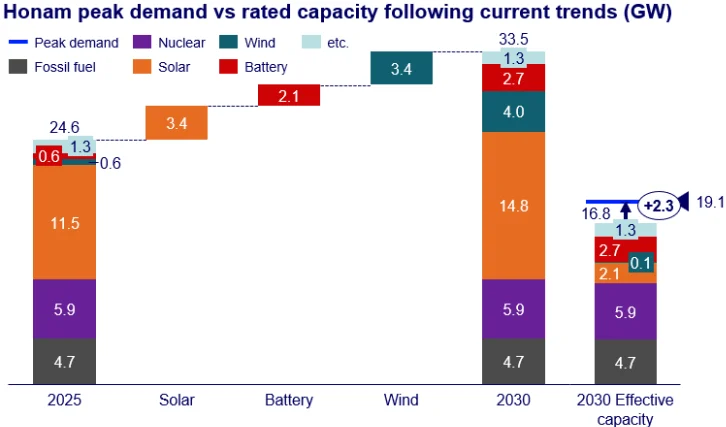
Source: Wood Mackenzie, KPX, KEPCO
Honam has the strongest renewable energy potential of any region in South Korea, yet much of that capacity cannot reach consumers because the transmission network is already constrained, Wood Mackenzie noted. The Honam-Central transmission corridor experiences congestion during spring months, preventing new renewable projects, including solar, from securing grid connections despite abundant resource availability.
Closing the capacity gap through solar generation alone would require approximately 19.5 GW of new installations within the next five years. By comparison, only 679 MW of solar capacity was added across the region during 2025. Wood Mackenzie concludes that such a build-out is unrealistic without rapid expansion of battery energy storage systems (BESS) alongside reforms that improve the economics of battery investment.
Current market design remains one of the largest barriers. Batteries can presently generate revenue primarily through South Korea's central contract market, limiting commercial deployment. Wood Mackenzie finds that either substantially expanding procurement volumes through the existing mechanism or introducing broader electricity market reforms that create additional revenue streams for BESS will be essential to support the pace of AI-driven power demand. The report also highlights non-wired alternatives, including dynamic line rating and transmission topology optimisation, as practical near-term measures to relieve grid congestion and accelerate renewable integration while larger transmission projects are developed.
For reliable generation, the report identifies extending the operating life of the Hanbit Nuclear Power Plant as the fastest source of additional firm capacity. A 10-year life extension could preserve approximately 2 GW of generation that would otherwise retire, with around 3 GW of Hanbit's 5.9 GW fleet currently scheduled to reach the end of its operating life by 2035. Natural gas also remains a viable near-term option. Although global gas turbine supply chains continue to experience lead times of five to six years, prioritising domestically manufactured turbines could allow new capacity to be delivered under South Korea's forthcoming 12th Basic Plan for Electricity Supply and Demand.
“This is ultimately a sequencing challenge,” commented Chung. “Near-term flexibility measures, firm generation and transmission upgrades all need to move in parallel. If any one of those elements falls behind, the pace of AI and semiconductor investment could become constrained by power infrastructure rather than technology or capital.”
Beyond the current planning horizon, Wood Mackenzie identifies two structural solutions that could support Honam's long-term electricity needs. Reserved land originally intended for Hanbit Units 7 and 8 offers the opportunity for brownfield nuclear development, which could reduce construction costs by approximately 10–15% while shortening project timelines compared with greenfield development. Reinforcing the Yeongnam-Honam transmission corridor would also enable surplus nuclear generation from Yeongnam, where effective capacity exceeds regional peak demand by 15.9 GW, to support Honam's rapidly growing industrial load.
The report also points to wider implications for South Korea's national transmission strategy. As new industrial demand increasingly consumes renewable generation within Honam itself, less electricity will need to flow north, potentially reducing the scale required for the proposed 8 GW West Coast HVDC transmission project. Further clarity is expected when the government publishes the 12th Basic Plan.